Utility and infrastructure field study
How Transmission Line Stringing Helicopters Work
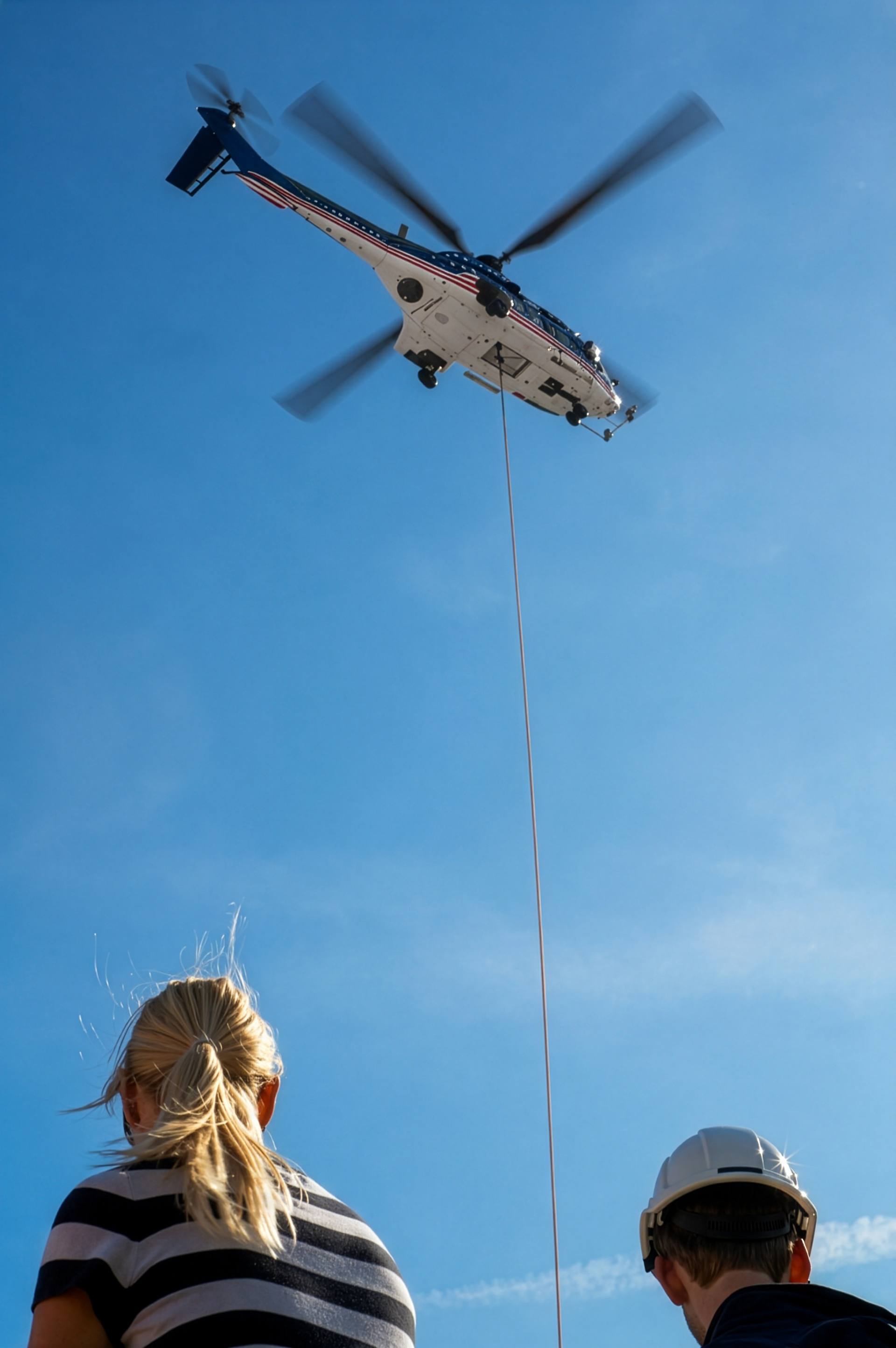
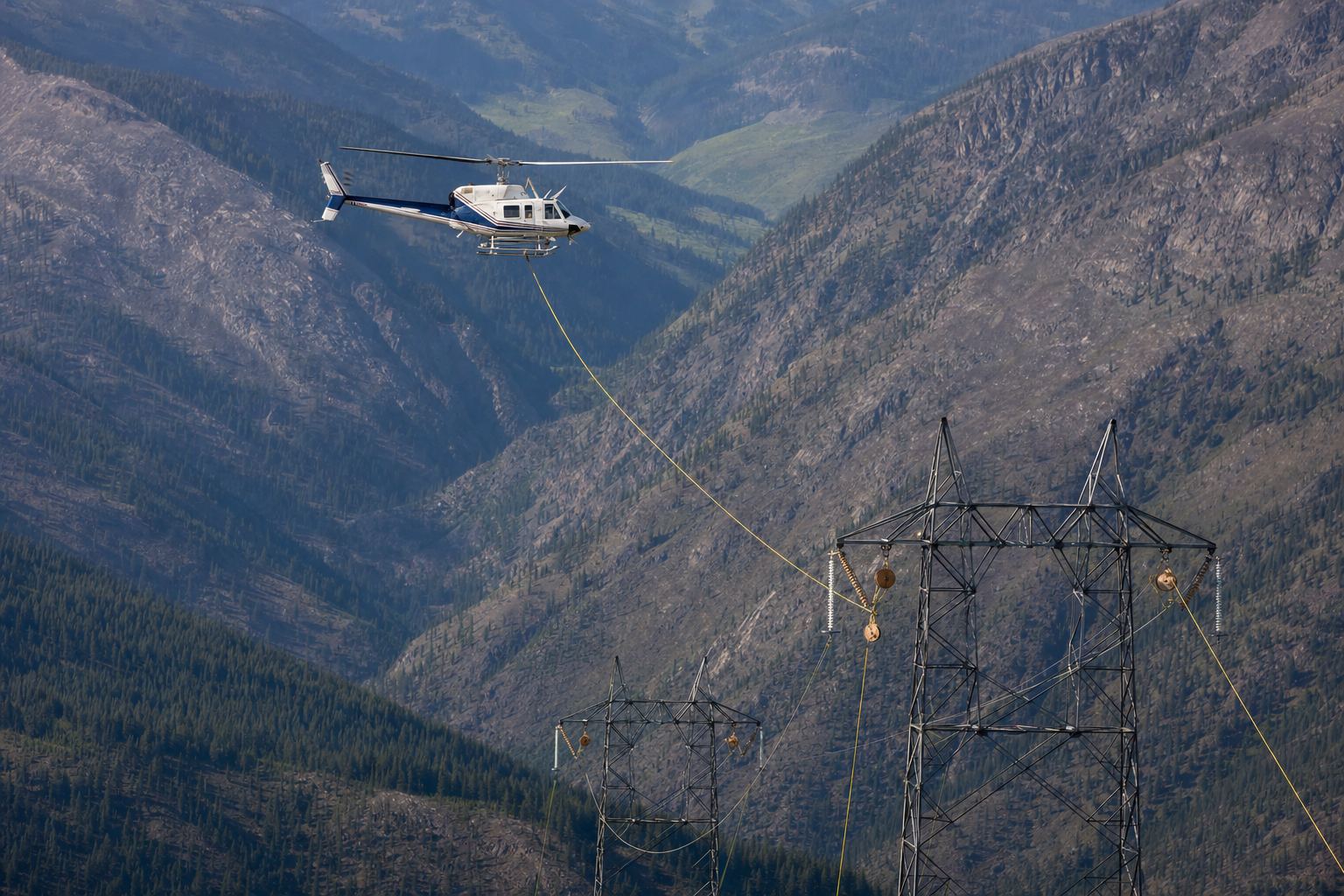
A transmission line stringing helicopter pulls lightweight sock line through travelers hung on each structure. Because the line stays in contact with the ground while it remains releasable, the work is a Class C external load operation under 14 CFR Part 133. Sustained work near energized circuits is commonly flown with twin-engine aircraft such as the Bell 412EP, which Avincis lists at a 4,500 lb maximum hook load. This page explains the method, the regulations and the aircraft for electrical contractors and engineers deciding how aerial stringing fits a transmission project.
The rulebook
What Makes Transmission Line Stringing Helicopter Work a Class C Operation Under Part 133?
Under 14 CFR Part 133, a Class C rotorcraft-load combination is a jettisonable external load that remains in contact with land or water during the operation. Wire stringing is the standard example. One end of the sock line pays out from a ground reel while the aircraft flies the running end down the corridor, so the load never fully leaves the ground. The pilot in command has to be able to release the line in flight, which makes the connection between the stringing rig and the aircraft part of the rigging design the operator checks.
The class matters at the contract stage. The operator's Part 133 certificate and the aircraft's Rotorcraft-Load Combination Flight Manual have to authorize each class flown. Ask for the certificate and confirm Class C is covered before an aircraft appears on a pull schedule. When a coordinator arranges the work, the check follows the named flight operator, the company that will actually fly the line. The Part 133 external load operations reference covers the full class system.
One transmission project typically exercises three load classes:
| Part 133 load class | Definition | Line construction application |
|---|---|---|
| Class B | Jettisonable load lifted free of land or water | Travelers, insulator strings, structure hardware, wire reels and pullers flown to pads, tower sections |
| Class C | Jettisonable load that remains in contact with land or water | Sock line and pilot line pulling, hard line pulls, conductor and OPGW stringing support |
| Class D | External load other than A, B, or C, specifically approved by the Administrator; includes human external cargo | Linemen delivered to structures or conductor where authorized under 14 CFR 133.35 |
The method
The Aerial Stringing Sequence: Sock Line, Travelers, Conductor
Aerial stringing follows the same tension stringing method linemen run on the ground, consistent with IEEE 524 installation practice. The helicopter changes how the pilot line reaches each structure, so structures between the pull sites no longer need ground access for that step.
1. Travelers go up as Class B picks
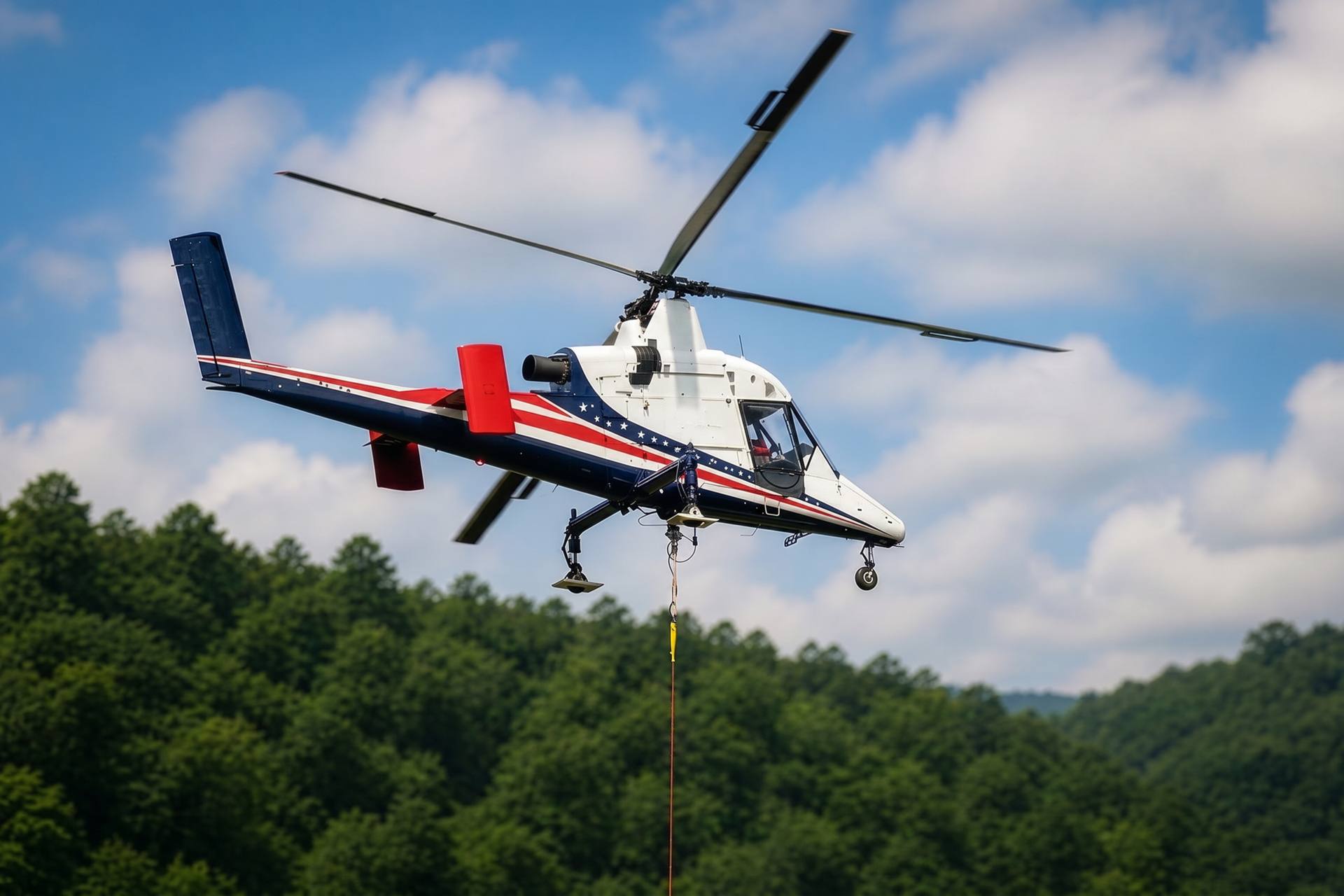
Stringing blocks (travelers) are flown to each structure and hung on the arms, either by linemen already on the structure or by longline placement with tag line control. The work is repetitive, and the Kaman K-MAX was built around repetitive external load work of this kind. How many travelers go up in an hour depends on the aircraft, the distance from the staging area and the work at each structure, so the figure belongs to the operator's estimate for the actual structure list.
2. The helicopter pulls the sock line
The aircraft flies the corridor with a lightweight synthetic sock line (pilot line) paying out from a ground reel, threading or laying the line into each traveler span by span. A stringing needle or drop-in traveler gate lets the crew make the line without a lineman handling every block. On a corridor where every structure would otherwise need truck access, this step is where the schedule can shorten. The aircraft moves between structures at flight speed, over swamp, rock and ridge lines, and over ground where an environmental restriction prohibits road building.
3. Hard line and conductor follow under tension
The sock line pulls the heavier pulling rope, and the pulling rope pulls the conductor from reel stands. A puller at one end of the section and a tensioner at the other keep the conductor off the ground and out of the vegetation for the whole pull. Sagging, clipping in, offset clipping and dead-end work then proceed as conventional lineman scope. The aviation contractor's deliverable is a sock line made through every traveler, timed to the outage calendar.
The fiber backbone
OPGW Installation: Stringing the Grid's Fiber Backbone
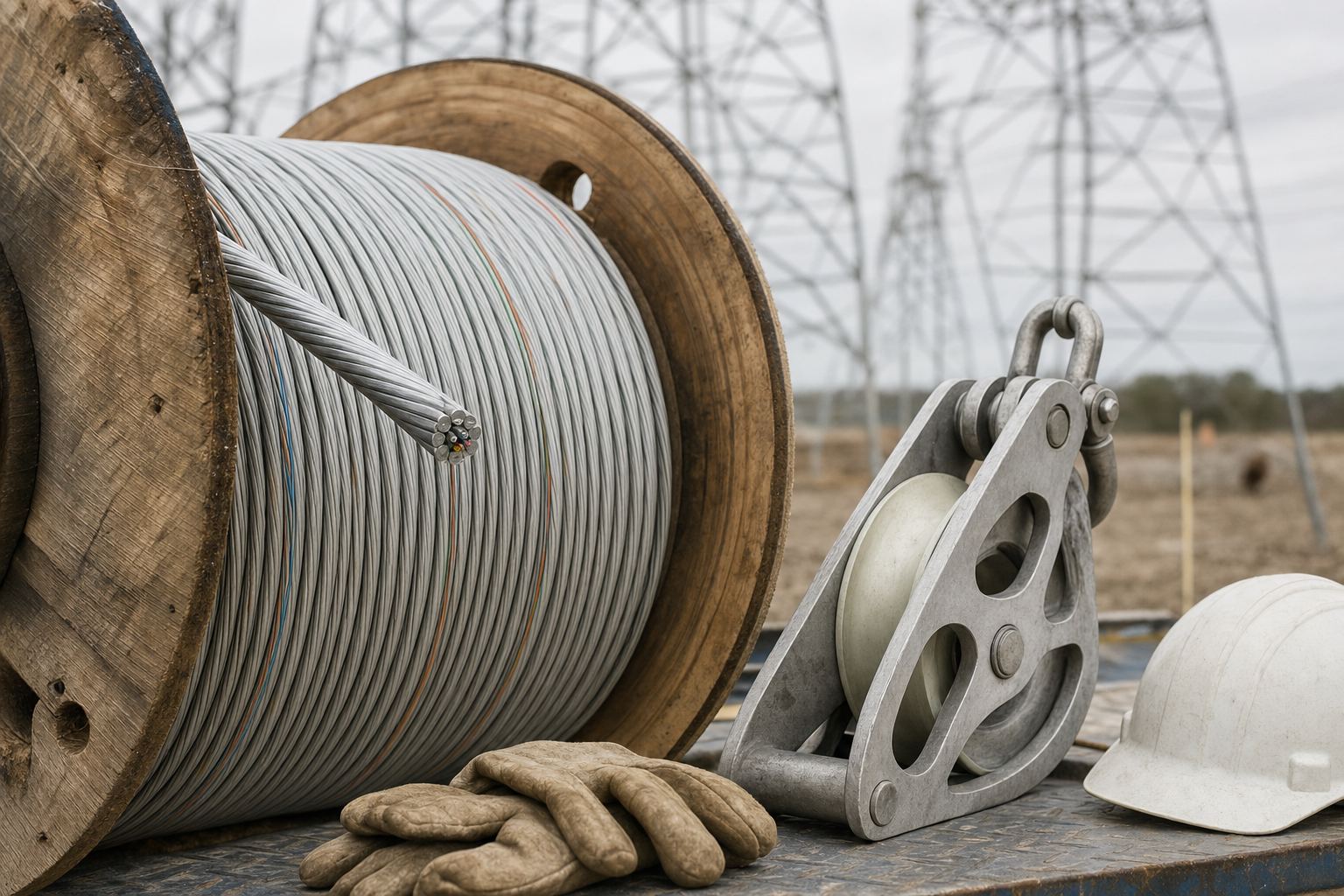
Optical ground wire (OPGW) replaces the conventional static wire at the structure peak and carries fiber optic communications inside a conductive armor. One wire provides lightning shielding, a fault current return path and a telecom link, which is why OPGW retrofit appears in grid modernization programs.
The fiber package sets minimum bend radius and tension limits. Dragging the wire across terrain or snatching it over an obstruction risks damage that a visual inspection may not reveal. Aerial sock line pulling keeps the OPGW in the travelers and under controlled tension from the start of the pull, and it reaches peak-of-structure hardware without a crane pad under each tower. The puller and tensioner sites still need ground access. On shield wire replacement along an energized corridor, pulling from the air can also reduce the time ground crews spend on the right-of-way beneath live phases; the lift plan should show where those crews will still be working.
The clearance standard
How Close Can a Helicopter Work to an Energized Conductor?
OSHA 1926.1408 Table A sets minimum clearance distances by voltage for cranes and derricks in construction. Helicopter crane operations have their own standard in OSHA 1926.551, so a lift plan citing Table A should say where each distance comes from:
| Line voltage (nominal, kV) | Minimum clearance distance (OSHA 1926.1408 Table A) |
|---|---|
| Up to 50 | 10 ft |
| Over 50 to 200 | 15 ft |
| Over 200 to 350 | 20 ft |
| Over 350 to 500 | 25 ft |
| Over 500 to 750 | 35 ft |
| Over 750 to 1,000 | 45 ft |
| Over 1,000 | As established by the utility owner/operator or a registered professional engineer |
The lift plan is built with the utility, not from the table alone. The utility confirms nominal voltage and system state for each circuit in the work zone, and its own minimum approach distances apply where they are stricter than Table A. A dedicated spotter in direct radio contact with the pilot watches the clearances the pilot cannot see. Any planned work inside those distances happens only under the utility's energized-work procedures, with the circuit condition (energized, de-energized and grounded, or under hold) documented before the aircraft launches.
Static discharge needs the same planning. A helicopter in flight builds a static charge, and OSHA 1926.551 requires that the charge on a suspended load be dissipated with a grounding device before ground personnel touch it, or that crews touching it wear protective rubber gloves. On line work, the plan should name the bonding or grounding procedure for each load and line coming off the hook, and linemen should hear it in the briefing before the first load arrives.
The doctrine
Why Twin-Engine Redundancy Is Doctrine Near Energized Circuits
A single-engine helicopter that loses power descends to the surface below. Over a transmission corridor, that surface is conductor, structures and an energized right-of-way. Sustained work close to energized circuits is therefore commonly flown with twin-engine aircraft such as the Bell 412EP. Engine count alone does not settle the question. What the aircraft can do on one engine at the day's weight and conditions comes from its flight manual performance data, so ask for that basis rather than the configuration.
For people, the FAA put a version of the same requirement into the rule. Under 14 CFR 133.45(e), a Class D operation requires a rotorcraft type certificated under transport Category A for the operating weight, with hover capability on one engine at that weight and altitude, plus an FAA-approved personnel lifting device. Section 133.35 limits who may be carried during external load operations. Where a project calls for linemen delivered to a structure or conductor by air, those provisions define the aircraft, and the rigging design should name the standard covering each component of the personnel line. Single-engine aircraft such as the K-MAX can still suit de-energized corridors and hardware cycles. The lift plan should state which aircraft flies which phase and why.
The aircraft
Aircraft Used for Transmission Line Stringing Work
| Aircraft | External load capacity | Engines | Cycle rate | Stringing role |
|---|---|---|---|---|
| Bell 412EP | 4,500 lb (Avincis specifications, page 4: maximum hook load) | Twin | Not published here | Energized-proximity work; sock line pulls, hardware, Class D personnel work where authorized |
| Bell 212 Eagle Single | Not published here | Single (Eagle Copters: single-engine conversion of the Bell 212) | Not published here | Sock line and light hardware cycles |
| Kaman K-MAX K-1200 | 6,000 lb (Kaman: published lifting capacity) | Single | Not published here | Traveler hanging and repetitive hardware on de-energized corridors |
| Sikorsky S-70M Black Hawk | Not published here | Twin | Not published here | Heavy pulls, wire reels, pullers and tensioners to remote pads |
| Bell 214B Big Lifter | About 8,000 lb (McDermott Aviation: 3,636 kg maximum hook load) | Single | Not published here | Heavy hardware and reel moves |
Table note: the sources above state different measurement bases, so the figures are not interchangeable lift-day allowances. Capacity depends on the specific aircraft and the conditions on lift day, including density altitude; the FAA Helicopter Flying Handbook, chapter 7 explains how temperature, altitude and humidity affect performance. A lift plan for a summer pull at elevation should carry the operator's figure for those conditions, not the published maximum. Cycle rate belongs to the operator's estimate against the actual structure list and is not published here.
The schedule math
Structures Per Day: What Aerial Stringing Does to the Schedule
Ground stringing production is gated by access. The puller site, the tensioner site and, in many methods, every structure in between must be reachable by truck. That can mean temporary road construction, matting, environmental permitting and restoration, all before the first pull and all in the contractor's costs. On wetland, mountain and restricted-habitat corridors, the access work can take longer than the stringing itself.
Aerial stringing removes most of that access requirement for the pilot line. The aircraft works the structures in a section from a staging area, and a sock line pull moves between structures at flight speed. The staging area, the pickup zone and protection along the flight route still belong in the plan and in the cost. Corridor-specific production (structures per day, spans per pull section, outage windows) is worked out at the lift plan stage from actual span lengths, terrain and circuit conditions, and it should be documented as a schedule the estimator can carry into the bid. Reduced road building drives aerial work across utility and infrastructure programs, from tower erection to pipeline corridors.
Ground methods remain the better choice in some cases, and the lift plan should say so when they are. A short reconductor with an existing access road at every structure can favor conventional equipment. So can heavy dead-end pulls where puller and tensioner setup governs the schedule regardless of how the pilot line arrived, or long, steady work concentrated at a single accessible location. The puller and tensioner are ground machines on every project. The question is how much of the corridor between them is worth reaching by road.
The vetting standard
How Utilities and EPCs Qualify Aviation Vendors for Stringing Work
Utility procurement qualifies aviation vendors the way it qualifies any high-consequence subcontractor. Expect a documented safety management system, prequalification through contractor networks such as ISNetworld or Avetta, and recordable incident and experience modification rates (TRIR and EMR) for review during onboarding, read against the thresholds the contract sets. Check the insurance actually carried, including aviation hull and liability, the scope of any cargo coverage while the load is on the hook, and the actual additional-insured and waiver-of-subrogation provisions, against the project's requirements rather than assuming them. On federally contracted transmission work, conformance to USACE EM 385-1-1 should be explicit in the contract.
Bid-stage engineering is part of the qualification. A usable aviation package supplies load parameters, aircraft assignments by phase, clearance planning that names the source of each distance, and a lift schedule the contractor can place in the master bid. The package may come from the flight operator directly or through a coordinator who assembles it; either way, the certificate and insurance review stays with the named flight operator. A published capacity figure without that package is not enough to carry the aerial scope into a bid.
Continue the analysis
The regulations behind this page are covered in the Part 133 external load operations reference. Within the utility and infrastructure vertical, the companion analyses on helicopter tower construction and pipeline corridor work cover the Class B side of the same programs. New heavy lift analyses are announced through the AHLH mailing list.
Frequently asked questions
What Line Contractors Ask First
From the technical library