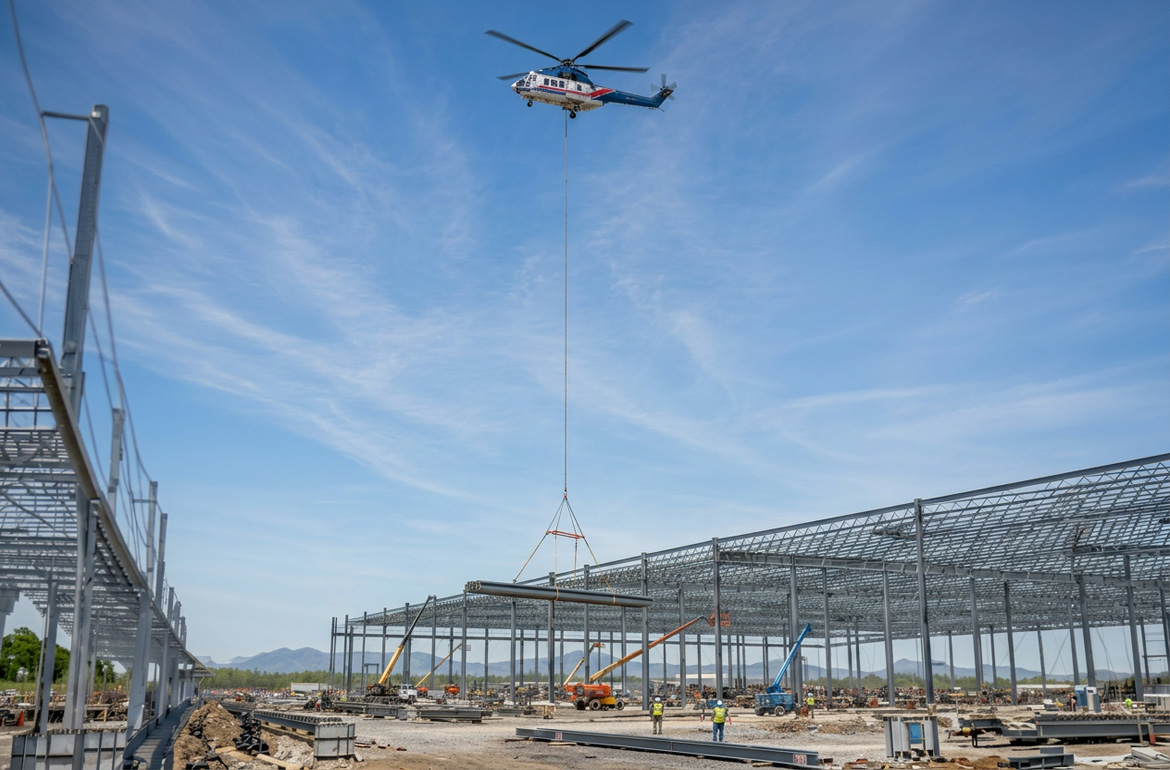
Helicopter Steel Erection & Infrastructure Placement
Helicopter steel erection puts structural members where crane geometry, ground bearing, or street access fails: heavy lift helicopters set steel at up to 25,000 pounds per pick (Erickson S-64F) and place members within inches. Operators run this work under 14 CFR Part 133, with ASME B30 rigging and a non-impact load-control discipline that holds forces on the fabrication under 0.5 G.
The boundary
When Does Helicopter Steel Erection Beat a Crane?
A crane's capacity chart is a curve that falls with radius. A helicopter's capacity is indifferent to reach. That single difference decides most of the steel work that goes aerial: the member is not too heavy for a crane, it is too far from anywhere a crane can stand.
The picks that end up on a longline share a pattern:
- Bridge and pedestrian-crossing sections over water, rail corridors, or ravines where there is no crane pad on either abutment.
- Penthouse steel, dunnage frames, and screen-wall steel on occupied towers where the street below cannot close and a tower crane cannot be justified for a two-day erection scope.
- Spires, masts, and architectural steel at heights and setbacks that push a mobile crane past its chart or into a lane-closure permit fight.
- Cell-carrier steel and antenna mounts on existing towers and rooftops, set at 15 to 20 picks per hour instead of a week of hand-rigging. For full structure erection, see Tower Construction.
- Long-reach picks over occupied structures, where the fall zone a crane boom would sweep is exactly the area the owner cannot vacate.
For the estimator, the math runs through the mobilization line, not the hourly rate. Before a large crawler or tower crane makes its first pick it can absorb $60,000 to $100,000 in transport, assembly, mats, and ground-bearing engineering, plus lane-use fees and police details if the street is involved. Aerial steel placement deletes those line items and compresses the erection window from weeks to hours. When the crane pencils out better, honest vetting says so; the full crane-versus-helicopter comparison lives on the Aerial Construction hub.

The discipline
What Is a Non-Impact Protocol?
A non-impact protocol is the load-control methodology precision operators apply to high-value fabrications: GPS-stabilized hovering and controlled vertical closure that keep G-loading on the suspended asset below 0.5 G from liftoff through release.
A welded truss, a machined bearing assembly, or an architectural spire with a six-month fabrication lead time does not get a second chance. The protocol treats the member as instrumentation, not freight.
In practice that means three controls:
- Engineered flight profile. Acceleration, translation, and descent rates are planned against the member's mass and rigging geometry before the aircraft launches, not improvised over the connection point.
- Stabilized final approach. The aircraft establishes a stationary hover above the connection, then closes vertically at rates measured in inches per second while ironworkers control alignment from the structure.
- No side-loading at release. The load is plumb over its seat before it takes bearing. Hooks release only after the connection crew confirms the member is landed and pinned.
On the S-64F, the aft-facing pilot station gives the pilot in command a direct sightline down the longline to the connection point, which is why that airframe carries so much of the industry's precision steel work.
The airframes
Which Aircraft Do Operators Fly for Structural Steel?
Airframe selection is driven by member weight, placement tolerance, and airspace category, in that order. Working numbers below are maximum external load capacities at standard conditions; density altitude reduces them (plan on roughly 3% power loss per 1,000 feet of density altitude, more in heat and humidity).
| Aircraft | Max external load | Steel erection role | Certification category | Typical picks/hr |
|---|---|---|---|---|
| Boeing CH-47D Chinook | 26,000 to 28,000 lbs | Heaviest members: bridge sections, plate girders | Restricted | 10 to 20 |
| Erickson S-64F Air Crane | 25,000 lbs | Precision sets; aft-facing pilot station | Restricted | 15 to 20 |
| Columbia BV-234 Chinook | 28,000 lbs max; 20,000 lbs precision placement | Heavy steel over congested urban areas | Standard | 10 to 15 |
| Bell 214B Big Lifter | 8,000 lbs longline; 6,614 lbs precision | Lighter members, infill steel, carrier mounts | Standard | 15 to 18 |
| Kaman K-MAX K-1200 | 6,000 lbs | High-cycle repetitive picks, lattice steel | Restricted | 20 to 25 |
Certification category is not a footnote. It decides who can legally fly an urban set, and it is covered in the congested-area section below.
The hardware
How Is the Rigging Engineered and Inspected?
Steel punishes casual rigging. A properly engineered lift plan specifies hardware to ASME B30.20 (below-the-hook lifting devices) and ASME B30.26 (rigging hardware), with design factors that exceed ground-crane practice:
- Slings: 5:1 minimum design factor against rated breaking strength.
- Longlines: 7:1 minimum design factor for non-human-external-cargo lines.
- Spreader and lifting beams engineered to the member's pick points and stamped weights, not to a generic capacity.
Two hardware disciplines matter specifically for steel:
Anti-rotation control. A long plate girder or open truss is an airfoil. Uncontrolled, it will weathervane and spin under the aircraft. Riggers place a swivel at the hook to decouple line torque from the load, and tag lines let the ground crew control heading through the final set. For members with high surface area, the lift plan sets a lower wind ceiling than the aircraft itself requires.
Load geometry. Sling angles, center-of-gravity offsets, and attachment eccentricity are calculated from the fabricator's drawings during technical vetting. A member that hangs 3 degrees off plumb does not seat in its connection at altitude.
Authority is explicit: under Part 133, the pilot in command holds final legal authority over rigging integrity and can refuse any pick. Rigging is inspected before the first cycle and re-inspected on a set interval throughout the operation, per OSHA 1926.551. That regulatory framework, including load classes and the physics behind them, is detailed on the External Load Operations reference page.

The airspace
Can a Helicopter Set Steel Over an Occupied Building?
Yes, under an FAA-approved Congested Area Plan (CAP) required by 14 CFR 133.31(f) and detailed in AC 133-1A. The operator prepares and files the CAP as part of the mission package. It defines:
- Flight routes engineered so the load never crosses uncontrolled people or traffic.
- Fall-zone security agreements with the property owner and adjacent stakeholders.
- An emergency jettison plan identifying where a load goes if it must come off the hook.
The schedule has to be planned around the review: the FSDO requires a minimum of 5 working days to evaluate a CAP, and experienced planners build that window into the erection sequence alongside NTP and permit milestones.
One constraint most erectors have never had reason to learn: aircraft certification category decides which helicopter can fly the urban set. Restricted-category surplus aircraft, including the CH-47D and the S-64 in most configurations, are barred from operations over congested areas. The standard-category BV-234 Chinook, with 20,000 pounds of precision placement capacity, is the legally cleanest heavy airframe for downtown steel. If a proposal quotes a restricted-category aircraft for a pick over an occupied block, the technical vetting failed before the aircraft left the ground.
Urban operations also run under ANSI S12.9 community noise measurement where local ordinances apply, and the compressed timeline is the mitigation: a 90-minute operation generates one morning of noise instead of three weeks of crane assembly, erection, and teardown. The same regulatory stack governs Modular Building Placement and HVAC and rooftop unit work over occupied properties.
The manifest
What Do the Fabricator and Erector Provide?
Role clarity is how a lift day stays boring. The division of responsibility on a well-run helicopter steel operation:
| Deliverable | Responsible party |
|---|---|
| Certified load weight per member (scaled or calculated and stamped, including all attached hardware) | Fabricator / client |
| Engineered pick points on the member, with drawings | Fabricator / erector's engineer |
| Rigging design, hardware, and inspection to ASME B30 | Helicopter operator |
| Lift plan, load calculations, flight profile | Helicopter operator |
| FAA Part 133 compliance, CAP filing, FSDO coordination | Helicopter operator |
| Connection crew, tag line handlers, landing zone control | Erector, briefed by the operator's ground coordinator |
| Final go/no-go on every pick | Operator's pilot in command |
The certified weight requirement is absolute. Takeoff performance, rigging design factors, and the aircraft's placarded external load limit are all computed from that number. An estimated weight is not a lift plan input; a member without certified weight documentation does not fly.
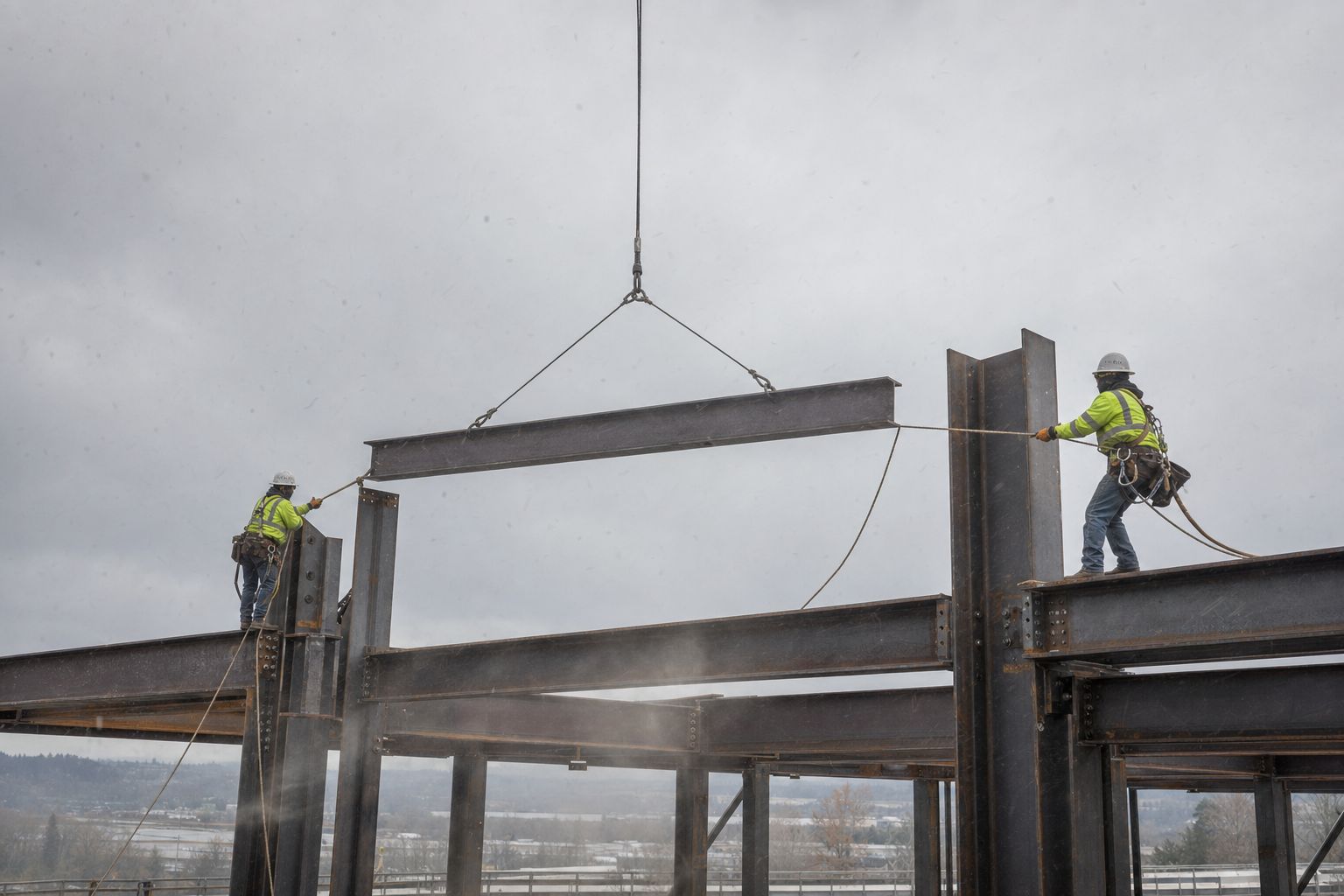
The erector's ironworkers stay on the steel and make the connections. Before the first cycle, the operator's ground coordinator briefs the crew on OSHA 1926.551 requirements: PPE under rotor wash that can exceed 100 mph, static discharge (the longline carries a charge; a grounding conductor touches the load before hands do), tag line handling, and hand signals with radio backup. Connections are designed for rapid landing and pinning: the aircraft holds position for the seat and pin, then releases and returns for the next member while the connection crew completes the bolt-up.
The cadence
Why Does Cycle Rate Decide the Bid?
An S-64F or CH-47D executing a planned erection sequence sets 10 to 20 members per hour. Helicopter beam placement at that cadence depends on sequencing engineered in advance from the erection drawings: members staged in flight order at the laydown yard, shake-out matched to pick order, connection crews positioned one set ahead of the aircraft.
For a contractor's bid, that cadence converts directly into protected margin:
- Labor compression. A raising gang paid for one flight day instead of two weeks of crane cycles.
- Zero mobilization bleed. No crane assembly, no mats, no ground-bearing analysis, no teardown.
- Schedule certainty. The erection window shrinks to hours, which shrinks weather exposure and the general conditions burn that comes with it.
Operators typically present the numbers as a fixed-scope logistics package: aircraft, cycle rate, insurance certificates, and permit timeline, structured so an estimator can carry it in a master bid as a single line item.
The honest boundary
When Does the Ground Crane Win?
Solution-agnostic vetting is the standard in this industry, so here is the honest boundary. A ground crane is the better engineering outcome when:
- The erection sequence requires long static holds. A crane can suspend a member for an hour of fit-up and welding. A helicopter sets and releases; if the connections cannot be designed for rapid pinning, nothing should fly.
- A single pick exceeds 28,000 pounds. That is the civilian rotorcraft ceiling. Above it, the conversation is about crane class, not airframes.
- The site has clear access and a long-duration steel scope. A tower crane erecting a high-rise frame over months is the right tool, and no flight-hour math changes that.
- Placement tolerance demands sustained mechanical guidance. Some slip-critical or machined-seat connections want a load that can be inched under full crane control.
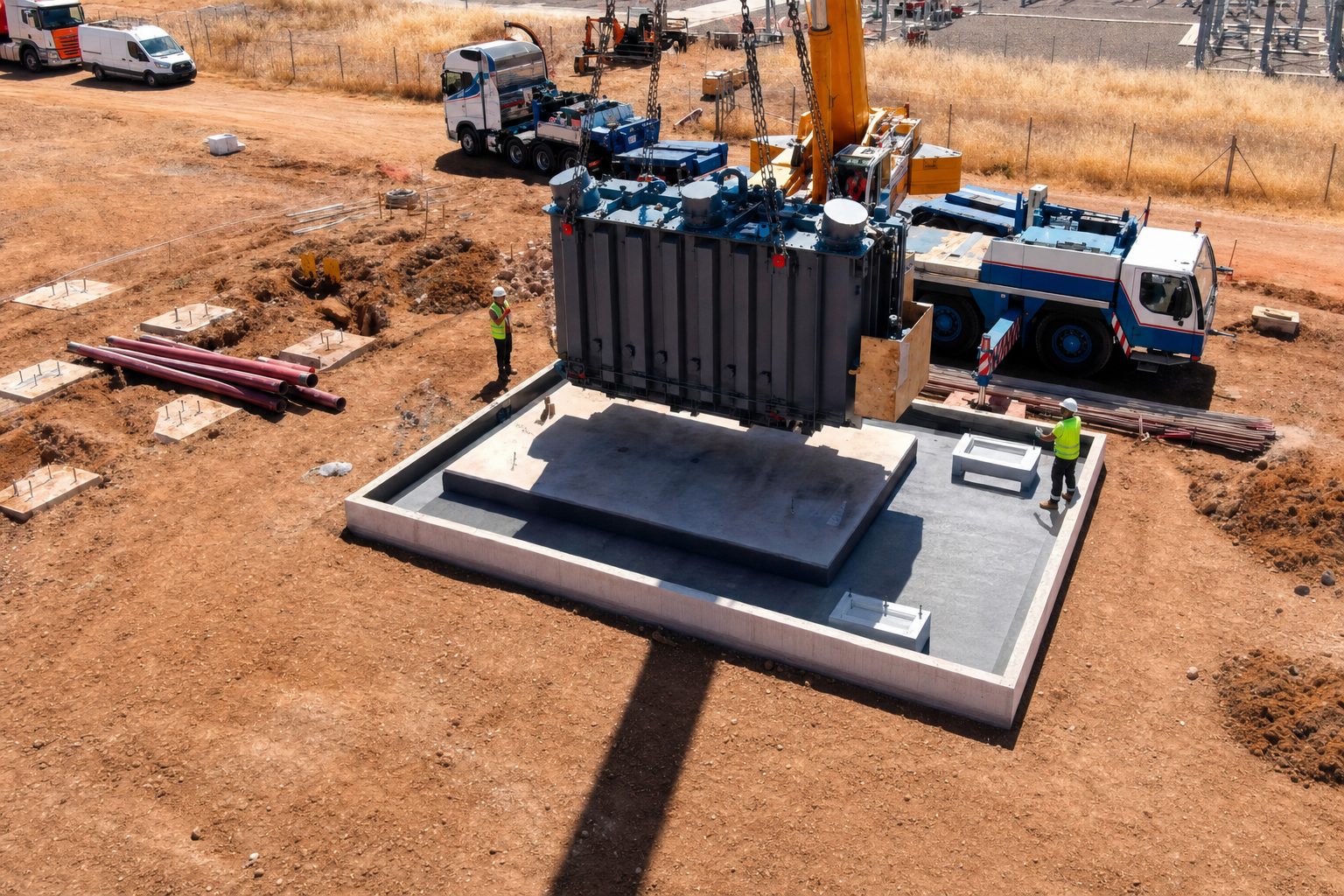
Projects that sit on that boundary get a defensible answer the same way every time: erection drawings on the table, both machines costed honestly, and the engineering comparison decides. Anyone weighing a helicopter lift for structural steel should start with the total-cost framework on the Aerial Construction hub, then go deep on the regulatory mechanics in External Load Operations. Related verticals in this series cover Modular Building Placement and HVAC and rooftop units. New analyses publish to the mailing list first; joining it is the one action this site asks of a reader.
Frequently asked questions
What Erectors and Estimators Ask First
From the technical library