
Setting a steeple is almost always a crane job, and weight is not the reason. Documented US replacement steeples run 2,600 to 23,000 pounds, which sits inside the civil rotorcraft fleet. What rules the aircraft out is the hold: a crane can stand still over a bolt pattern for an hour, and a helicopter cannot stand still for four minutes.
Steeple, spire, and cross placement is the most photographed small lift in American construction. A congregation gathers in the parking lot, a load rises over the roofline, and the local station runs ninety seconds of it. The method in nearly every one of those clips is a wheeled crane. That consistency is not habit or cost aversion. It is the correct engineering answer to a load with an unusual set of properties, and understanding why makes the rarer cases where an aircraft does win much easier to identify.
This analysis assembles the published weights and heights from recent US steeple projects, sets them against the working end of the civil fleet, and isolates the four constraints that decide the method. Three of the four favor the crane on an ordinary parish church. The fourth is where the helicopter earns its hourly rate.
What a steeple actually weighs
The category spans two orders of magnitude, which is the first thing a planner has to accept. A stock fiberglass steeple for a small sanctuary is a two-person unloading job. A copper-clad steeple over a welded steel frame for a nineteenth-century masonry tower is heavier than a transmission structure. Both are called steeples.
| Documented project | Weight | Height and set elevation | Method and date |
|---|---|---|---|
| St. Patrick's Church, Utica, Nebraska | 23,000 lb | 30 ft steeple, hollow copper-clad | 100 ton mobile crane, 13 Apr 2019 |
| Saint John the Baptist Catholic Church, Jefferson, Wisconsin | 17,000 lb | 72 ft steeple | Crane, 2 Jun 2026, after a 2024 fire |
| Holy Redeemer Church, Madison, Wisconsin | 16,000 lb | 48 ft steeple carrying a 10 ft cross | Crane, 20 Nov 2025, after a 2024 fire |
| Episcopal Church of the Incarnation, Highlands, North Carolina | 6,500 lb bell frame, then 2,600 lb copper steeple | Two picks, both set at 76 ft | Crane, 25 Aug 2021 |
| Coventry Cathedral fleche, United Kingdom | About 1.5 tons, plus a half-ton cross | 80 ft bronze fleche onto the roof | Bristol Belvedere helicopter, 28 Apr 1962 |
| St. Bernard Church, Freetown, Massachusetts | Not published | 10 ft aluminium steeple | Crane, 21 Nov 2011, nine months after wind damage |
| Stock fiberglass steeple, 21 ft | About 300 lb | Catalogue unit, single section | Boom truck or crane, current production |
| Stock fiberglass steeple, 14 ft | About 200 lb | Catalogue unit, single section | Boom truck or crane, current production |
Weights as published by Barnhart (Utica), WKOW (Jefferson), WMTV (Madison), Plateau Daily News (Highlands), Historic England (Coventry), CBS Boston (Freetown), and Southeast Church Supply (catalogue units). Figures are the assembly alone and exclude rigging, spreader steel, and any temporary bracing, all of which the payload budget has to carry. Fiberglass catalogue weights are shipping weights for the shell and do not include a bell, a clock, or the steel base frame a masonry tower usually needs.
Read against the fleet, the band is unremarkable. The aircraft-by-aircraft lift capacity table puts a Bell 214B at 8,000 pounds on the longline and an S-61 near 10,000, which covers the Highlands copper steeple with room to spare and covers neither Wisconsin steeple. The 17,000 and 16,000 pound units need an S-64 Air Crane or a Chinook. The 23,000 pound Nebraska steeple sits under the top of the civil fleet and above every machine except the Chinook family. A 100 ton wheeled crane handled it from the churchyard for the cost of a mobilization.
Note also what the proportion rules do to the problem. Steeple vendors size a unit at roughly one to one and a quarter times the peak height of the building, with a base width near one sixth to one seventh of the building width. A 25 foot sanctuary therefore takes a 25 to 31 foot steeple, and a 36 foot wide building takes a 5 to 6 foot base. That is a slender object, tall relative to its footprint, with almost nothing inside it.
Why the crane wins: the hold
The decisive difference between the two methods is not capacity and not reach. It is duration.
A steeple does not land the way a rooftop air handler lands. It is set onto a base frame, aligned to a bolt circle, plumbed, and mechanically fastened before the rigging comes off, and on a restoration the receiving structure is a hundred and fifty years old and was measured by hand. At the Episcopal Church of the Incarnation in Highlands, North Carolina, the crew had to raise the copper steeple into position repeatedly while drilling sixteen holes through the steel octagon base, working inside a space the project manager described as leaving very little room to move. The senior project manager called it time-consuming. A crane can absorb time-consuming. It parks, it holds, and it costs the same per hour whether the load is moving or hanging.
An aircraft cannot do that at any price. A helicopter in a stationary out-of-ground-effect hover over an obstacle is burning its highest fuel flow at its narrowest power margin, and the crew is holding position against every gust for the entire duration. Precision external-load work is measured in seconds at the set point, not in hours. The published aerial spire sets follow that pattern exactly: the Coventry Cathedral fleche was in place eight minutes after the Belvedere picked it up, and a 1963 spire set at Bethesda Bible Church in Ypsilanti, Michigan, took about fifteen minutes from a field to its base, with the load slipping off the pick once along the way (Ann Arbor District Library). Those are heroic minutes, not working hours.
The consequence is a sequencing rule. An aerial steeple set only works when the receiving detail is engineered as a drop-in: a pinned or self-aligning connection that captures the load in one motion, with all drilling, all fitting, and all fastening done before flight day or after release. The National Park Service documented the ground-side version of that discipline on the 1826 Weathersfield meetinghouse, where all three stages of a 70 foot steeple were framed independently on the ground so that scaffolding never had to exceed 24 feet, and a 75 ton hydraulic crane set the assembled stages over two days (National Park Service). Two days of crane time is two days no aircraft will ever sell.
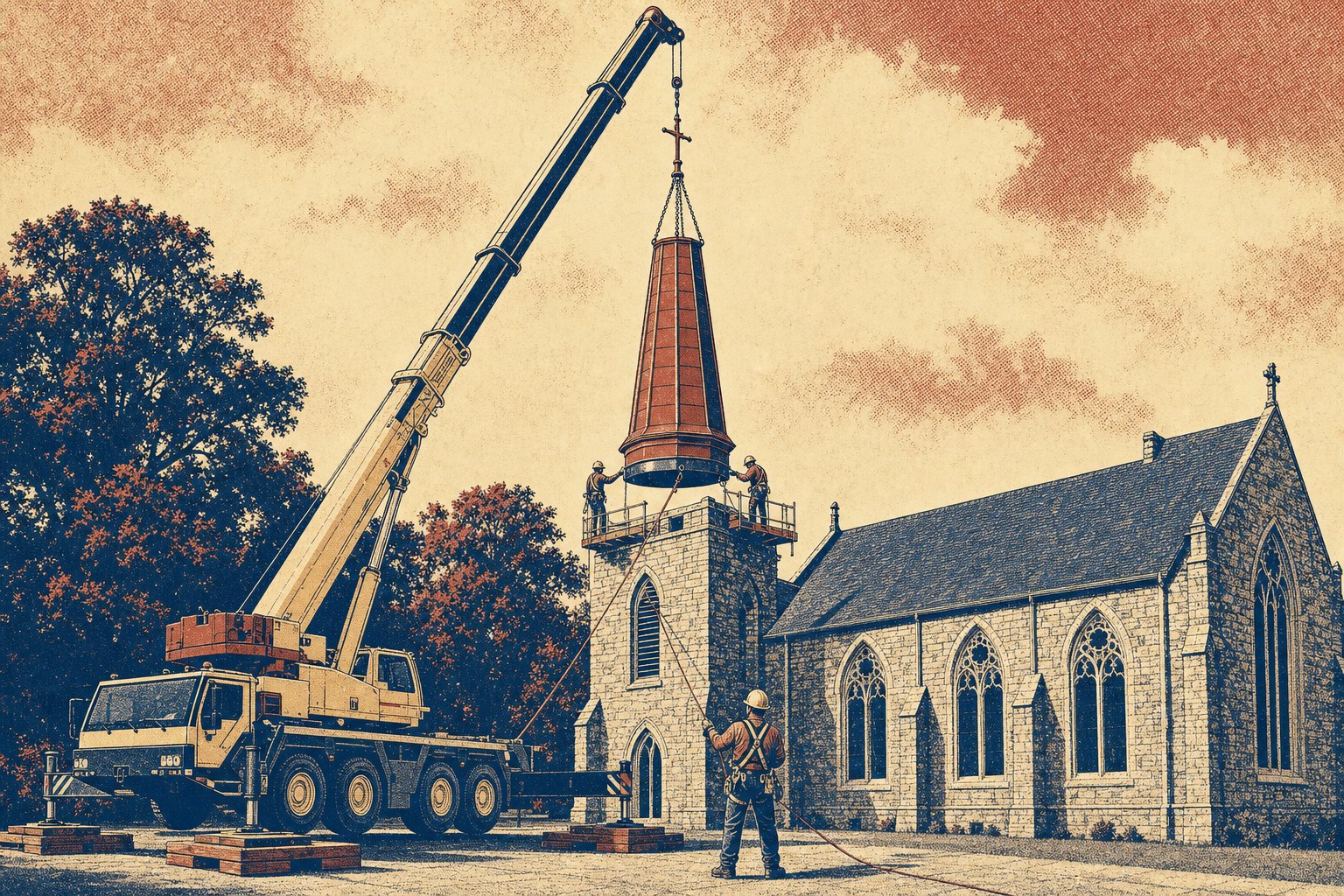
The load is the wrong shape
A steeple is close to the worst external load geometry in commercial aviation. It is tall, hollow, broad-sided, and light for its volume, which is the textbook definition of a low-density load. Army sling-load doctrine sorts every external load into high density, low density, and aerodynamic, and states the order plainly: the high density load offers the best stability, the low density load the least, and an aerodynamic load stays unstable until it streamlines itself into the airflow (FM 57-38, external loads).
That is not an abstraction. Coventry proved it in public. The Belvedere placed the 80 foot bronze fleche successfully on 28 April 1962, then the second half of the operation, lowering the half-ton cross onto the top of it, was postponed because the wind came up. The aircraft was not short of capacity: the Belvedere's external hook was rated to 5,250 pounds, and the cross weighed roughly a fifth of that (RAF Museum airframe record). The cross was the lighter load and the harder one. Weight buys stability; surface area spends it. The site's analysis of load spin, swing, and bounce works the same physics from the other direction, and the published remedy for a light bulky load is to add ballast until the rigged weight is high enough to behave, which is not an option when the object is a finished architectural element with a copper skin.
The regulation anticipates this. Before a new rotorcraft-load combination flies, 14 CFR 133.33(c) requires an initial flight check in which the crew lifts the load, establishes that it can be controlled in a hover, accelerates to determine controllability, watches for load oscillation, and determines the airspeed at which the combination can safely be flown. A one-off steeple has no history and no published data, so that check is not paperwork. It is the flight in which somebody finds out how the object behaves, and it happens with the real steeple on the hook.
Rigging follows from the geometry rather than from the weight. A steeple is picked upright, from a collar or base frame that transfers the load into the structural members instead of into the shell, with legs rising to a single point and tag lines run to control rotation. Nothing about that is unusual to a rigger, and the general practice is covered in the AHLH reference on rigging a helicopter lift. What is unusual is that the lifting hardware is a design deliverable from the structural engineer, because a hollow architectural shell has very few places that will accept a sling without deforming.
Rotorwash over an old roof
The third constraint is what the aircraft does to everything it is not lifting. Downwash reaches its maximum velocity roughly two rotor diameters below the disc and spreads outward across a radius of about three rotor diameters, and the FAA Rotorwash Analysis Handbook treats the 30 to 40 knot band as the point where rotorwash becomes hazardous to people and property on the surface (FAA Rotorwash Analysis Handbook). A medium helicopter at a working hover puts that field directly onto the object under it.
On a church that object is frequently slate, clay tile, or standing-seam copper laid over sheathing that predates the building code, plus stained glass, plus a churchyard with headstones and mature trees. A crane exerts a vertical load through outrigger mats on a parking lot and nothing else. The aircraft alternative adds a wind field over the whole property for the duration of the approach, which becomes a survey item, an insurance item, and often a preservation review item on a listed building. None of that is prohibitive. It is simply cost and risk the crane does not carry.
Where the church sits decides the paperwork
Churches are located where congregations live, which in the United States means residential blocks, town squares, and downtown cores. That siting drives the regulatory stack harder than the lift itself does. Operations over a congested area require the operator to develop a plan for the complete operation, coordinate it with the responsible Flight Standards office, and obtain approval, and the plan has to include an agreement with the appropriate political subdivision that local officials will exclude unauthorized persons from the area, coordination with air traffic control where necessary, and a detailed chart of flight routes and altitudes. Each flight must then be conducted at an altitude and on a route that allows a jettisonable load to be released and the rotorcraft landed without hazard to persons or property below.
14 CFR 133.33 Congested area plan
Read that against a steeple set and the friction is obvious. The congregation is the reason the project exists and the congregation is exactly who has to be excluded from beneath the route, and the jettison requirement means the plan has to identify somewhere the steeple could legally be dropped. The full sequence of agencies, lead times, and municipal permits is broken out in the AHLH guides to congested area plans and which agency approves what.
Aircraft selection narrows at the same moment. The heavy end of the US civil fleet is largely surplus military iron on restricted category type certificates, and 14 CFR 91.313 bars a restricted category civil aircraft from operating over a densely populated area, in a congested airway, or near a busy airport without a specific FAA authorization, with the Part 133 twin at 133.45 imposing the same limitation on external-load work. A 16,000 pound steeple in a residential neighborhood therefore does not merely need a heavy aircraft. It needs a heavy aircraft that is standard category, and that is a short list.
14 CFR 91.313 Restricted category limits 14 CFR 133.45 Operating limitations
On the ground the crew rule is the helicopter-specific one rather than the crane standard: eye protection and chinstrapped hard hats, no loose clothing near the hoist line, static discharge managed before anyone touches the load, and constant reliable communication between the pilot and one designated ground employee who is distinctly recognizable from everyone else on site.
OSHA 1926.551 Ground crew rule
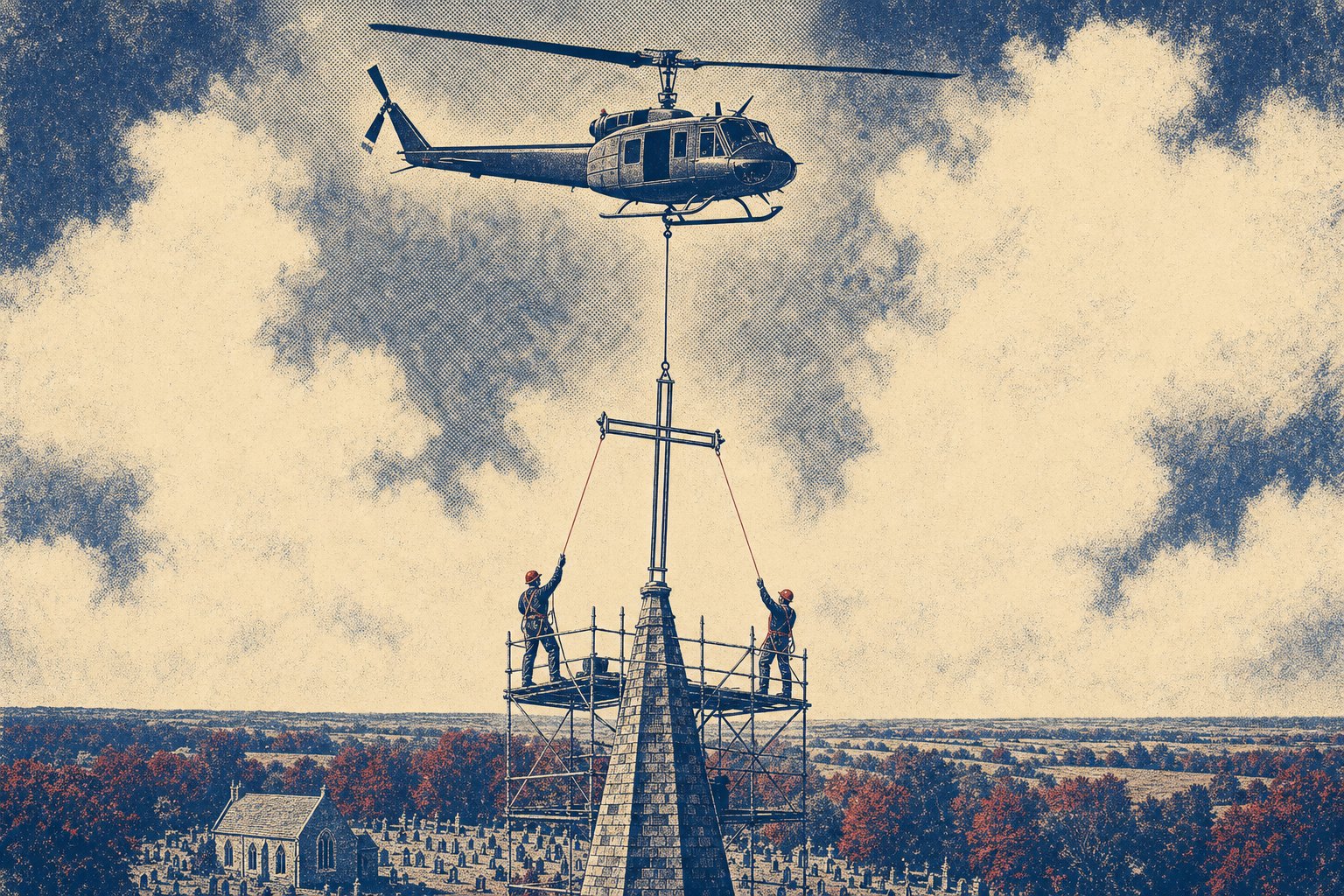
The cases where the aircraft is right
Ruling the helicopter out of ordinary parish work does not rule it out of the category. Four conditions move the answer, and any one of them can carry the decision on its own.
| Site condition | Usually wins | Why |
|---|---|---|
| Suburban or rural church, paved lot, steeple under 25,000 lb | Mobile crane | Inside a 100 ton class machine and inside a single mobilization; the hold is free |
| Urban church hemmed in by other buildings with no crane setup square | Helicopter | No outrigger footprint exists; the alternative is a tower crane erected for one pick |
| Set point above about 200 ft on a cathedral tower or a hillside site | Helicopter | Beyond an ordinary 100 ton class hoist height without escalating to a very large crane |
| Mountain or island church with no road able to carry a crane | Helicopter | Access cost dominates; the aircraft flies from a staging field as at Ypsilanti in 1963 |
| Restoration requiring drilling, plumbing, or fitting while suspended | Mobile crane | The hold is the job; an aircraft cannot buy the duration at any hourly rate |
| Slender cross or finial under a few hundred pounds at height | Crane or boom lift | High sail area, low mass, and a set that has to be threaded onto a pin |
| Steeple removal after fire or wind damage, structure of unknown integrity | Mobile crane | Weight is an estimate at best, and an estimate is not a load the pilot can accept |
Reach thresholds reference published crane data: a 100 ton class all-terrain such as the Liebherr LTM 1110-5.1 reaches about 197 ft of hoist height, a 275 ton Grove GMK5275 reaches 354 ft of tip height with a swingaway jib on a 223 ft boom, and the largest telescopic all-terrain in production tops out near 617 ft. Practical reach on a church job is whatever the local rental fleet actually carries, which is usually far less.
The reach column matters more than it looks, because American steeples get tall. Riverside Church in New York rises 392 feet, Trinity Church Wall Street reached 281 feet when it was completed in 1846, and St. Michael's in Rochester stands at 256 feet. Work at the top of any of those is outside the ordinary regional crane fleet and inside an aircraft's envelope, which is the same reasoning that governs antenna work on tall broadcast towers. It is also the reasoning behind the precision placement discipline documented on the AHLH steel and infrastructure reference, where spires are one of the named applications.
Scale is worth keeping in view. When Notre-Dame de Paris rebuilt its 315 foot oak and lead spire after the 2019 fire, the work ran on scaffolding and cranes from 2022, with the rooster set on 16 December 2023 and the spire unveiled on 13 February 2024 (Spire of Notre-Dame de Paris). The most watched spire reconstruction of the century was not an aviation project, because a multi-year assembly at height never is.
What the planning team owes the lift
Whichever method is selected, the deliverables that decide the day are identical, and three of the four belong to the owner and the design team rather than to the lifting contractor.
- A certified weight for the assembly as it will fly. Not the vendor's shipping weight for the shell. The finished number includes the steel base frame, the bell, the louvers, the cross, the finish, and any bracing left in place, and on a removal it is genuinely unknown until the object is on a scale. Removals get planned against the top of a range.
- Engineered pick points designed into the object. A hollow shell has almost no place that will accept a sling. The collar, bail, or spreader is a structural design item delivered before fabrication ends, not a field decision made by whoever is holding the strap.
- Verified capacity in the receiving structure. The tower has to accept the load, the anchorage, and the wind case that comes with a taller silhouette. On a nineteenth-century masonry tower that is an investigation, not an assumption.
- An exclusion zone that a named local official has agreed to enforce. Congregations gather for this. The plan has to say who keeps the fall zone clear and who has authority to stop the operation, and on an aerial lift that agreement is a regulatory element of the congested area plan rather than a courtesy.
The honest summary is narrow, and it points the same direction the total cost comparison points on most small commercial work. A steeple is a light load at a modest height on a site with parking, and that is a crane's home ground. The aircraft earns the job when the site removes the crane's footprint, when the set point outruns the regional fleet's boom, or when no road reaches the church at all. Everywhere else, the right recommendation is the one that has been quietly correct in every local news clip for sixty years.