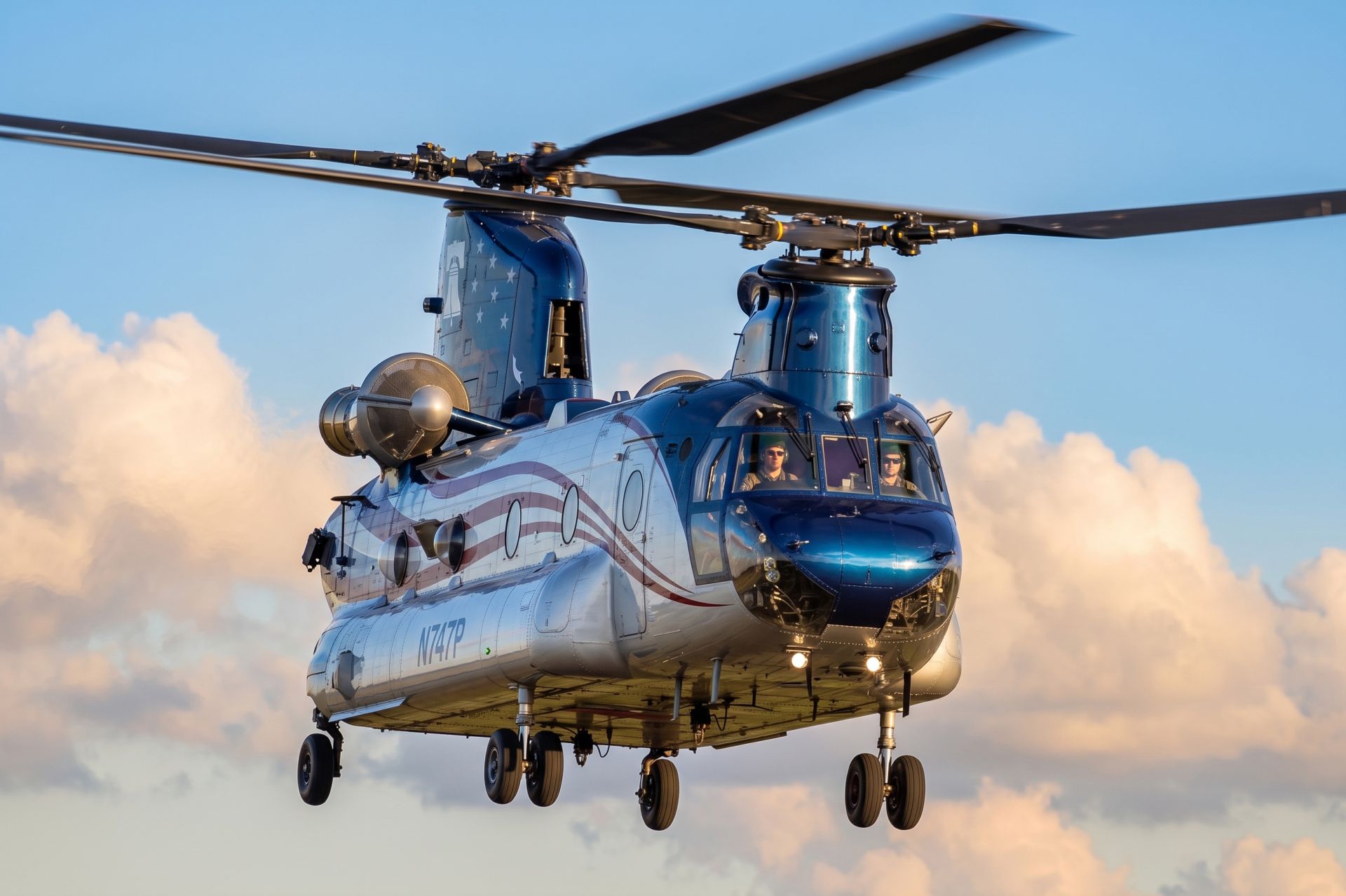
A helicopter lifts anywhere from roughly 1,000 pounds under a light utility single to 44,000 pounds under the largest production machine ever built. In the United States, civil external load work tops out at roughly 28,000 pounds on the hook, held by the Chinook family; the Erickson S-64F Air Crane carries 25,000 pounds, and the high-cycle Kaman K-MAX carries 6,000. The Russian Mi-26 lifts 44,000 pounds but holds no FAA type certificate and flies no United States commercial work. Every figure above is a sea level standard day number. Heat and altitude tax available payload by roughly 3 percent per 1,000 feet of density altitude, which is why the honest answer is a table and a formula, not a single number.
Every short answer to this question is a single number, and every single number fails somewhere. Lift capacity is not a property of the aircraft alone. It is the output of four interacting limits (hook rating, gross weight, power available, and the weight of the rigging itself) evaluated against the temperature and elevation of a specific job site on a specific afternoon. A capacity figure published without its conditions is trivia. A capacity figure published with its conditions is a planning number an estimator can actually build on.
This analysis publishes the full capacity table for the machines that do commercial lift work in the United States, plus the world-record class for context. It then defines what the published payload number actually means, works the density altitude math that shrinks it, places the four FAA load classes around it, and states where lift capacity stops being the deciding variable at all. All aircraft figures are sea level standard day values drawn from published manufacturer and operator data.
The capacity table: maximum external load by aircraft
Two definitions before the table. First, airworthiness category matters as much as capacity: standard category aircraft hold conventional FAA type certificates, while restricted category aircraft (mostly converted military surplus) are barred from operating over congested areas, which removes them from most urban work regardless of what the hook can hold. Second, precision placement rating is listed where an operator publishes a lower figure for setting a load precisely on a point than for simply carrying it; holding a load steady at a bolt pattern demands power margin that carrying it in cruise does not.
| Aircraft | Max external load (sea level, std day) | Precision placement | Airworthiness category | Working role |
|---|---|---|---|---|
| Bell 212 | 3,500 to 4,500 lbs (modified) | Rated load | Standard | Light utility twin: line hardware, compact rooftop units |
| Bell 412EP | 4,500 lbs | Rated load | Standard | Light twin workhorse; twin-engine redundancy near energized lines |
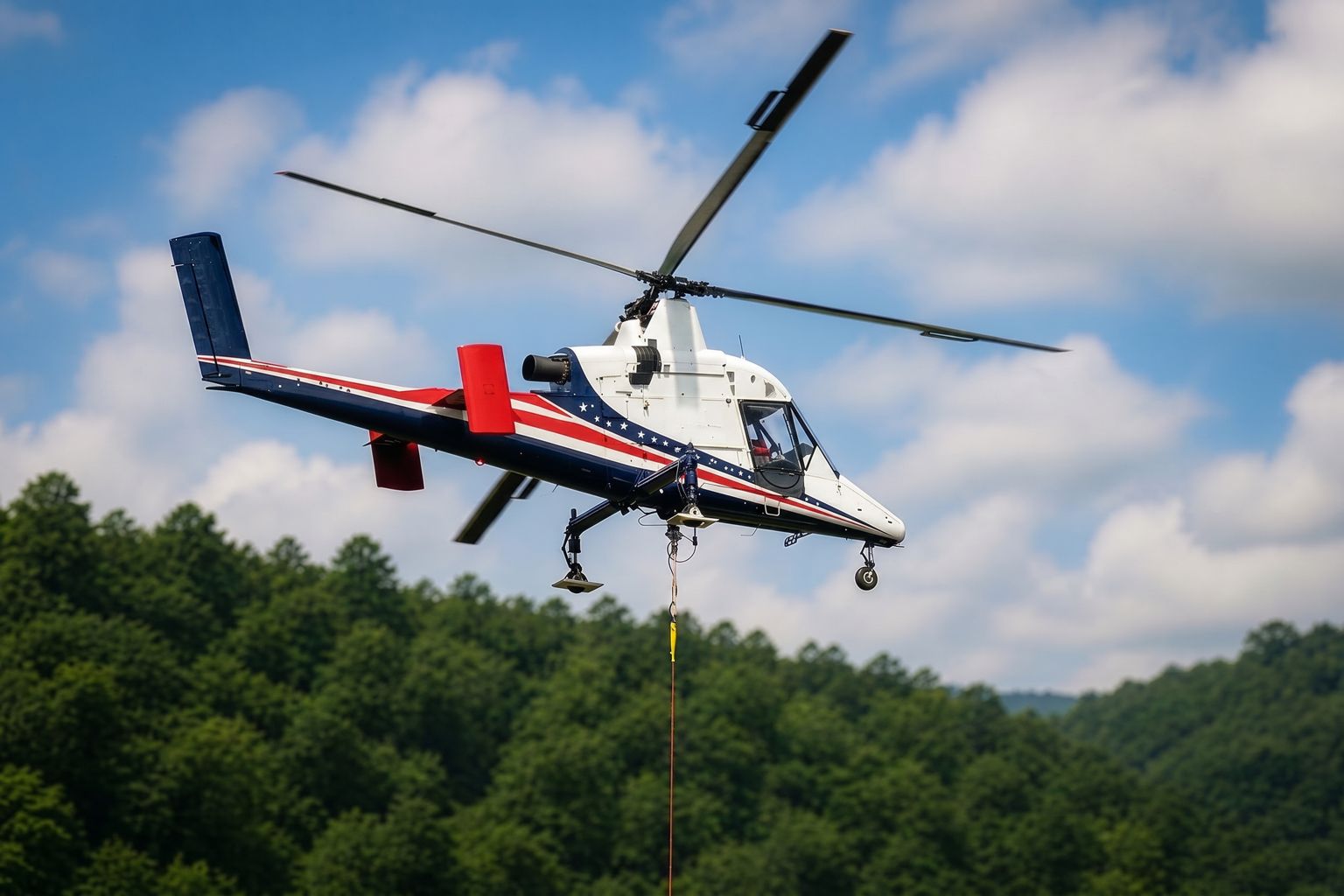
| Kaman K-MAX K-1200 | 6,000 lbs | Rated load; designed for repetitive precision | Standard | High-cycle specialist: 20 to 25 picks per hour |
| Bell 214B BigLifter | Roughly 7,000 to 8,000 lbs at its 16,000 lb external load gross weight | Rated load | Standard | Hot-and-high single; fire and construction support |
| UH-60 Black Hawk conversions | 8,000 lbs (UH-60A), 9,000 lbs (UH-60L) | Rated load | Restricted | Surplus military conversions: fire, logging, remote freight; no congested area work |
| Sikorsky S-61N | 10,000 lbs (with composite main rotor blades) | Rated load | Standard | The medium-heavy twin workhorse tier |
| Erickson S-64E Air Crane | 20,000 lbs | Rated load, aft-facing pilot station | Standard | Heavy: chillers, steel, modules, towers |
| Erickson S-64F Air Crane | 25,000 lbs | Rated load, aft-facing pilot station | Standard | The heaviest Air Crane variant |
| CH-47D Chinook conversions | 26,000 lbs (center cargo hook) | Rated load | Restricted | Maximum restricted-category capacity: fire, remote heavy freight |
| Columbia BV-234 Chinook | 28,000 lbs | 20,000 lbs | Standard | The United States civil ceiling; legally cleanest over congested areas |
| Mil Mi-26 | 44,000 lbs (20,000 kg) | Rated load | No FAA type certificate | Global context only; the largest production helicopter ever built |
Three rules for reading the table. First, the United States civil ceiling is roughly 28,000 pounds on the hook, held by the Chinook family, with the Air Crane fleet directly behind it; a load above that line belongs to ground equipment, full stop. Second, category decides geography: a restricted category CH-47D and a standard category BV-234 are cousins by airframe, but only the BV-234 can legally execute the congested-area work that defines urban construction lifting. Third, the precision column is the honest one: the BV-234 carries 28,000 pounds but is rated at 20,000 pounds for precision placement, and precision placement is what construction is.
A note on sourcing. The capacity figures in the table come from manufacturer specifications and the published data of the operators who fly these aircraft commercially. The authoritative documents behind them are the FAA type certificate data sheet, the rotorcraft flight manual, and the rotorcraft load combination flight manual that governs external load configurations. When a marketing figure and a flight manual figure disagree, the flight manual is the one the pilot in command is bound to, and it is the number a serious lift plan cites.
What the payload number actually means
The figure a manufacturer publishes is the end of a subtraction problem, and the subtraction is worth seeing once in full. Four numbers govern every lift.
Empty weight is the machine with nothing in it: no fuel, no crew, no rigging. Maximum gross weight is the most the whole system (aircraft plus everything it carries) may weigh, and it frequently comes in two values, because regulators allow a higher gross weight when the load is jettisonable on an external hook. The Bell 214B is certificated at 13,800 pounds for internal load and 16,000 pounds with a jettisonable external load; the difference is the regulation acknowledging that a load which can be released in an emergency is a different risk than one bolted inside the cabin. Hook rating is the structural limit of the cargo hook and its attach points, a hard number that no cool morning improves. Power available is what the engines and rotor system can actually produce in the day's air, and it is the only one of the four that changes between the morning briefing and the afternoon pick.
The load that can actually fly is the smallest of three results: the hook's structural rating, the gross weight minus the operating weight (aircraft, fuel for the cycle block, crew), and the power-limited hover weight at the day's density altitude. Operators plan against whichever governs, and on heavy picks in summer it is almost always power.
Fuel is the payload lever operators actually pull on site. Jet A weighs about 6.7 pounds per gallon, and every gallon aboard trades pound for pound against the hook. This is why production lift operations run short fuel cycle blocks with a fuel truck at the staging area: the aircraft launches with 45 minutes to an hour of fuel, flies the block at maximum usable payload, and lands to take on more. An aircraft topped off for a long ferry flight and the same aircraft configured for a heavy pick carry two very different numbers on the load cell.
Then the rigging comes off the top. A 100 to 200 foot longline, a remote hook, spreader bars, and slings routinely weigh 300 to 500 pounds, and every pound of it is payload the load cell counts against the aircraft. A pick plan that compares a unit's certified weight against the brochure capacity without subtracting the rigging is wrong by exactly the weight of the rigging. The complete rigging discipline, including design factors of 5 to 1 and higher, is covered in the external load operations reference linked below.
One airframe in the table deserves a paragraph for what it says about design intent. The Kaman K-MAX has an empty weight of 5,145 pounds and a rated external load of 6,000 pounds: it lifts more than itself. Its intermeshing twin rotors eliminate the tail rotor, so no power is spent holding the fuselage straight; effectively everything the engine makes goes into lift. It carries less than half the S-61N's load, but it was drawn around one job (repetitive external lift at high cycle rates) more purely than any other machine in civil service, which is why it appears on production programs that heavier aircraft would price out of viability.
The last distinction is between manufacturer numbers and operator numbers. The published maximum is a certification value. A working operator states payload for a specific project at that project's forecast density altitude, per the aircraft's rotorcraft load combination flight manual. When the two numbers differ, the operator's number is the real one.
Density altitude: the 3 percent tax on every published number
Density altitude is the altitude the rotor system behaves as if it were flying at, which is field elevation corrected for temperature and pressure. Hot air is thin air: a rule-of-thumb correction adds roughly 120 feet of density altitude for every degree Celsius above standard temperature. Thin air gives the rotor disc less to push against and the engines less oxygen to burn, and the planning consequence compresses into one figure every experienced lift planner carries: available payload falls by roughly 3 percent per 1,000 feet of density altitude.
Worked example. A Sikorsky S-61N rated at 10,000 pounds at sea level on a standard day is contracted for a mountain project at a 5,000 foot field elevation:
| Condition | Density altitude | Available hook load (3 percent per 1,000 ft rule) |
|---|---|---|
| Sea level, 59 F (standard day) | 0 ft | 10,000 lbs |
| 5,000 ft elevation, 60 F morning | Roughly 6,300 ft | Roughly 8,100 lbs |
| 5,000 ft elevation, 90 F afternoon | Roughly 8,200 ft | Roughly 7,500 lbs |
Now subtract the rigging: a 150 foot longline and remote hook at roughly 400 pounds leaves about 7,700 pounds of usable payload in the morning and about 7,100 pounds by mid afternoon. A 7,600 pound unit that cleared the sea level brochure figure with a 2,400 pound margin flies at 7 a.m. and does not fly at 3 p.m. on the same site with the same aircraft. This single calculation explains why lift days start at dawn, why mining and mountain work is described as high, hot, and heavy, and why heavy tier aircraft get contracted for loads their sea level rating would call light: the Chinook that carries 26,000 pounds at sea level still holds roughly 19,600 pounds of capability at an 8,200 foot density altitude, and that margin is what the mountain job is actually renting.
The rule of thumb is a planning gate, not a performance chart. The aircraft's hover-out-of-ground-effect charts at forecast temperature govern the final pick plan, and a serious operator runs that math on the heaviest pick before the aircraft is contracted, not on lift morning. Humidity plays a smaller role than temperature but pushes the same direction, since humid air is less dense than dry air. Wind is the planner's occasional friend, because a steady headwind over the pick point improves hover performance, but no competent lift plan banks on it: temperature and elevation are forecastable, gusts are not.
The strongest helicopters in the world
The global ceiling sits well above the United States civil market, and the distinction between the two answers most of the follow-up questions this topic generates.
The Mil Mi-26 is the largest production helicopter ever built: an eight-blade main rotor and a rated payload of 20,000 kilograms, which is 44,000 pounds, carried internally or on the sling. It has hauled downed aircraft, including other heavy helicopters, out of terrain nothing else could reach. It also holds no FAA type certificate, so it performs no commercial work in the United States; its operating world is Russia, the CIS states, and heavy utility contracts elsewhere.
The absolute lift record belongs to a machine that never entered production. In August 1969 the Soviet Mil V-12 prototype, with four engines driving two side-by-side rotors, lifted 40,204 kilograms (88,636 pounds) to 2,255 meters. More than five decades later the record still stands.
The heaviest lifter in current United States military service is the Sikorsky CH-53K King Stallion, designed to carry 27,000 pounds over a 110 nautical mile radius mission and rated to a maximum external load of 36,000 pounds. It is a military aircraft; it does not appear on commercial lift plans.
So the phrase strongest helicopter in the world has three correct answers depending on the question actually being asked: the Mi-26 among production aircraft, the V-12 for the standing record, and the Chinook family at roughly 28,000 pounds for civil work in the United States. For anyone planning a lift on a United States job site, only the third number is real.
Load classes: where capacity meets the regulation
In the United States, every one of these numbers operates inside 14 CFR Part 133, which sorts external loads into four classes by how the load attaches and whether it can be released. Class A is a fixed, non-jettisonable load attached to the airframe. Class B is a jettisonable load on the cargo hook lifted free of the ground, which is nearly all construction lifting: the HVAC unit, the steel, the concrete bucket, the tower section. Class C is a jettisonable load that stays in contact with land or water, the signature of wire stringing and towing work. Class D is human external cargo, governed by its own provisions.
The class determines the certification, the authorization, and parts of the rigging standard, which means the capacity number in the table only becomes a lawful lift once it is paired with the right class and the right paperwork. The Part 133 certificate, congested area plans, rigging design factors, and the load class table all live in the FAA external load operations rulebook that every figure in this analysis answers to.
14 CFR 133 External load certificate
Capacity is only half the decision
The capacity table answers whether a load can fly. It says nothing about whether it should. That determination is economic, and it turns on right-sizing: matching the smallest airframe that carries the heaviest pick with margin for density altitude and rigging weight. Stepping from the S-61N tier to the Air Crane tier can multiply the hourly rate for capability the pick list never uses, and stepping too small forces multiple cycles or a mid-project aircraft swap that erases the schedule advantage the helicopter was chosen for.
The economics run on cycle count as much as capacity. Production external load work executes 10 to 15 lifts per hour on typical construction picks, which is why the aircraft with the intimidating hourly rate is frequently the cheaper machine on high-count or access-constrained work, the full math the helicopter versus crane cost breakdown for estimators builds line by line.
And the honest boundary stands: above roughly 28,000 pounds on a single pick, at sea level, on the best day of the year, no civil helicopter in the United States is the answer. A 60-ton press or a bridge girder belongs to a crawler crane or a modular jack system. Physics, not preference.
The working answer to how much weight a helicopter can lift is therefore a sentence, not a number: it depends on the aircraft, the hook, the day's density altitude, and the rigging, and the table above plus the 3 percent rule turns that sentence into a figure for any machine and any site. That is the form of the answer a lift plan can be built on.