Aerial construction field study
Helicopter Concrete Pouring & Bucketing
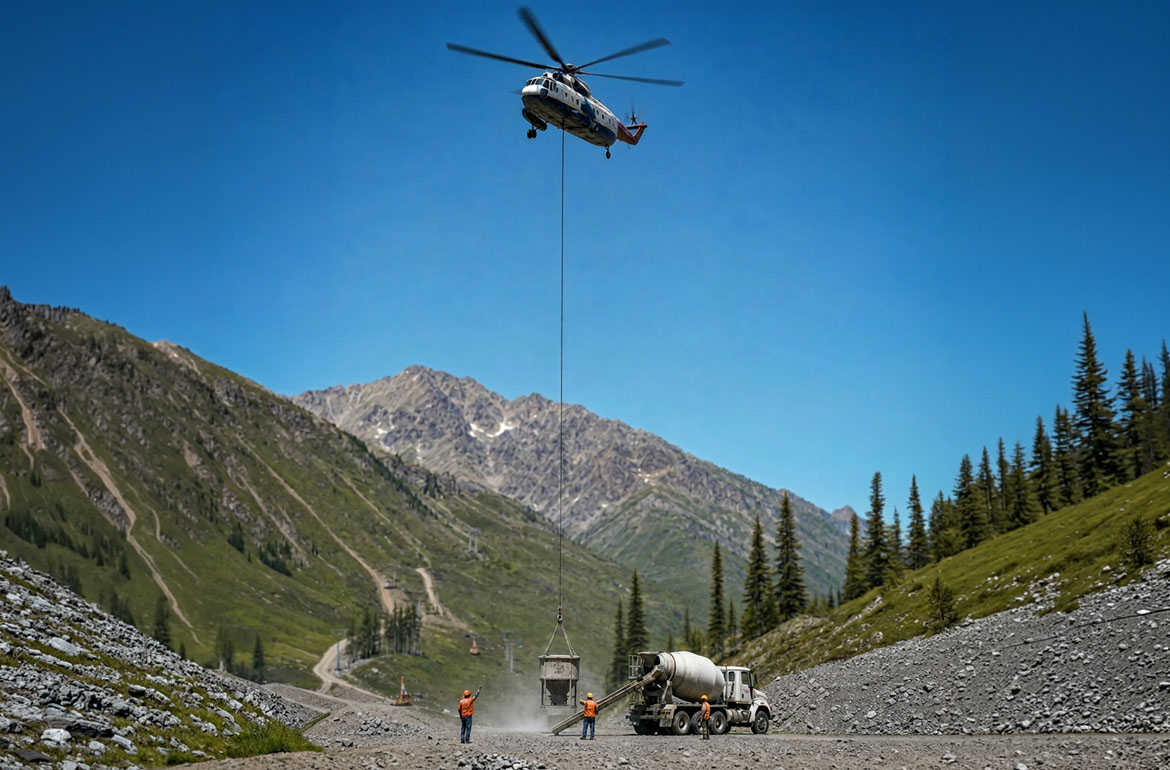
Helicopter concrete pouring places 10 to 80 cubic yards per hour on forms beyond pump and truck reach; a high-cycle K-MAX flies 20 to 25 buckets per hour. Operators engineer batch timing, bucket sizing, and pour cadence under FAA Part 133 before the first pick. And when a pump can reach the forms, the pump is the right tool. This page lays out the numbers behind both conclusions.
Concrete does not negotiate. Once the batch plant loads the truck, the clock on workability, discharge limits, and cold joints starts running, and it does not care that the pour is a tower foundation at 9,500 feet or a bridge pier at the bottom of a roadless canyon. Aerial concrete placement exists for exactly those pours: mountain footings, transmission tower foundations, dam and spillway repairs, and remote piers where the alternative is building a road that costs more than the structure.
The number that wins or loses an aerial pour is not maximum lift capacity. It is cycle rate: how many pick-to-pour rotations the aircraft completes per hour, how many yards each bucket carries after density altitude takes its cut, and whether that cadence stays ahead of the concrete's initial set. Competent operators engineer all three before an aircraft is committed, because a helicopter that places concrete slower than it cures is not a delivery method. It is a cold-joint generator.
This page gives estimators and engineers the planning numbers. For the broader crane-versus-rotorcraft decision framework on commercial sites, start at the aerial construction hub. For the regulatory foundation under every external load flight, see external load operations.
The mission set
Where Helicopter Concrete Pouring Wins
Ground delivery fails in predictable ways. A truck chute needs the mixer within a few feet of the forms. A boom pump needs a set-up pad and reach measured in the low hundreds of feet. A line pump extends further but demands continuous pipe runs, access for the pump truck, and pressure margins that fall off hard with vertical rise and distance.
When the pour sits beyond all three, the traditional answer has been temporary road construction, and the modern permitting environment has made that answer expensive: clearing, grading, erosion control, environmental review, and reclamation, all for a road used for one pour sequence.
The missions where the helicopter is the correct engineering call:
- Transmission and telecom tower foundations. Drilled pier and spread footing pours along ridge lines, sequenced with tower construction flights so foundations and steel ride the same mobilization.
- Dam, spillway, and penstock work. Placement onto faces and benches where crane geometry fails and pump line anchorage is impractical.
- Remote bridge piers and abutments. Stream crossings where in-water access is restricted and temporary causeways trigger their own permits.
- Mountain footings for tramways, lifts, and instrumentation sites. High-elevation pours where density altitude, not access, is the governing constraint. The mining operation support page covers the high-altitude payload math in full depth.
- Backcountry structures and trail infrastructure. Small-yardage pours for agencies and contractors working under land-use rules that prohibit new road cuts.
The planning numbers
How Many Yards of Concrete Can a Helicopter Place per Hour?
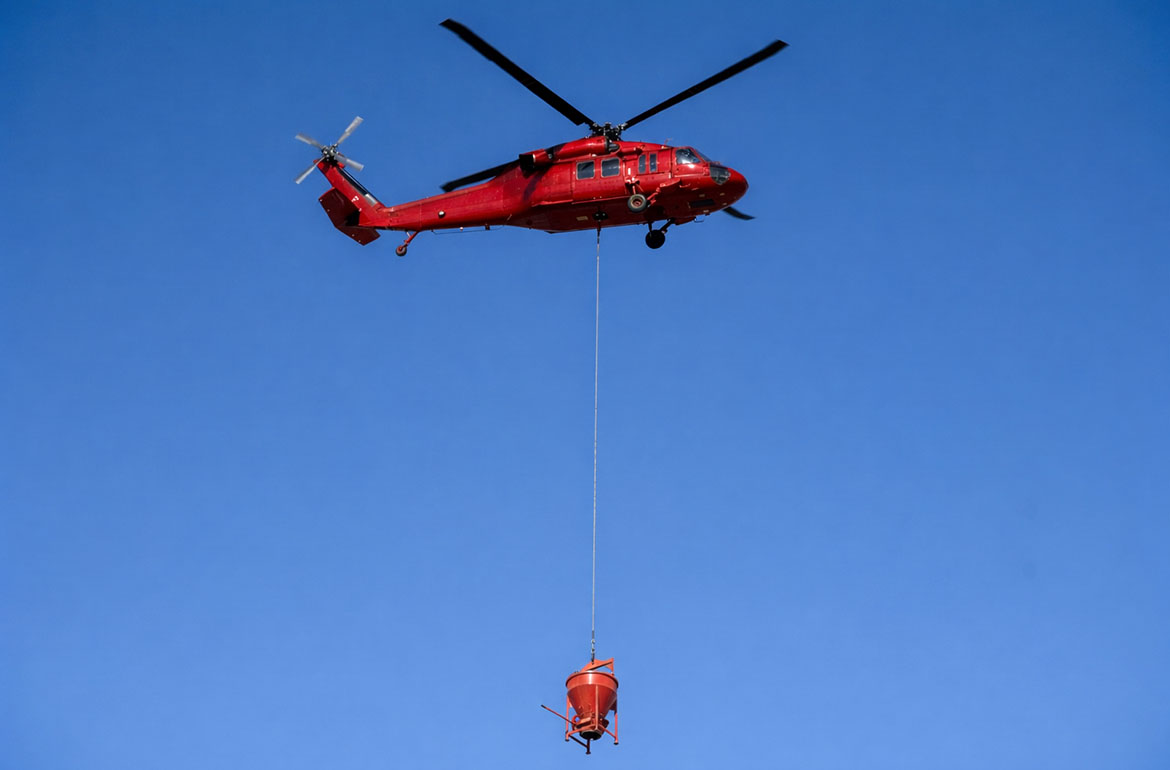
Fresh normal-weight concrete runs approximately 150 pounds per cubic foot, close to 4,000 pounds per cubic yard before adding the tare weight of the bucket. That single number drives aircraft selection. Divide the aircraft's usable hook capacity by loaded bucket weight, multiply by realistic cycles per hour, and the result is the placement rate.
Planning figures below assume a short shuttle (staging within roughly one mile of the forms), sea level, standard day. Every capacity carries a density altitude qualifier: heat, humidity, and elevation all reduce these numbers, and on a well-run job the reduction is engineered into the lift plan, not discovered on pour day.
| Aircraft | Max external load | Approx. concrete per cycle | Cycles per hour | Effective placement rate |
|---|---|---|---|---|
| Bell 212 Eagle Single | 3,500 lbs std / 4,500 lbs modified | 0.5 to 0.75 yd | 15 to 20 | 8 to 14 yd/hr |
| Bell 412EP | 4,500 lbs | 0.5 to 0.75 yd | 15 to 20 | 8 to 15 yd/hr |
| Kaman K-MAX K-1200 | 6,000 lbs (sea level, ISA +15C) | 1.0 to 1.25 yd | 20 to 25 | 20 to 30 yd/hr |
| Bell 214B Big Lifter | 8,000 lbs longline | 1.25 to 1.5 yd | 15 to 18 | 19 to 27 yd/hr |
| Sikorsky S-61N Mk II | 10,000 lbs (Carson blades) | 1.75 to 2.0 yd | 12 to 15 | 21 to 30 yd/hr |
| Erickson S-64E Air Crane | 20,000 lbs | 3.5 to 4.0 yd | 15 to 20 | 55 to 80 yd/hr |
| Erickson S-64F Air Crane | 25,000 lbs | 4.5 to 5.0 yd | 15 to 20 | 70+ yd/hr |
Concrete-per-cycle figures net out bucket tare weight and hold margin against the placarded limit. All figures derate with density altitude; see the worked example below.
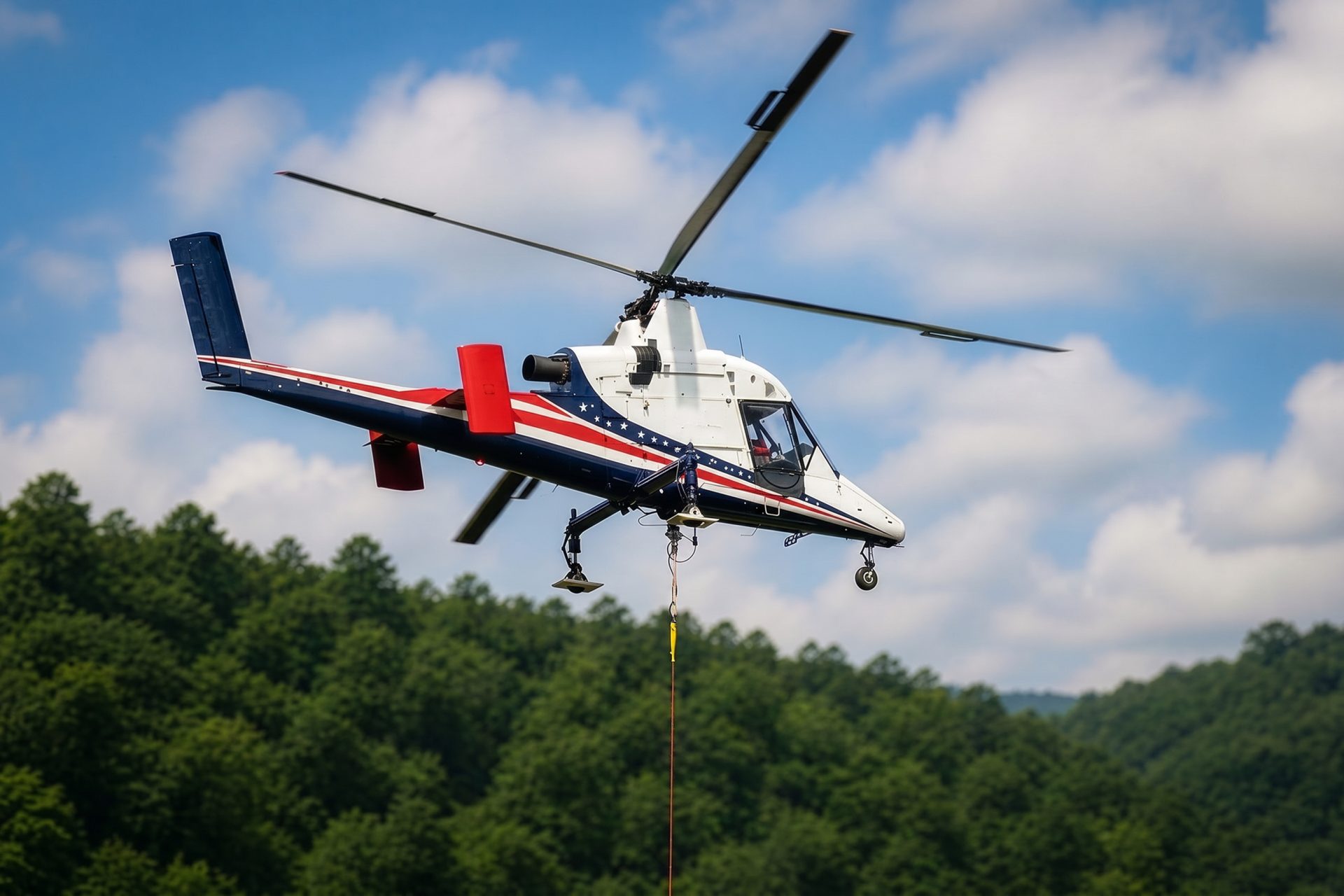
Two aircraft deserve comment. The K-MAX is the high-cycle specialist: intermeshing rotors, low downwash, and a 20 to 25 pick-per-hour cadence that keeps a mid-size pour continuous with a single aircraft. The S-64 Air Crane family is the volume answer: at 3.5 to 5 yards per bucket it turns a 300-yard foundation from a multi-day exposure into a single-shift operation, and the aft-facing pilot station puts the bucket on the form, not near it.
The schedule discipline
How Is a Continuous Pour Maintained with Flight Cycles?
Cold joints are not accepted on an aerial pour. They are engineered out. A cold joint forms when fresh concrete is placed against concrete that has reached initial set, and on a remote pour every variable that produces one is a scheduling variable the operation controls.
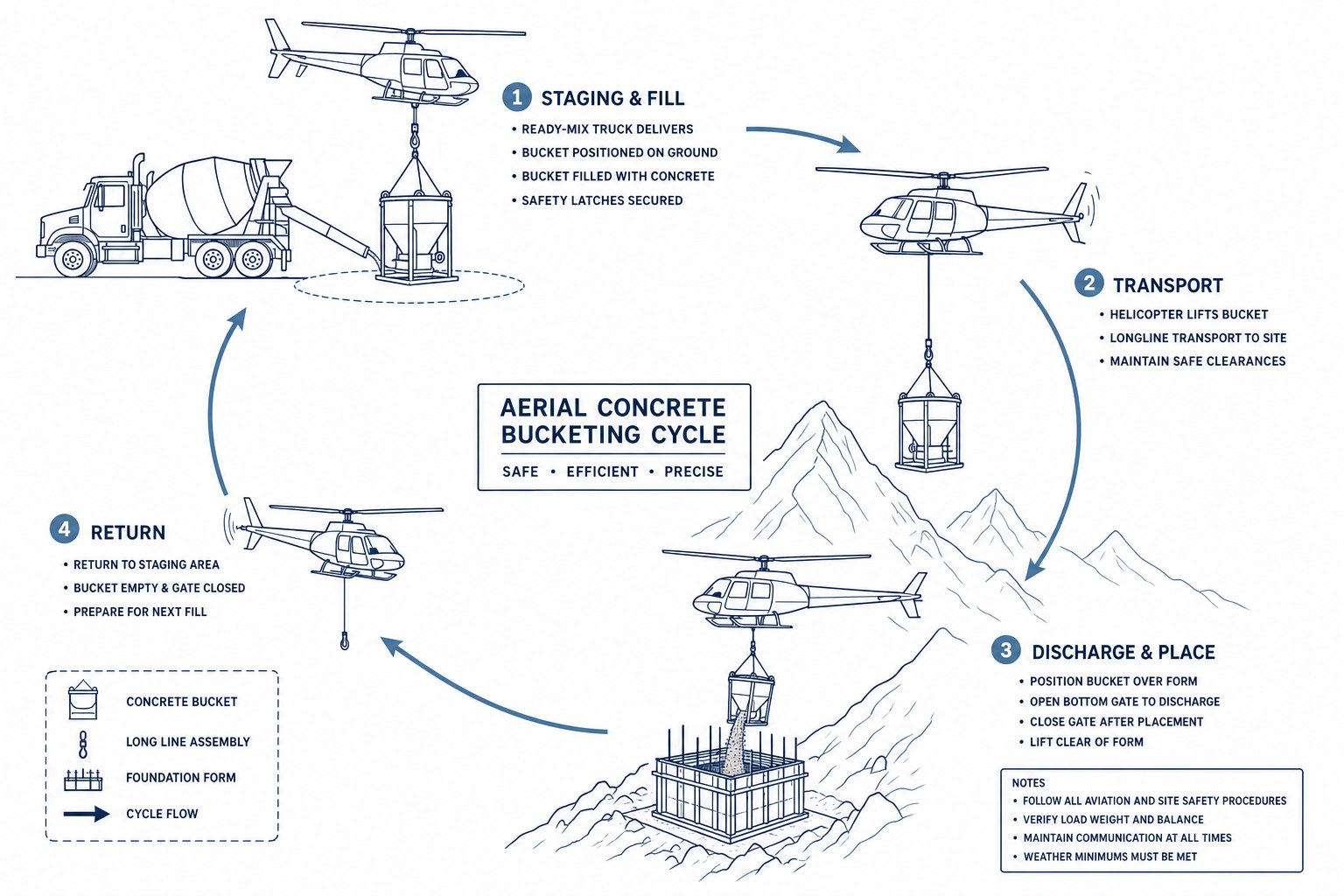
Batch timing is flight timing. ASTM C94 requires ready-mix discharge within 90 minutes of batching. On an aerial pour the planning team works backward from that limit: truck arrival at the staging LZ is sequenced against aircraft cycle time so no load waits at the hopper burning workability. The batch plant dispatcher and the operator's flight coordinator run the same clock.
Cycle cadence is matched to set time. The mix designer supplies the initial set window for the specified mix at forecast site temperature. The lift plan validates that the aircraft's cycle rate covers each lift area before the previous layer sets, with margin. Where cycle distance or yardage pushes that margin, the answer is engineered before mobilization: a hydration-stabilizing or retarding admixture in the mix design, a second aircraft on the rotation, or a revised pour sequence broken at planned construction joints instead of accidental cold ones.
Slump is managed at the hopper. Aerial buckets discharge through a gate the pilot or a ground crew member actuates over the form. Slump outside the design range either hangs up in the bucket or segregates on discharge. Ground crews verify slump at the staging area against the pour plan and reject loads outside tolerance, exactly the discipline a finisher expects at a chute.
Weather holds are pre-planned. Every pour plan defines the wind and visibility limits that pause flying, and what happens to concrete in transit and at the plant when a hold is called. A pause procedure decided at 8,000 feet with a loaded bucket on the hook is not a procedure.
The physics tax
What Happens to Helicopter Concrete Bucket Capacity at Altitude and in Heat?
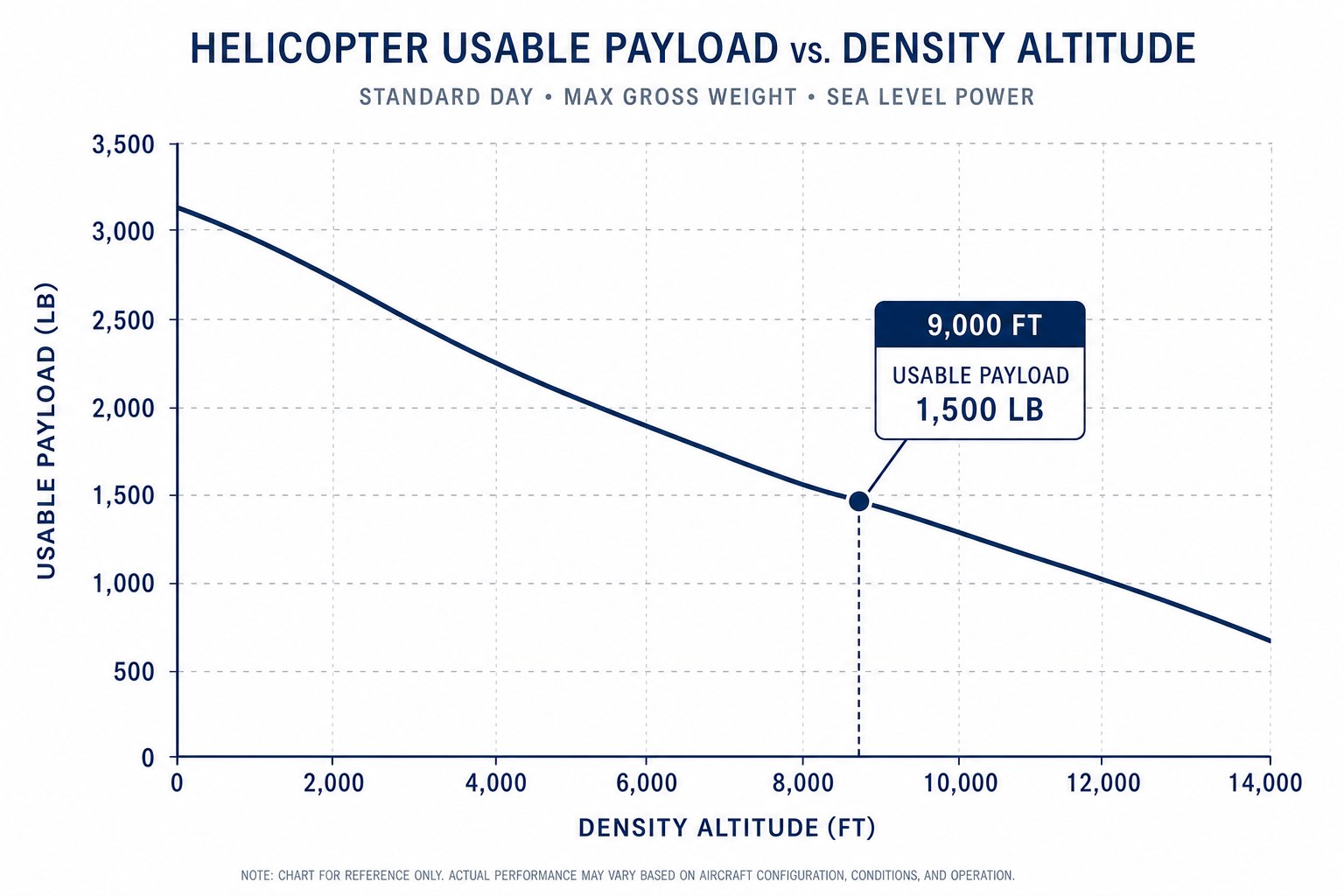
Payload is dynamic, never static. Density altitude climbs roughly 600 feet for every 10 degrees Fahrenheit above standard temperature, and each 1,000 feet of density altitude costs approximately 3 percent of available engine power. High humidity subtracts another 3 to 4 percent. Mountain pours stack all three penalties at once.
Worked example: a K-MAX rated for 6,000 pounds at sea level arrives at a tower foundation site at 6,500 feet elevation on an 85 degree July morning. Density altitude computes near 9,000 feet. Available lift drops on the order of 25 percent, putting usable hook weight near 4,500 pounds. The 1.25-yard bucket that penciled at sea level is now overweight when loaded. The engineered answer is a smaller bucket or a reduced fill line, a recalculated cycle count, and a pour schedule built around the cooler morning hours when density altitude is lowest. Experienced operators run this math before the job is priced, and it appears in the lift plan as a per-day capacity table, not a footnote.
This is also where airframe selection earns its keep: the Bell 214B holds useful longline capability to 14,000 feet density altitude, which makes it the default candidate for the highest pours in the Mountain West.
The rulebook
The Helicopter Concrete Bucket, the Rigging, and the Regulation
Aerial concrete work is the textbook Class B external load under 14 CFR Part 133: a jettisonable load lifted free of the surface on the cargo hook.
That word jettisonable is doing real safety work. The pilot in command retains the authority and the hardware to release the load instantly if the aircraft's performance or the environment demands it, and the flight path is planned so a jettisoned bucket falls into a secured zone, never over crew or public. The hardware stack under the hook is governed and inspected:
| Element | Standard | What it means on the pour |
|---|---|---|
| Concrete bucket | ASME B30.20 (below-the-hook lifting devices) | Rated, marked, and inspected discharge bucket; gate function verified before the first flight of every day |
| Slings and hardware | ASME B30.26; 5:1 minimum design factor | Rigging selected against loaded bucket weight, not empty weight |
| Longline | 7:1 design factor (non-human external cargo) | Line length set for downwash management and placement visibility |
| Ground crew operations | OSHA 1926.551 | PPE, static discharge grounding before any hand touches bucket or line, tag line discipline, rigging inspection protocol |
Role delineation is exact, and it protects the estimate. The operator supplies and maintains the certified bucket, the engineered rigging, and the Part 133 operational envelope, and the pilot in command holds final legal authority over rigging integrity and can refuse any lift. The contractor's side of the line: the pour design, formwork ready to receive at the planned cadence, finishing crew staffing, and a batch source that can hold the schedule. Everything at the interface (staging LZ layout, hopper position, signal protocol, discharge procedure) is written into the lift plan both crews brief from.
The honest comparison
When a Pump or a Crane Beats Aerial Concrete Placement
Solution-agnostic vetting is the mark of a serious lift plan, and it is the first thing an estimator should look for in any aerial proposal. Aerial bucketing loses on total cost in three common situations:
- The pump reaches. If a boom or line pump can be staged with existing access and the vertical rise is within its pressure budget, the pump places more yards per hour at a fraction of the hourly cost. A helicopter should never fly concrete a pump can push.
- High-volume pours with road access. A continuous mat or large foundation pour fed by a truck rotation belongs to ground equipment. Rotorcraft economics favor pours that are remote, vertical, or fragmented across sites, not big flat yardage.
- Long-duration, low-rate placement. If the pour sequence stretches across weeks at low daily yardage, standby aviation cost outruns the access savings. A crane and hopper, or staged pumping, wins.
Where the helicopter wins is equally specific: no road, no pump reach, environmental or permitting constraints on ground disturbance, multiple scattered pour sites on one corridor, or a schedule where weeks of access construction die against a fixed energization or in-water work window. Run both columns honestly and the answer is usually obvious. The credible operators put that comparison in writing so the contractor's bid carries the math, not a sales pitch. Projects that also fly forms, rebar, and equipment to the same sites consolidate flight planning under remote site freight logistics, which spreads mobilization cost across every line item.
The vetting standard
What a Complete Aerial Pour Bid Package Contains
Concrete placement bids fail on vagueness. When contractors evaluate operator proposals, the strong ones plug into the estimate as fixed line items:
- Placement rate table. Yards per hour by aircraft for the site elevation and forecast temperature band, with the density altitude derate shown, not hidden.
- Cycle plan. Staging LZ location, shuttle distance, cycle time, and truck sequencing coordinated with the batch supplier against the ASTM C94 discharge window.
- Priced structure. Flight hour rate, ferry, fuel, and standby terms stated separately, so weather-day exposure is a number in the risk column instead of a surprise.
- Compliance file. Part 133 certificate, insurance certificates including on-hook cargo coverage and additional insured status, rigging inspection records, and the site-specific lift plan for the safety manager's review.
An operator that returns all four, including "use the pump" when that is the honest answer, is one worth shortlisting. Mobilization for a standard aerial pour is measured in days, not weeks, which is exactly why the planning discipline above matters more than the flying.
For the adjacent airframe and payload analysis, continue with tower construction and remote site freight, or step back to the aerial construction hub for the full crane-versus-rotorcraft framework. New cycle-rate and payload analyses are announced through the mailing list; join it to get them as they publish.
Frequently asked questions
What Estimators Ask About Aerial Pours
From the technical library