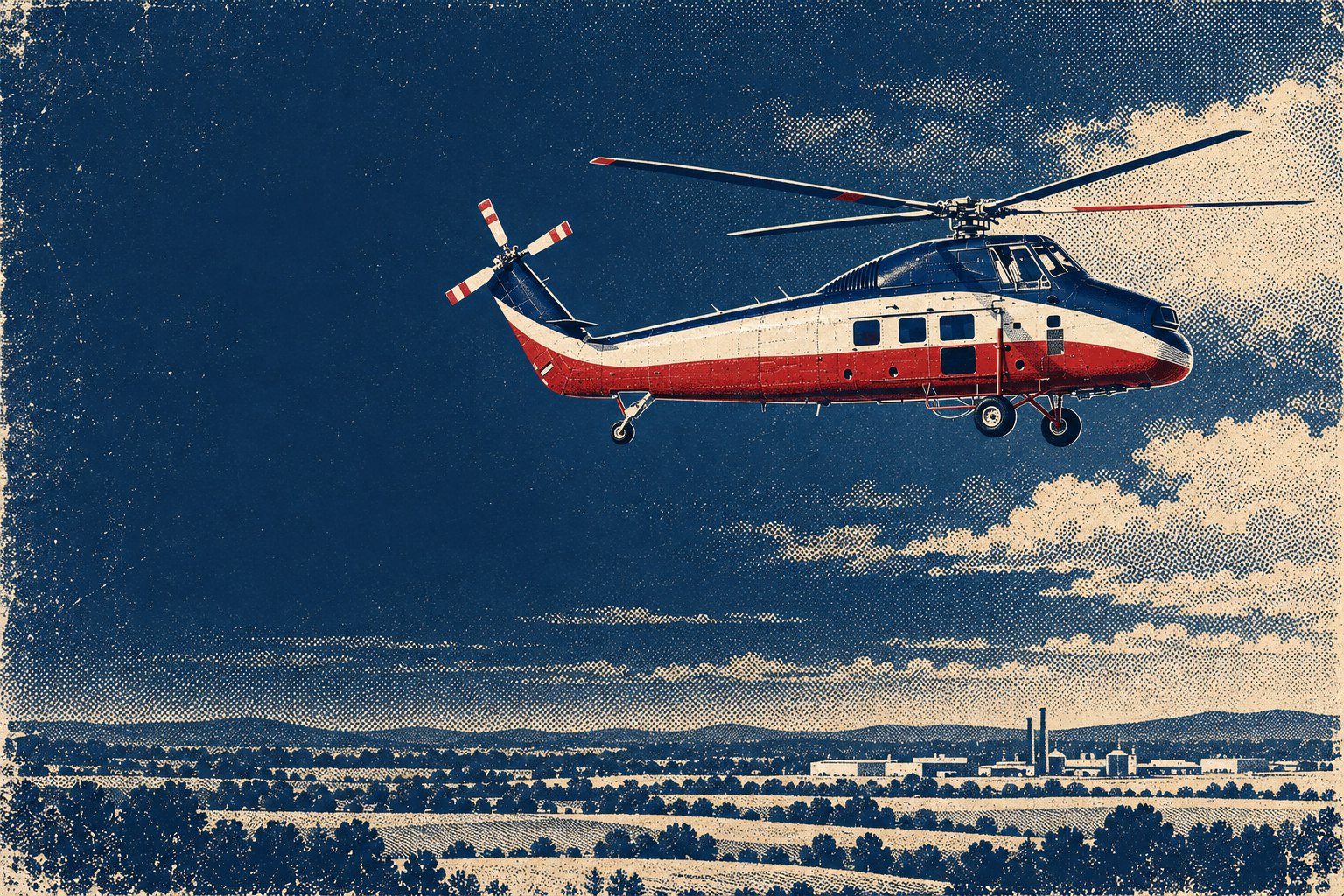
The Sikorsky S-55 first flew in 1949; the larger S-58 followed in 1954 and became the military H-34 family. The S-58T brought turbine power to that later design. It still appears in commercial lift fleets, where the specific aircraft's approved configuration and lift-day performance matter more than its familiar silhouette.
The high cockpit and deep cabin make the family recognizable. The useful story is how that shape served the work: room for a load, access to the engine and, later, a different way to power the rotor. Each step deserves its own name.
For someone researching a lifting project, the history also explains why a helicopter with such an old silhouette can appear in a current fleet. The design has a lineage. The aircraft proposed for a job has its own configuration and operating limits.
The S-55 put the cabin beneath the rotor
The S-55 first flew on November 10, 1949. Its engine sat below and forward of the cockpit, leaving a roomy cabin beneath the main rotor. Offset hinges in the rotor head helped accommodate different load positions. H-19 belongs to this earlier family. Source: Sikorsky Archives S-55 history.
The arrangement tackled a practical transport problem: fit a substantial engine without giving away the room needed for passengers or cargo. The load gets a useful space of its own.
Clamshell nose doors opened around the engine compartment; the rotor head and main gearbox formed a quick-change assembly. Access mattered alongside carrying capacity. Source: S-55 maintenance layout.
For readers comparing the modern fleet, this is the start of a lineage rather than a capacity ranking. The practical meaning of heavy-lift helicopter depends on the lifting work being discussed. An aircraft that expanded utility transport in its own period does not acquire the capabilities of today's largest lifting machines merely because both appear in that history.
The S-58 and H-34 names describe the next design
The follow-on S-58 first flew on March 8, 1954. Its military family includes Army H-34 and CH-34 names, the Marine UH-34D and Navy SH-34 variants. Source: Sikorsky Archives S-58 history.
| Name encountered | Place in the lineage | What to keep separate |
|---|---|---|
| S-55 / H-19 | Earlier utility family, first flown in 1949 | The ancestor, not an S-58 variant. S-55 history |
| S-58 / H-34 family | Follow-on design, first flown in 1954 | Military designations and civil model names. S-58 history |
| S-58T | Turbine development of the S-58 | Installed engine model and approved conversion records. PT6T applications |
A lineage guide, not a list of interchangeable aircraft or a determination of airworthiness category. The complete model designation and aircraft records control identification.
The rotor changed too. The S-58 used four main-rotor blades against the S-55's three. Sikorsky's account explains that the change reduced blade loading, the aerodynamic burden carried by each blade, and helped delay blade stall at higher forward speeds. It also reduced vibration. Source: S-58 rotor design.
The S-58's main rotor spans about 56 feet, and its landing gear has two main wheels and a tailwheel. That diameter describes a substantial moving footprint. It is useful context when picturing the aircraft beside a worksite, though it is not a prescribed clearance distance. Source: S-58 dimensions and arrangement, pages 4 and 8.
Commercial lifting did not begin with the turbine conversion. Sikorsky's history records piston S-58s hauling external cargo and placing loads at construction sites. The later conversion carried an existing utility role forward. Source: Civil S-58 construction history.
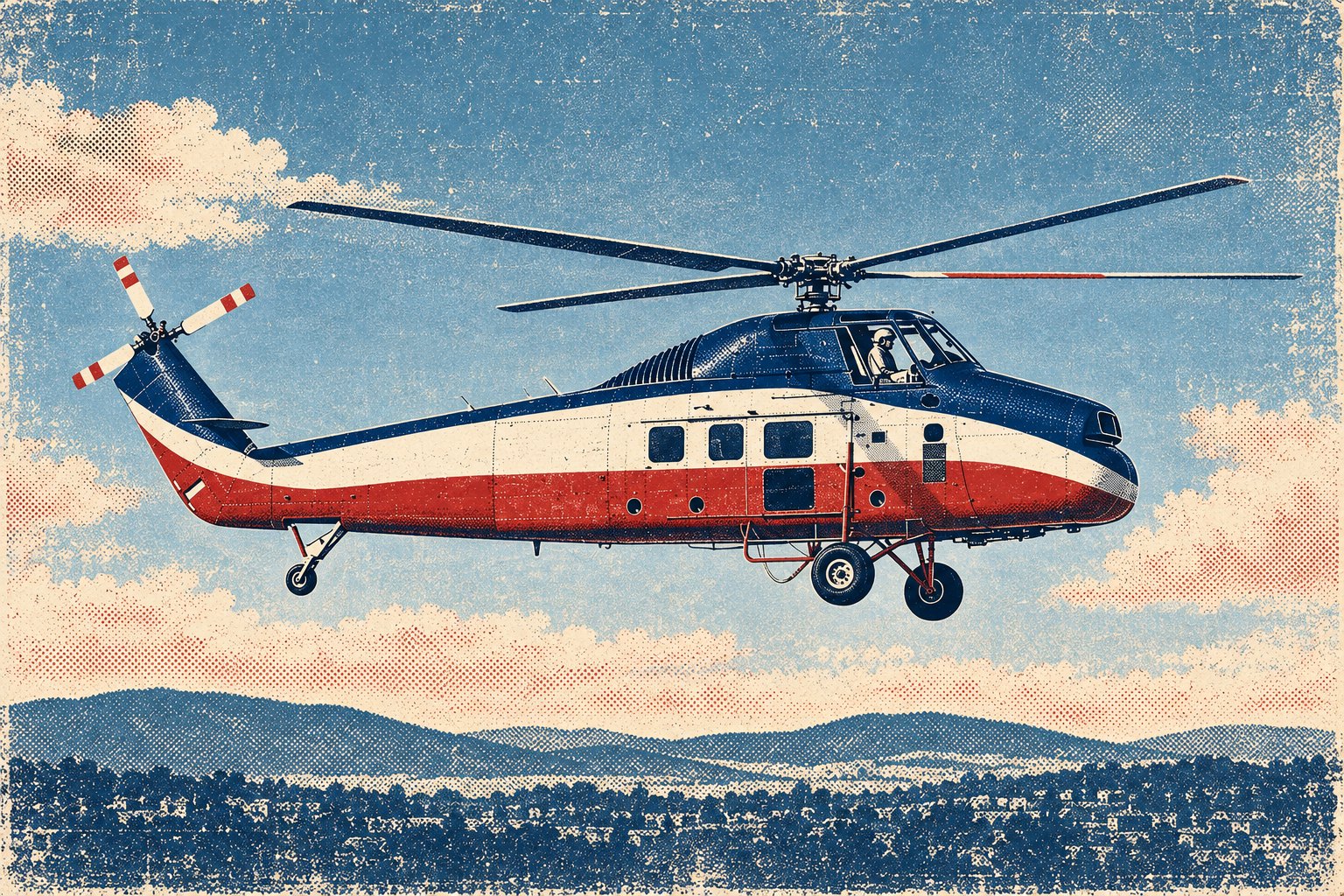
The S-58T conversion changed the powerplant
The military H-34 used a Wright R-1820 radial piston engine, with cylinders arranged around the crankshaft. A turboshaft instead uses a gas turbine to deliver shaft power to the drive system. The conversion changed the powerplant technology as well as the engine model. Source: H-34 piston powerplant.
EASA's September 2020 S-58 type-certificate data sheet records the first PT6T-3 installation approval on April 15, 1971, under a supplemental type certificate. The turbine models were subsequently added to the type certificate in 1972. That sequence explains why accounts of the conversion can mention either year. Source: EASA S-58 data sheet, note 10.
A supplemental type certificate approves a change to an existing aircraft design. It is a useful distinction here. Converting an aircraft does not make its earlier history disappear or mean it was newly built on the conversion date. The approved change becomes part of the aircraft's configuration.
Pratt & Whitney describes the PT6T's basic arrangement as two PT6A power sections feeding a combining gearbox. That gearbox brings their output into a common drive. Its application list includes S-58Ts under both PT6T-3 and PT6T-6 models. Source: Pratt & Whitney PT6T description and applications.
The visible aircraft family and the installed engine therefore answer different questions. S-58 identifies the design lineage; the turbine installation explains how the rotor receives its power. Two power sections feed a shared combining gearbox, not independent drivetrains. A horsepower figure by itself cannot establish the weight that can hang beneath the helicopter.
The conversion is a major part of the aircraft's story, but it is not a claim of unlimited performance. In particular, two power sections do not guarantee continued flight after one fails while carrying a suspended load. The applicable aircraft performance information must answer that question.
Commercial lift fleets still list the S-58T
The family remains relevant because operators still publish S-58T lifting capabilities. Midwest Helicopter Airways lists loads up to 4,500 pounds. Separately, 5 State Helicopters describes its S-58Ts as picking loads typically up to 4,000 pounds. Those are each operator's published descriptions, not competing measurements of a universal cargo-hook rating. Sources: Midwest Helicopter Airways and 5 State Helicopters.
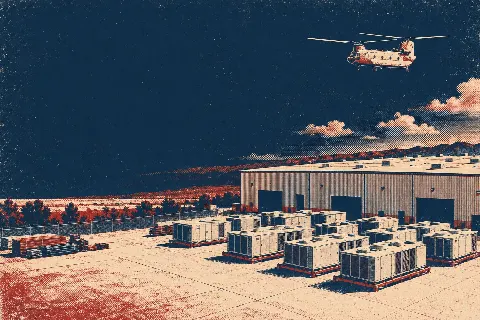
Those figures put the aircraft in a useful planning context: loads measured in a few thousand pounds, rather than the largest loads handled by purpose-built heavy lifters. For an equipment schedule, that makes the weight of each individual item worth resolving early. Combining two modest units into one assembly can change the aircraft discussion.
Summit Helicopter's fleet page lists the S-58T for construction work, including placing steel and concrete pouring. It also describes in-house major maintenance, field maintenance personnel and stocked spare parts. That connects the aircraft to a working support operation, rather than merely an appearance in a historical collection. Source: Summit Helicopter fleet and maintenance information.
Steel placement and concrete pouring also involve different load arrangements. A piece of steel arrives as an item to place; a concrete operation involves the material and its delivery container. The aircraft's role makes more sense when the object being carried is clear. Fleet listings establish published uses, not availability on a particular date.
A published load figure is the start of the capacity check
The ground crane remains the comparison baseline where it can reach the load positions with workable access. The rooftop equipment lifting comparison explains why the site can matter as much as the equipment's weight. An S-58T's place in that comparison starts with the load and the available approach to it.
A pick is one lift of a load. Define what hangs beneath the aircraft for each pick, including rigging and any other gear carried with the load. An equipment shipping weight does not automatically describe that complete suspended load. The load-weight documentation guide covers the information needed to resolve that difference.
Performance also depends on the conditions at the aircraft. Density altitude expresses air density as an altitude; thinner air changes hovering performance. The FAA's Helicopter Flying Handbook discusses performance through the particular helicopter's charts, with weight and conditions considered together. There is no single percentage deduction that turns every published S-58T figure into a usable site allowance. Source: FAA helicopter performance guidance.
Consider a replacement unit whose ordered options change after the initial equipment schedule. The relevant question is whether the proposed aircraft can carry the revised suspended weight under the planned conditions. Quoting the model family's published capability again does not resolve the change. The operator needs the updated load information before the schedule is treated as settled.

Capacity and production are separate questions. After the load is accepted, the route and work at both ends still determine how many cycles fit the available window. The complete-cycle production calculation shows why a payload figure alone cannot establish the duration of an equipment-setting operation.
Read the aircraft's records, not its age alone
More than seventy years separate the S-58's first flight from this article's publication. That describes the age of the design. It does not mean every aircraft in a current lift fleet has flown continuously in its original configuration. A conversion, the particular model and its subsequent records belong to the individual machine.
For U.S. external-load operations, 14 CFR 133.33(a) requires compliance with the rotorcraft-load combination flight manual, the operating document covering the aircraft and load combination. A familiar military name cannot replace that document. Source: 14 CFR 133.33(a).
That brings the design history back to the people planning the work. The equipment supplier resolves what is being lifted; the flight operator evaluates it against the proposed aircraft and conditions. A coordinator can keep those decisions connected. The division of lift-planning responsibilities explains the handoffs.
The S-58T's place in published lift fleets connects the earlier utility design to turbine power and the organizations maintaining it for work. Its history explains the familiar silhouette. The load and site explain whether it belongs on a particular project.