Four kinds of weather stop a helicopter lift: low visibility, wind and turbulence, thin air from heat and altitude, and storms. The pilot in command makes the call under 14 CFR 91.3, and OSHA 1926.551(h) bars a lift the operator believes unsafe. At a 6,000 foot site, a hot afternoon costs an illustrative 10,000 pound aircraft about 960 pounds against the morning.
Most lift delays are weather delays, and most of them are decided well before anyone sees an aircraft. A project that depends on a single flight day is a project that depends on a forecast. The useful questions are narrower than "will it fly": which conditions stop a lift, who is allowed to call it, when the call is made, and what the delay costs the people waiting on the ground. This guide takes those in turn.
A theme runs through all of it. The regulations that apply to a lift are short on weather numbers. No section cited here sets a wind speed limit for an external-load flight. The limits come from the aircraft's flight manual and from a pilot's judgment on the day, which is why the decision belongs to one person and why the rest of the project plans around that person's answer.
Who makes the call
Federal rules put the decision with the pilot in command. Under 14 CFR 91.3(a), the pilot in command "is directly responsible for, and is the final authority as to, the operation of that aircraft" (14 CFR 91.3). Nothing in that text lets a project manager, a client or a general contractor overrule a no-go. Section 91.9(a) adds that no person may operate a civil aircraft without complying with the operating limitations in the approved rotorcraft flight manual, which is where an aircraft's own wind, temperature and weight limits live (14 CFR 91.9).
The construction rule says the same thing from the ground side. OSHA 1926.551(h) makes the helicopter operator responsible for the size, weight and manner in which loads are connected, and then closes with a sentence that carries the weather decision: "If, for any reason, the helicopter operator believes the lift cannot be made safely, the lift shall not be made" (29 CFR 1926.551). The words "for any reason" matter. The operator does not have to prove that a measured wind speed crossed a published threshold. A gust pattern the pilot dislikes is enough.
That authority is not a loophole for the operator and not an obstacle for the owner. It is the reason weather clauses in a lift plan are written as schedule and cost terms, not as performance tests. Who holds which duty on a lift day, including the weather call, is mapped in who is responsible for what during a helicopter lift.
14 CFR 91.3 Pilot in command authority OSHA 1926.551 Ground crew rule
The conditions that stop a lift
Six conditions account for nearly every weather hold. They differ in who sees them first and in how quickly they change, which shapes when the decision can be made.
| Condition | What it changes on a lift | Who sees it first | Usual response |
|---|---|---|---|
| Low ceiling or fog | Hook, load, set point and wires cannot be seen; legal minimums are not met | Forecast, then the site crew at first light | Hold until the layer lifts or burns off |
| Steady wind | Sets the hover heading, adds drag on a large load and shifts the downwash pattern across the site | Site anemometer and the pilot on approach | Reposition the pick or set points, reduce load area, or hold |
| Gusts and turbulence | Loads swing, the aircraft needs reserve power at the hover, and tail rotor control margins shrink | The pilot, usually only in the air | Hold; move the work to a calmer period or a sheltered location |
| Heat and altitude | Thinner air cuts hover power and available payload | Forecast temperature and site elevation, known days ahead | Fly early, lighten the load or break it into more picks |
| Rain, snow and icing | Reduces visibility and handling; icing limits come from the flight manual | Radar, forecast and the crew | Hold for a gap, or move the window |
| Thunderstorms and lightning | Downdrafts and wind shear near the cell, lightning at the site | Radar and the forecast | Stop work, clear the ground crew and wait |
Planning summary drawn from the rules and sources cited in this article. Wind and temperature limits for a specific aircraft come from its flight manual (14 CFR 91.9(a)); no figure in this table is a limit for any aircraft.
Visibility and ceiling
Visibility is the one condition with legal numbers attached. Part 133 treats external-load flight as visual flight: 14 CFR 133.33(f) bars external-load operations under instrument flight rules unless the Administrator specifically approves them, and bars carrying a person as part of the external load under IFR under any circumstances (14 CFR 133.33). The visual minimums then come from 14 CFR 91.155. For a helicopter in Class G airspace at or below 1,200 feet above the surface, the minimums are one half statute mile of flight visibility and clear of clouds by day, and one statute mile and clear of clouds at night (14 CFR 91.155). Controlled airspace near an airport carries higher minimums, as the night external-load operations guide sets out in a table.
Those numbers are a floor, not the working standard. A lift needs the pilot to see the hook, the load, the set point, the ground crew and every wire in the approach, and a half mile of visibility does not provide that. Fog that fills a valley can leave the ridge site above it perfectly clear, and a pad in the fog can sit under a ceiling that the aircraft crosses easily. Dust is its own visibility problem and a controllable one; the rotor wash safety guide covers wetting a pad before the aircraft arrives.
14 CFR 91.155 VFR weather minimums 14 CFR 133.33 Operating rules

Wind, gusts and terrain
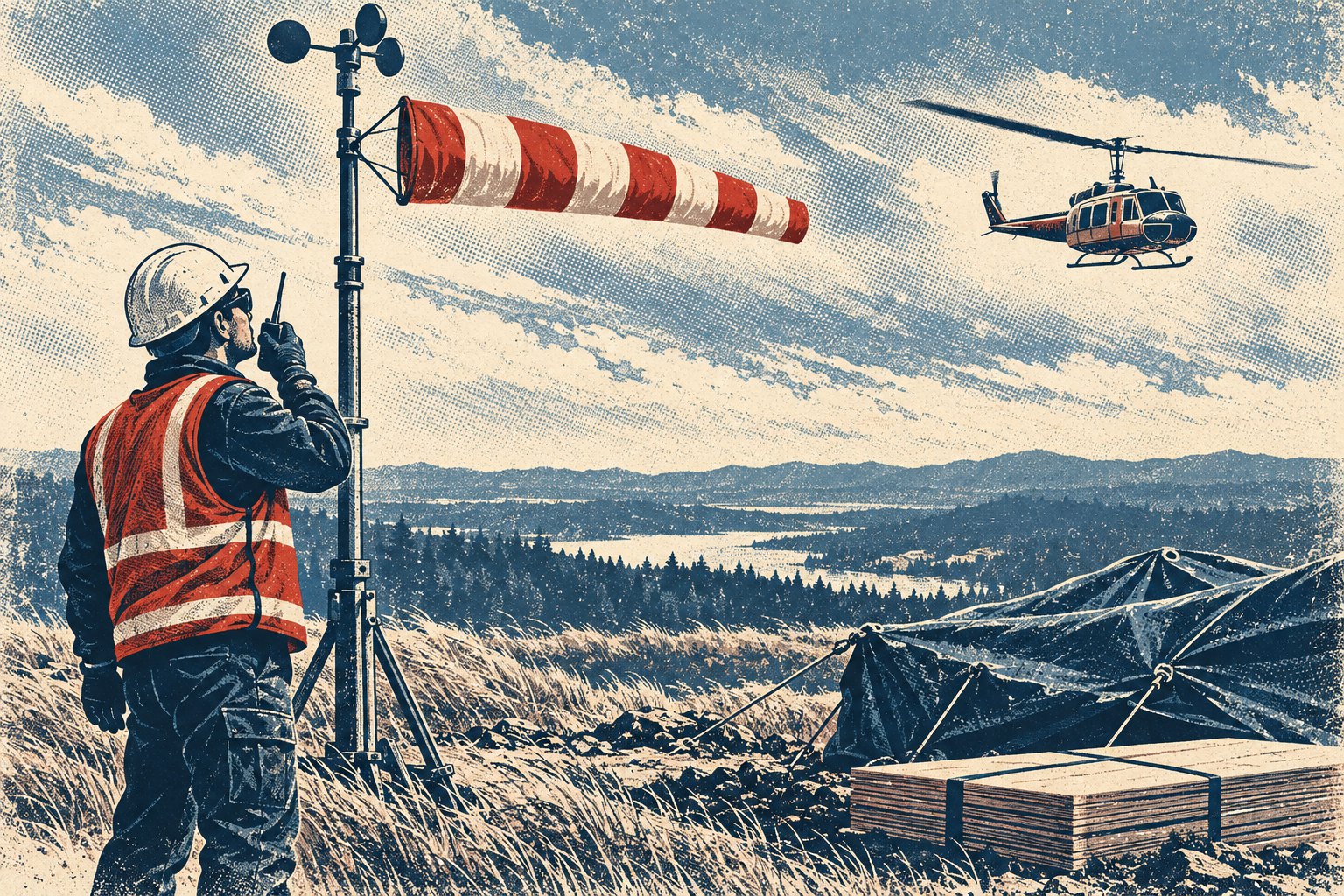
Wind is where the absence of a regulatory number matters most. A crane has one: Liebherr's mobile and crawler load charts generally apply up to a 3-second gust of 9 meters per second, about 20 miles per hour, measured at the maximum hoist height, and federal rules require the competent person to adapt the operation to the effect of wind on stability and capacity (Liebherr, Influence of wind on crane operation; 29 CFR 1926.1417(n)). Wind stops both methods. The comparison is set out in when a ground crane is the better choice. A helicopter has a flight manual limit for its own envelope, but it has no single figure for a lift, because the answer depends on the aircraft, the load and the ground under both.
Terrain and turbulence matter more than the headline wind speed. Interagency Aviation Lessons Learned memo IA LL 15-01, written after a contracted helicopter was lost during external-load work supporting wildland fire operations, shows how the pieces combine (IA LL 15-01, Helicopter Load Management). The surface winds were moderate, 10 to 20 knots, but they flowed up and over a hilltop, creating updrafts on the windward side and downdrafts and turbulence on the leeward side. The delivery point had been moved from the ridge top, at about 9,000 feet, to a spot below the ridge where the wind was likely to run downslope. The aircraft was at the hover on a long line, the load weighed 942 pounds against an allowable 852 pounds, and the memo concludes it is "highly conceivable" that the down-flowing air raised the power required and contributed to the onset of loss of tail rotor effectiveness. The aircraft rotated, lost altitude and struck the ground. Nobody was hurt. The memo names no operator or pilot, and it identifies weight errors as a contributing cause as well; wind was one link in the chain.
Its practical lesson for planning is that a lee-side set point in moderate wind is a different job than the same set point on the windward side. A set point that looks equivalent on a site plan can be a no-go on the day for exactly this reason, and a request to move the set point for convenience changes the weather the aircraft works in.
Turbulence is also judged by aircraft type. Writing in Aviation Week in 2021, Patrick Veillette notes that moderate or greater turbulence poses serious risks to two-bladed, semi-rigid rotor helicopters and that pilots should consider landing and waiting for conditions to improve (Veillette, Helicopters in Turbulence: Part 2). The same gusts also move the load. A suspended load picks up motion from the aircraft and from the air, and the load swing and spin control guide explains how load area, line length and airspeed shape that response. A large, light load such as ductwork or a panel assembly presents more area to the gusts than a dense one of the same weight.
Heat, altitude and the morning window
Of the six conditions, heat is the only one that a planner can calculate days ahead. Thin air cuts rotor thrust and engine power together, and the loss is easy to put a number on. The density altitude guide works the planning rules in full: about 120 feet of density altitude for every degree Celsius above standard temperature, and about 3 percent of payload for every 1,000 feet of density altitude. Both are screening figures, and the aircraft's hover charts govern the actual pick.
The table applies those rules to one illustrative aircraft rated at 10,000 pounds of external load at sea level on a standard day, working a site at 6,000 feet field elevation, where standard temperature is about 37 degrees Fahrenheit.
| Time of day | Air temperature | Above standard | Density altitude | Payload reduction | Remaining hook capability |
|---|---|---|---|---|---|
| Early morning | 50 F (10 C) | about 7 C | about 6,800 ft | about 20 percent | about 7,960 lb |
| Summer afternoon | 95 F (35 C) | about 32 C | about 9,800 ft | about 29 percent | about 7,000 lb |
Illustrative planning arithmetic, not a flight manual value. Applies the 120 feet per degree Celsius and 3 percent per 1,000 foot rules from the density altitude guide to a 10,000 pound sea level standard day baseline, with pressure altitude taken as field elevation. Rigging, fuel and longline weight come off the top of both figures, and the aircraft's hover chart governs the real number.
The gap, about 960 pounds, is nearly a tenth of the sea level figure. On a load list built around a heavy lift, it can be the difference between one pick and two, or between an aircraft class that works and one that does not. That arithmetic is why heat-limited jobs are scheduled for the first hours of the day, and why a late start from a morning fog hold can turn a feasible plan into an infeasible one without a single gust. A hold that pushes the lift into the afternoon changes the payload, not only the schedule.
14 CFR 91.9 Flight manual limits
Storms, rain and static
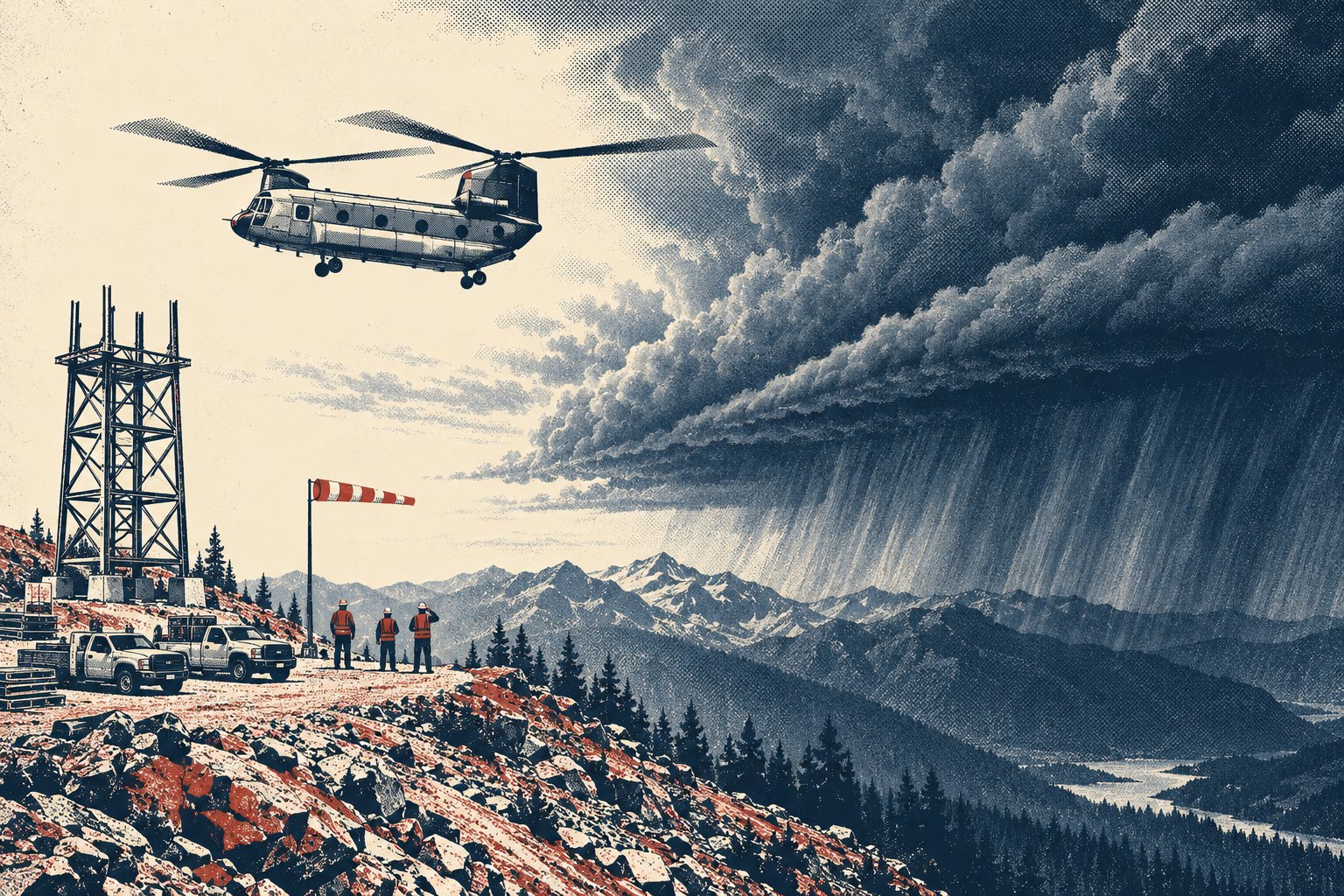
Thunderstorms are the one condition with an unambiguous answer. The FAA's Aeronautical Information Manual advises pilots to avoid severe thunderstorms, and storms giving an intense radar echo, by at least 20 miles (FAA Aeronautical Information Manual, chapter 7). The AIM is advisory material, not a regulation, but it describes the hazards that make a storm a hard stop for a hovering aircraft: strong downdrafts, wind shear and sudden gusts well outside the rain shaft. A cell approaching a lift site is ordinarily reason enough to stop before the first drop of rain, with the ground crew clearing the pick and set areas as the aircraft leaves.
Rain and snow are softer limits. Precipitation reduces visibility and handling, and flight manuals set the icing and temperature limits that apply to each aircraft. Static electricity is the weather-adjacent hazard that OSHA addresses directly: 1926.551(j) requires the charge on a suspended load to be dissipated with a grounding device before ground personnel touch it, or protective rubber gloves to be worn by everyone touching it. That requirement applies on every lift, so a crew that follows it has no extra step to add when the weather turns dry or stormy.
OSHA 1926.551 Ground crew rule
When the call is made
A weather decision is not a single event. It is a series of checkpoints, each with more information than the last, and the cost of a no-go falls the earlier it is made.
| Checkpoint | What is known | What it can still change |
|---|---|---|
| Days before | Forecast trend, site elevation and the density altitude arithmetic | The date, the aircraft class and the number of picks |
| Evening before | Short-range forecast, fog and storm risk, daybreak and temperature | Whether crews, trucks and road closures stay committed |
| First light | Observed visibility, ceiling and surface wind at the site | The start time and the order of the loads |
| Daily briefing | The plan for pilot and ground crew, set out as 1926.551(b) requires before each day's operations | Abort cues, who radios gusts and where the crew goes if the lift stops |
| First pick | Actual hover power, gusts at the set point and load behavior in the air | Whether the planned load weights stay as listed |
| During the lift | Changing wind, building heat and approaching cells | A mid-lift stop, with the abort plan already agreed |
Checkpoint sequence is general planning practice, not a regulatory list; 1926.551(b) is the only checkpoint above that the rule itself requires. How a helicopter lift is planned places the same checkpoints in the full planning sequence.
The pattern behind the table is that the pilot and the ground crew share a feed of facts, and the pilot alone decides. The crew radios wind and gust readings, the pilot reports what the aircraft feels, and a mid-lift stop is not a failure of the plan if the abort cues were set at the briefing. A project that treats a morning hold as a surprise has usually skipped the first three rows.
What a weather day costs
The pilot's authority is absolute, but the cost of using it lands somewhere, and the contract decides where. Standby, mobilization and the other lines on a flight bid are covered in helicopter lift mobilization costs explained; weather turns those lines into the main schedule risk.
A bid and plan that handle weather well answer a short list of questions before the day arrives:
- Who declares a weather hold, and on what basis (the pilot's call is final under 14 CFR 91.3, so the contract defines the consequences, not the decision).
- When standby begins and ends, and whether the clock runs while the crew and aircraft wait at the site.
- How a partial day is treated, such as a morning lost to fog and an afternoon too hot to fly the full plan.
- How many days of float the schedule carries, and which of the other trades, road closures and utility outages are tied to the single day.
- What happens to the ground-side rental equipment and crew during a hold, and what re-mobilization costs if the aircraft has to leave.
- Whether the plan carries a backup method, which often means a ground crane booked as an alternative; the helicopter versus crane cost comparison shows what that backup costs.
Weather risk differs by project type, and the reasons are structural. A job that needs only the first hour of morning air tolerates a late start less than a job with a loose window. A job at 6,000 feet in summer carries more heat risk than one at 500 feet. A job at a ridge site carries more gust risk than one in a sheltered valley. The first sign of a well-planned lift is that the plan states which of these conditions it expects to face and what it will do about each.
Weather is the only part of a lift that no one on the project controls, so the plan can only control what it does with the answer. The pilot decides whether the aircraft flies, the operator's flight manual sets the limits, and the owner of the schedule decides how much room the project leaves for a no. The external-load operations hub covers the operating side of the same work, and how to vet a helicopter lift operator covers the checks that sit behind the pilot's authority.