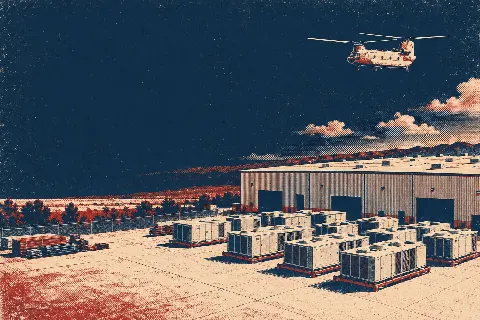
Mobilization on an aerial lift is the ferry flight, and it bills at the flight rate in both directions. Montana pays $9,785 per flight hour for a CH-47D. A 2,120 nautical mile positioning leg from the Oregon heavy-lift cluster to the New York area runs 17.7 hours at 120 knots, which is roughly $173,000 of billed ferry before the aircraft makes a single pick.
Every comparison between a helicopter and a ground crane eventually arrives at the same awkward line on the estimate. The flight hours are easy to price and easy to defend. Mobilization is neither. It is the largest single variable on most aerial lift quotes, it moves by a factor of ten depending on where the aircraft happens to be sitting that week, and it is the line contractors most often discover late.
The good news is that mobilization is not a black box. Federal and state wildfire contracts price the same components a commercial charter prices, they publish the clauses that govern each one, and several of them publish the dollar figures. Reading those documents gives a contractor a structure to check any quote against, and a vocabulary for asking what a number covers.
What mobilization actually buys
Mobilization is the cost of assembling an aviation operation at a place it does not normally live. On a crane job that means transport permits, escort vehicles, multi-truck convoys, a prepared pad, and days of assembly labor before the hook moves. On an aerial lift it means something different in kind. The aircraft transports itself, which is the entire structural advantage, but the aircraft is only one of the things that has to arrive.
A working external-load operation is an aircraft, a flight crew, an airframe and powerplant mechanic, a jet fuel servicing vehicle with a qualified driver, and a support vehicle carrying longlines, remote hooks, rigging, spares and ground equipment. The Forest Service treats that composition as a requirement rather than a preference: a fuel-servicing vehicle is mandatory for all fire support and non-fire project use, and the mechanic and the fuel vehicle driver are explicitly not authorized to ride in the aircraft during tactical flight. They drive.
That split is the whole story. One element of the operation moves at 120 knots in a straight line and the rest of it moves at highway speed on a road network, and the mobilization calendar is set by the slower half.
The ferry leg, priced
The governing commercial convention is stated plainly in the Region 8 call-when-needed helicopter contract: ferry time of the aircraft to and from the point of hire, measured from the contractor's base of operations or the aircraft's current location, whichever is closer, is paid at the applicable flight rate (USFS solicitation 12024B19Q9811, clause B-32(c)). Ferry hours are not discounted hours. They are flight hours with no production attached.
The "whichever is closer" qualifier matters more than the rate does. An aircraft already working two states away is a fundamentally cheaper mobilization than the same aircraft sitting at its home base, and that is why identical scopes quote differently in March and in September. It is also why the first question worth asking an operator is not what the ferry costs but where the airframe currently is.
The American heavy-lift fleet is geographically concentrated, which sets the floor on that distance for most of the country. Columbia Helicopters operates its Chinook fleet out of Aurora, Oregon. Erickson, with a fleet of 69 aircraft including 20 S-64s, is headquartered at Central Point in the same state (Erickson Inc.). A contractor in Florida or New England is not negotiating a local mobilization no matter how the quote is worded.
| Destination metro | Direct distance (nm) | Ferry time at 120 kt | Fuel burned at 405 gal/hr | Fuel at spot ($3.72/gal) | Fuel at FBO retail ($7.97/gal) |
|---|---|---|---|---|---|
| Denver, CO | 861 | 7.2 hr | 2,905 gal | $10,800 | $23,200 |
| Phoenix, AZ | 866 | 7.2 hr | 2,922 gal | $10,900 | $23,300 |
| Dallas, TX | 1,401 | 11.7 hr | 4,727 gal | $17,600 | $37,700 |
| Chicago, IL | 1,516 | 12.6 hr | 5,117 gal | $19,100 | $40,800 |
| Atlanta, GA | 1,888 | 15.7 hr | 6,372 gal | $23,700 | $50,800 |
| Newark, NJ | 2,120 | 17.7 hr | 7,155 gal | $26,600 | $57,000 |
| Boston, MA | 2,211 | 18.4 hr | 7,461 gal | $27,800 | $59,500 |
| Miami, FL | 2,345 | 19.5 hr | 7,914 gal | $29,500 | $63,100 |
Distances are great-circle from Aurora State Airport, Oregon to the principal airport of each metro, computed for this article. Real routing is longer. Cruise speed of 120 knots is the Columbia Model 234 figure carried in the Chinook profile. Fuel consumption of 405 gal/hr for the BV-234 and CH-47 is the Forest Service figure in the Helicopter Services Hourly Flight Rates, Fuel Consumption, and Weight Reduction Chart. Fuel prices are the EIA US Gulf Coast jet fuel spot average for August 2026 of $3.724 and the GlobalAir FBO survey national average of 10 September 2026 of $7.97. This column is fuel only. It is not the ferry bill, because the ferry bills at the flight rate, which carries crew, maintenance reserve, insurance and depreciation on top.
The size of the gap between those two fuel columns is itself a planning variable. Retail FBO pricing roughly doubles the same gallon, so where the aircraft refuels on a long positioning leg is a real number rather than a detail, and an operator with bulk fuel arrangements along a corridor is quoting a different job than one buying at the pump.
Range imposes the other constraint. The Model 234's published range is 550 nautical miles standard and 850 with two extended tanks, so a transcontinental positioning leg is not one flight. It is four legs with at least three en route fuel stops, each stop carrying landing fees, handling, and the risk that weather closes the next segment. Published ferry time is the arithmetic floor, not the schedule.
The convoy sets the calendar, not the aircraft
A Chinook-class machine covers 2,120 nautical miles in 17.7 flying hours. The fuel truck that has to meet it there covers the same 2,440 statute miles under federal driver hours-of-service limits: ten consecutive hours off duty before driving, a fourteen consecutive hour window once on duty, a hard eleven hour driving limit inside that window, and a thirty minute interruption before eight cumulative driving hours elapse (49 CFR 395.3). At eleven driving hours and a realistic 55 mph average, that is about 605 miles a day, so four days minimum in each direction before any road routing penalty.
49 CFR 395.3 Driver hours of service
Federal wildfire contracts price that drive directly, and the rate is keyed to how much aviation fuel the vehicle carries. The mileage schedule in clause B-38 runs $4.43 per mile where the carrying capacity is 1,500 gallons or more, $3.20 per mile from 750 to 1,499 gallons, $2.47 per mile from 350 to 749 gallons, and $1.73 per mile below 350. A 2,440 mile repositioning of a large tanker is therefore about $10,800 one way on that schedule, and roughly $21,600 for the round trip, for a vehicle that lifts nothing.
Tank capacity is not an arbitrary tier. It is a proxy for how many hours of flying one truckload supports, and the spread across the fleet is severe.
| Type | Fuel consumption (gal/hr) | Flight hours on one 1,500 gal tanker load | Tanker loads for a 12 hour ferry |
|---|---|---|---|
| Sikorsky CH-54B / S-64F | 522 | 2.9 | 4.2 |
| Sikorsky CH-54A / S-64E | 506 | 3.0 | 4.0 |
| Sikorsky CH-53D | 425 | 3.5 | 3.4 |
| Boeing BV-234 / CH-47 | 405 | 3.7 | 3.2 |
| Sikorsky H-3 / S-61, all series | 170 | 8.8 | 1.4 |
| Bell 214B | 160 | 9.4 | 1.3 |
| Sikorsky S-70 / UH-60 | 160 | 9.4 | 1.3 |
| Sikorsky S-58T (PT6T-3) | 115 | 13.0 | 0.9 |
| Kaman K-1200 K-MAX | 86 | 17.4 | 0.7 |
Fuel consumption figures are the Forest Service contract values in the awarded 2018-2021 flight rate chart. Hours per load and loads per ferry are computed for this article against a 1,500 gallon tanker, the top tier of the clause B-38 mileage schedule. The figures assume the tanker is dedicated to one aircraft and ignore reserve fuel, ground running and the fuel the truck itself burns.
An S-64F burns six times what a K-MAX burns per hour. On a short local job that difference is a rounding error against payload. On a 1,500 mile positioning leg it is the difference between one tanker shuttling comfortably and a fuel logistics problem that needs contracted en route supply. Matching the airframe to the load is the obvious analysis; matching the airframe to the distance is the one that gets skipped.

Availability and standby: paying for the aircraft to exist
Once the operation is on site, a second meter starts, and it runs whether or not anything is lifted. Montana's exclusive-use contract for a Type 1 twin turbine tanked helicopter, a Billings Flying Service CH-47D, sets a daily availability rate of $37,750 and a flight rate of $9,785 per hour for the term running 1 July 2025 to 30 June 2026 (Montana DNRC contract DNR25-1303, section 5.1). The contract labels the availability figure a dry rate, meaning fuel sits outside it.
The Region 8 contract explains what an availability rate is supposed to cover, and the list is a useful audit tool. Clause B-30(g) states that the awarded daily availability rate includes all fixed and variable costs, naming depreciation, salaries, overnight allowances, travel costs to and from lodging, overhead and permanent shop facilities, exclusive of costs directly attributed to actual flight. Anything on that list appearing again as a separate mobilization line is being billed twice.
The same clause sets the convention for partial days that most disputes turn on. Availability does not begin until the aircraft and flight crew have arrived and are available for standby. Arrival at or before local noon on the first day earns a full day of availability; arrival after noon earns half. Release at or before noon on the last day earns half a day, and release after noon earns a full day. No more than one day of availability can be earned in a calendar day.
Standby beyond nine hours per authorized crew member is a separate hourly line under clause B-31, and it is expressly not payable on a day when mobilization or demobilization is paid. Weather days are availability days. So are days lost to a permit that did not clear, which is the practical reason the permitting sequence belongs on the mobilization schedule rather than beside it. A congested-area operation additionally needs an FAA-approved plan for the complete operation and a written agreement with the local political subdivision to exclude unauthorized persons, neither of which is produced on the morning of the lift.
14 CFR 133.33 Congested area plan

Demobilization is a second mobilization
The return leg is the line contractors most reliably forget, and it is not a discount. The Region 8 clause pays demobilization costs back to the original point of hire. If the aircraft relocates elsewhere, demobilization is paid from the last assigned work location back to the original point of hire, or to the final destination if that destination is closer (clause B-35(i) and (j)). A round trip, not a one-way positioning, is the correct mental model for every figure in the distance table above.
Crew travel on those legs has its own convention. Clause B-35(a) pays a lump sum of $500 per authorized crew member on any mobilization or demobilization day where flight is performed, no daily availability is earned, and the crew has to remain overnight. The clause is candid that the payment is not intended to compensate the contractor on a one-to-one basis for incurred costs, which is a reasonable position against the FY2026 standard CONUS per diem of $178 per day, $110 lodging plus $68 meals and incidentals (GSA Per Diem Bulletin FTR 26-01).
Two further boundaries in clause B-35(e) are worth quoting to any operator. Fuel service vehicle mileage, airport landing fees, tie-down and airport use costs, and truck permits or taxes at points of entry are reimbursable against itemized receipts. Costs associated with preparing the aircraft for service are not paid at all. Configuring an airframe for external-load work, hanging the hook and longline, and fitting mirrors and cameras is overhead the operator carries.
| Line item | What it covers | How a federal contract bills it |
|---|---|---|
| Aircraft ferry | Positioning the airframe to the job and back | Applicable flight rate, from the operator's base or the aircraft's current location, whichever is closer, clause B-32(c) |
| Fuel servicing vehicle mileage | Driving the jet fuel tanker to and from the work location | $1.73 to $4.43 per mile by tank capacity, clause B-38 |
| Crew travel and overnight | Pilots, mechanic and fuel driver in travel status | $500 lump sum per authorized crew member on a mobilization or demobilization day with flight and no availability, clause B-35(a) |
| Landing fees, tie-downs, entry permits | En route airport charges and state truck permits | Reimbursed against itemized receipts, clause B-35(e) |
| Preparing the aircraft for service | Hook, longline, mirrors, mission configuration | Not paid, clause B-35(e) |
| Daily availability | Holding aircraft and crew on site, flown or not | Daily availability rate, covering depreciation, salaries, overnight allowances, lodging travel, overhead and shop facilities, clause B-30(g) |
| Extended standby | Crew duty beyond the first nine hours per day | Hourly, and not payable on a day mobilization or demobilization is paid, clause B-31 |
| Demobilization | The return leg, aircraft and convoy | Paid back to the original point of hire, or to the final destination if closer, clause B-35(i) and (j) |
Clause references are to USFS solicitation 12024B19Q9811, Region 8 Type III Call When Needed Helicopter Services. Commercial construction charters are not bound by these terms, but they price the same components, and the clause structure is a workable checklist for reading any quote. Construction contracting handles the same problem differently: DFARS 252.236-7004 makes mobilization and demobilization a single lump-sum line, paid as a stated percentage on completion of mobilization at the work site and the remainder on completion of demobilization.
What actually compresses the number
Four things move mobilization materially, and only two of them are inside a contractor's control.
- Where the aircraft already is. The single largest variable, and entirely outside the contractor's control. It is worth asking the question in writing, because "whichever is closer" is a real contractual term, and a quote written against a home-base ferry when the airframe is working three hundred miles away is leaving money on the table.
- Scope density. Mobilization is a fixed cost amortized across picks. A single set does not carry a transcontinental ferry. A sixty-pick program does. Consolidating a season's aerial work into one window is the most reliable lever a general contractor has, and it is the same arithmetic that governs remote-site freight economics.
- Airframe sizing. Over-sizing the aircraft is expensive twice, once in the flight rate and again in ferry fuel and tanker logistics. Sizing is a payload-and-margin exercise that has to account for density altitude at the work site, not a preference for the biggest machine available.
- Readiness on arrival. Every availability day burned on a permit that has not cleared, a load without a certified weight, or a receiving structure that has not been verified costs the full day rate. The lift planning sequence exists mostly to prevent that, and the allocation of duties determines who absorbs the day when it happens.
None of this makes the aerial option expensive on its own terms. The reason mobilization dominates the conversation is that it is the one cost a helicopter does not obviously beat a crane on, and the total lifted cost comparison only resolves once both mobilizations are on the table at full size, including the crane's road closures, escort vehicles, pad engineering and assembly labor.
The practical test is narrow. A quote that states ferry hours, the origin they are measured from, the fuel vehicle mileage, the availability rate, the standby convention, and the demobilization basis as separate lines can be checked. A quote that states one mobilization number cannot, and the difference between those two documents is a reasonable proxy for how the rest of the project will be run. Reading a quote at that resolution belongs alongside the rest of the operator vetting checklist, because the estimate and the operation are written by the same people.