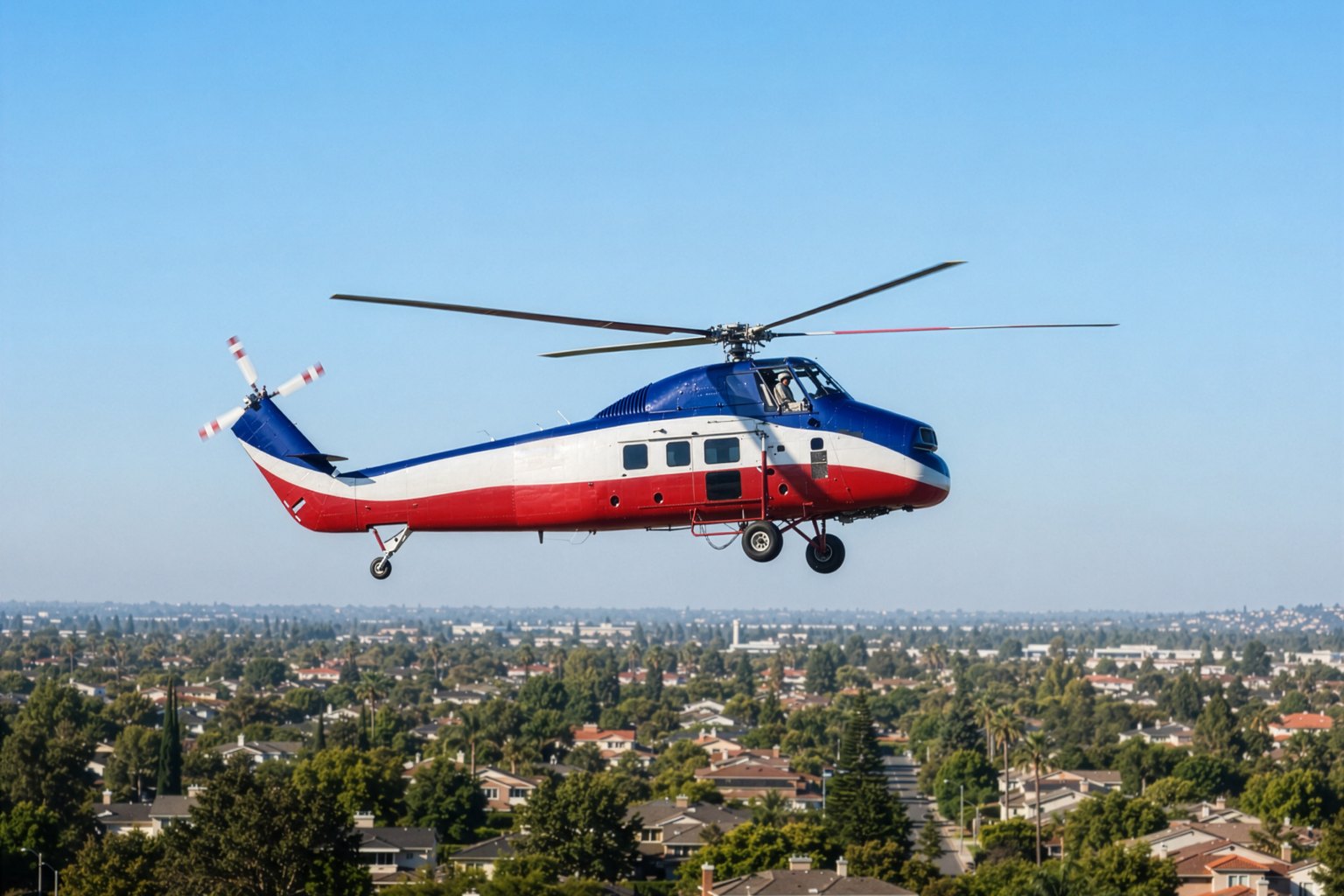
No single permit authorizes a helicopter lift in the United States. Approval arrives in layers: the FAA governs the flight, a state aeronautics office may license the landing site, and the local jurisdiction controls the ground beneath it. New York City requires its lift permit application at least 20 days ahead, and only after the Department of Buildings has already signed off.
Contractors planning a first aerial lift usually ask a reasonable question in the wrong shape: who issues the helicopter permit. There is no such document. What exists instead is a stack of separate authorizations held by different levels of government, issued by offices that do not coordinate with one another, on lead times that range from a phone call on the morning of the lift to a municipal filing that has to be in the building twenty days early. A project that treats the stack as one item discovers the missing layer late, usually within two weeks of a date that has already been promised to a crane-free schedule.
This analysis maps the layers in the order they bind: what the FAA actually approves for a specific lift and what it leaves alone, why federal land is its own jurisdiction, which states license the place a helicopter touches down, and how a city asserts control over an operation it has no power to regulate in the air. It assumes the aviation framework underneath all of it, the twenty-four-month external-load operator certificate and the load classes it authorizes, and concerns itself with what a project team has to file, when, and with whom.
Why there is no such thing as a helicopter lift permit
The split that confuses buyers is written into federal law. Congress placed the airspace under exclusive federal control: 49 U.S.C. 40103(a)(1) states that the United States Government has exclusive sovereignty of airspace of the United States, and the FAA Administrator alone prescribes the air traffic rules that govern how aircraft navigate and how people and property on the ground are protected from them. A city council cannot vote on whether a helicopter may fly over a block, set an altitude for it, or license the flight.
What a city can do is govern everything the aircraft is not. It controls the street the load stages on, the sidewalk the public is excluded from, the building the unit is being set on, the fire protection standing by, the police officers holding the perimeter, and the permission of the property owner. Those are ordinary local powers, and they apply to a helicopter lift exactly as they apply to any other construction operation. The result is a division of labor that looks arbitrary from a jobsite trailer and is perfectly consistent from a legal one: the federal government approves the flying, and the local jurisdiction approves the ground the flying happens over.
The planning consequence is the part worth carrying into a schedule. Federal aviation approvals for a routine lift are comparatively fast and comparatively predictable, because they are handled by people who do this work constantly and are measured in business days. The approvals that delay lifts are almost always ground approvals, issued by offices that may have never processed one before, and that is where the calendar risk actually sits.
The federal layer: what the FAA approves, and what it does not
Three distinct things get confused under the heading of FAA approval, and only one of them is filed for a specific project.
The first is the operator's certificate. A company conducting rotorcraft external-load operations holds a Part 133 certificate that names the aircraft and the load classes it is authorized to carry. That certificate is a standing credential, renewed on its own cycle, and it is not project-specific. Nobody applies for it before a lift. The buyer's job is to verify it exists and covers the aircraft and load class actually proposed, which is a prequalification task rather than a permitting one.
The second is the congested area plan, and it is the closest thing to a federal permit for an individual lift. Section 133.33(d) permits external-load work over a congested area only under a written plan coordinated with and approved in advance by the responsible Flight Standards office. The plan carries a specific payload: an arrangement with the local political subdivision to keep unauthorized people out of the operating area, air traffic coordination where it is needed, and a detailed chart of routes and altitudes chosen so that a jettisonable load could be released and the aircraft landed in an emergency without hazard below. Advisory guidance asks for the submission at least five business days before the operation, and a single plan can cover a job that takes many flights. Five business days is the floor rather than the plan, because assembling it requires the local exclusion agreement first, and what a congested area plan has to contain before an urban lift can be approved is a longer exercise than the review window suggests.
14 CFR 133.33 Congested area plan

Aircraft category decides whether that plan is even available. Restricted-category rotorcraft, the surplus military conversions that make up much of the American heavy fleet, are barred from carrying external loads over densely populated areas, and the parallel prohibition in the general operating rules reinforces it. There is no waiver for external-load work. A project that has budgeted a restricted-category aircraft for a lift over an occupied downtown has not found a permitting problem, it has found an aircraft-selection problem, and the fix is a standard-category airframe rather than a better application.
14 CFR 91.313 Restricted category limits
The third item is the one most often mistaken for a permit: air traffic coordination. Working inside Class B, C, or D airspace requires the pilot to establish communication and obtain the clearances that airspace demands, and a lift near an active approach corridor may warrant a notice to airmen so other traffic knows the operation is there. None of that is an application, none of it has a filing deadline measured in weeks, and none of it is the buyer's paperwork. It belongs to the operator and the controlling facility, and it happens on the operational timescale rather than the permitting one.
The landing area, and the notice a crane triggers that a helicopter does not
Two federal rules routinely get raised in planning meetings, and both usually resolve to no action. The first is the landing-area notice requirement. Establishing or altering a civil airport, which includes a heliport, requires notice to the FAA, but the rule carves out exactly the case a construction lift presents: the intermittent use of a site that is not an established airport, where operations are conducted only under visual flight rules, used no more than three days in any one week, with no more than ten operations per day, for a total duration of less than one year. A staging field used for a two-day tower job sits comfortably inside that exception. A staging area supporting a nine-month program at twenty cycles a day does not, and that is the case worth checking rather than assuming.
The second is the obstruction notice, and it runs the other direction. Construction or alteration more than 200 feet above ground level, or penetrating the sloped surfaces that extend outward from nearby runways and heliports, requires a notice filing with the FAA. A tower crane is a structure and routinely triggers it. A helicopter is an aircraft, not a construction, and does not. This is one of the few places where the aerial method subtracts a federal filing from a project instead of adding one, and it is a legitimate line in a bid comparison: the crane creates an airspace review near an airport, and the lift does not.
14 CFR 157.1 Landing-area notice 14 CFR 77.9 Obstruction notice
Federal land is a separate jurisdiction with its own permit
A second federal approval exists that has nothing to do with aviation, and projects on public land discover it late because it is administered by land managers rather than by the FAA. Inside the national park system, delivering or retrieving a person or object by parachute, helicopter, or other airborne means is prohibited outright, except in emergencies involving public safety or serious property loss, or pursuant to the terms and conditions of a permit. That language reaches a communications site resupply, a trail bridge set, and a utility component delivery just as squarely as it reaches recreational activity. The authority to allow it rests with the park superintendent, not with a Flight Standards office.
36 CFR 2.17 Park air delivery permit
National forest land runs on a parallel structure. Commercial use of National Forest System lands, and uses that affect the forest, are authorized through a special-use authorization issued by the administering unit, and the Forest Service special uses program is where a helicopter operation supporting construction, utility work, or timber access is processed. Designated wilderness is stricter still, because the statutory prohibitions on motorized equipment and aircraft landing apply to the ground rather than to the overflight, and an exception is an act of agency discretion rather than a form.
The scheduling point matters more than the citations. Land-management authorizations run on land-management timelines, which include environmental and cultural resource review and are measured in weeks to months rather than business days. A lift that touches federal ground at either end, at the pick site or at the set site, needs that authorization identified during the feasibility conversation, because it is the single item in the stack most capable of moving a project into a different season.
The state layer: landing-site licensing most projects never budget for
Between the federal government and the city sits a layer almost no construction team anticipates. Many states license the places aircraft take off from and land at, through a state aeronautics division inside the department of transportation, and those statutes were written broadly enough to reach a temporary landing zone in a farm field. Whether they actually do reach it depends entirely on the state, and the variation is genuine rather than a matter of enforcement appetite.
New Jersey licenses temporary aeronautical facilities directly. An application for a temporary license must include Form DA-5 and be received by the Bureau at least 10 working days before the requested start date. Beyond the form, the application requires a letter, statement, or certificate from the appropriate governing body, meaning a mayor, township or business administrator, or chief of police, or a municipal resolution, stating there is no objection to issuing the temporary license. It also requires an annotated sketch or current satellite photograph demonstrating the site can accept the proposed operation, certification that the areas are under the applicant's control or used with the landowner's permission, a description of the provisions made for the safety of persons in the immediate vicinity, and aircraft specifications and performance data showing the intended operations can be safely conducted. That municipal no-objection letter is the trap inside the trap: it is a local political document embedded in a state aviation filing, and it takes longer to obtain than the ten working days the state itself asks for.
California attaches its requirement to proximity rather than to the landing site's status. Under Public Utilities Code section 21662.5 and its implementing regulation, no helicopter may land or depart in any area within 1,000 feet, measured by air line, of the boundary of any public or private school maintaining kindergarten classes or any classes in grades 1 through 12, without approval of the department. The instrument is a Helicopter Landing Authorization issued by the Caltrans Division of Aeronautics or a designated public safety agency, and the application requires signed statements from every affected school indicating no objection and waiving the right to a public hearing, plus landowner approval where applicable. Permitted heliports, designated emergency medical service landing sites, and federally operated heliports are exempt. The division asks for a minimum of two weeks and strongly recommends 30 days. School districts do not process no-objection letters quickly in July, which is precisely when summer rooftop equipment work is scheduled.
Pennsylvania illustrates the opposite pattern, and it is the reason a blanket assumption fails in both directions. Section 471.3 of the state code prohibits establishing, maintaining, or operating an airport without authorization from its Bureau of Aviation, and then exempts, in the same sentence, infrequent operations by helicopters or aircraft with characteristics permitting operation from sites not specially prepared for them. A short construction lift working from an unprepared field is written out of the licensing requirement by the rule itself. For operations that do not qualify, a temporary license may be issued for temporary operations or special occasions, carrying a $25 inspection fee as published.
| State example | Instrument | What triggers it | Published lead time | The condition that actually costs time |
|---|---|---|---|---|
| New Jersey | Temporary aeronautical facility license (Form DA-5) | Operating a temporary landing site | Received at least 10 working days before the start date | A no-objection letter or resolution from the municipal governing body or chief of police |
| California | Helicopter Landing Authorization | Landing or departing within 1,000 feet of a K-12 school boundary | Two weeks minimum, 30 days recommended | Signed no-objection statements from every affected school, waiving public hearing rights |
| Pennsylvania | Temporary airport license, or no filing at all | Licensing does not reach infrequent helicopter operations from unprepared sites | Not applicable when the exemption applies | Determining whether the operation is infrequent enough to qualify |
Three states shown to illustrate the range, not as a national survey. Requirements, fees, and lead times are as published by the issuing agency and change without notice; the state aeronautics office is the authority for its own jurisdiction. States not listed may impose more, less, or nothing.
The disciplined move is to treat the state question as a binary that must be answered rather than a requirement that must be met. One call to the state aeronautics office, made during feasibility, establishes whether a two-week item with a political dependency is entering the schedule or whether nothing is. Both answers are useful. Only the unasked question is expensive.
The municipal layer: New York City as the worked example
New York City operates the most fully developed helicopter lift permitting regime in the country, and it is worth reading in detail for a reason beyond New York: it makes explicit the approvals that other cities impose informally through fire marshals, street-use offices, and building departments.
The Fire Department issues a Helicopter Lift Operations Permit. As published, it costs $315, is valid for 30 days, and the application must be submitted at least 20 days before the proposed operation. The permit is not the first approval in the sequence. Authorization from the Department of Buildings is a condition precedent to the Fire Department issuing it, so the building side has to be complete before the aviation side can even be filed. The operation is restricted to daylight hours under visual flight rules, and the Fire Department reserves the right to restrict the day of the week and the hours of the lift.

The coordination requirement is where the calendar really lives. At least two weeks before the scheduled lift date, the applicant must convene a pre-lift meeting at the lift site with the building owner and a specific roster of agencies: the Fire Department, the local Police Department precinct, the Police Department Aviation Unit, the Department of Transportation, and the Department of Buildings where required. The Fire Department then conducts its own pre-operational site inspection to determine adequate clearances and to decide how much apparatus and how many firefighters are needed for fire protection, and use of the site is subject to its approval. The applicant carries the cost of that fire protection at an hourly rate per apparatus, billed after the fact. The Police Department must be given the ability to monitor communications between the pilot and the ground, alongside the same capability for the Fire Department, and both departments may suspend or cancel the operation if conditions endanger public safety.
The documentation list reveals how the layers interlock. The applicant submits a site map, the aircraft's FAA airworthiness certificate, the pilot's FAA certificate, the operator's Rotorcraft External-Load Operator Certificate, an affidavit from the property owner authorizing the operation, all relevant permits and approvals from other city agencies, and proof of liability and casualty insurance in an amount set by the Fire Commissioner but not less than $5 million. That last figure is a floor for the permit, not a judgment about the exposure, and it sits well below what a heavy pick over an occupied block would warrant on its own merits; sizing aviation liability limits against what actually lies beneath the flight path is a separate analysis from clearing a municipal threshold.
| Days before lift | Step | Who holds it |
|---|---|---|
| Before anything else | Department of Buildings authorization, a condition precedent to the fire permit | Applicant, typically the contractor or building owner |
| At least 20 days | Helicopter Lift Operations Permit application filed with the Public Transportation Safety Unit, with fee and full documentation | Applicant |
| At least 14 days | Pre-lift meeting at the site with the owner, Fire Department, local police precinct, Police Aviation Unit, Department of Transportation, and Buildings if required | Applicant convenes |
| Before the permit issues | Fire Department pre-operational site inspection setting clearances, apparatus, and staffing | Fire Department |
| Lift day | Daylight VFR only, monitored air-to-ground communications, fire protection on scene, suspension authority retained by Fire and Police | Fire Department and Police Department |
| After | Hourly fire protection cost billed per apparatus | Applicant pays |
Sequence and figures as published by the New York City Fire Department for the Helicopter Lift Operations Permit. Other approvals, including street closures and police details, run in parallel through their own agencies. Verify current terms with the issuing agency before relying on any date or fee.
Most American cities have no permit with helicopter in its name, and that absence is routinely misread as absence of requirement. The same approvals still arrive, distributed across a street-occupancy or right-of-way permit from public works, a fire department review of the standby and exclusion arrangement, a building department sign-off on the structural and rooftop work, a police detail for the perimeter, and in some jurisdictions a noise or special-event authorization. The single item that appears in every version, named or not, is the local agreement to exclude unauthorized people from the operating area, because the federal congested area plan cannot be approved without it. The city's cooperation is not merely a courtesy layered on top of the FAA approval. It is an input the FAA approval structurally depends on.
Building the permit calendar backward from the lift date
The stack only becomes manageable when it is sequenced, because several of the items are dependencies rather than parallel tasks. The building approval gates the fire permit in New York. The local exclusion agreement gates the congested area plan everywhere. The municipal no-objection letter gates the state license in New Jersey. Filing in the wrong order produces a schedule that looks compliant and is not.
| Layer | Instrument | Issued by | Who files it | Typical lead time |
|---|---|---|---|---|
| Federal, aviation | Part 133 external-load operator certificate | FAA | Nobody, the operator already holds it | Verified at prequalification, not filed |
| Federal, aviation | Congested area plan under 133.33(d) | Responsible Flight Standards office | The operator, using the site information the project supplies | Five business days minimum for review, weeks to assemble |
| Federal, aviation | Air traffic coordination and notices to airmen | Controlling ATC facility | The operator | Operational, days to hours |
| Federal, aviation | Landing-area notice, when the intermittent-use exception does not apply | FAA | The party establishing the landing area | Check applicability during feasibility |
| Federal, land | Park permit or Forest Service special-use authorization | Park superintendent or forest unit | The project sponsor | Weeks to months |
| State | Temporary landing site license or proximity authorization | State aeronautics division | Usually the operator or landowner | Ten working days to 30 days where required |
| Local | Named helicopter lift permit where one exists | Fire department or equivalent | The contractor or building owner | 20 days in New York City |
| Local | Building or structural authorization for the work itself | Building department | The contractor | Precedes the lift permit |
| Local | Street closure, right-of-way occupancy, and police detail | Transportation or public works, and police | The contractor | Days to weeks, varies widely |
| Local | Written agreement to exclude unauthorized persons from the operating area | The local political subdivision | Negotiated jointly, supports the federal plan | Start first, it gates the congested area plan |
A planning framework, not a legal determination for any specific project. Which rows apply depends on the site, the airspace, the land ownership, the state, and the municipality. Lead times shown are the published minimums where an agency publishes one.
Worked backward from a committed lift date, the order of operations is consistent even when the specific offices are not:
- Establish jurisdiction before anything else. Determine the land ownership at both ends, the airspace class, whether the route crosses a congested area, and which state and municipality govern the site. Every subsequent item is derived from these four answers, and all four are available from a site survey.
- Call the state aeronautics office. It is one call, it resolves a layer most teams never check, and the answer is either a two-week item with a political dependency or nothing at all.
- Open the local conversation immediately. The exclusion agreement, the fire department's expectations, and the street closure all originate here, and the federal congested area plan cannot be assembled until the local piece exists. This is the long pole, not the FAA.
- Sequence the local filings in dependency order. Building authorization first where it gates the lift permit, then the lift permit itself, then the street and police work that has to match the approved date.
- Hand the operator a complete site package. Routes, altitudes, fall zones, staging, and the signed exclusion agreement are what the congested area plan is built from, and the operator cannot file a plan the project has not resourced.
- Hold a weather contingency inside every permit window. A permit valid for a fixed period and a lift that scrubs for wind are a scheduling collision waiting to happen, and a 30-day permit validity is a real constraint on how far a weather delay can push a date.
That last item is the one most often learned the expensive way. Permits expire, pre-lift meetings are scheduled against a specific date, fire apparatus is assigned to a specific morning, and a scrubbed lift can force a partial or complete refiling. Building the window with slack inside it, rather than aiming the permit at a single day, is the same discipline that governs the pre-lift sequence that turns a site survey into an executable plan, applied to the paperwork instead of the flying.
The organizing insight is worth restating plainly, because it makes the whole stack predictable. The FAA owns the air and approves the flight. Land managers own the ground where the ground is federal. States own the places aircraft touch down, where they have chosen to. Cities own the street, the building, the perimeter, and the public. A project that maps its site against those four questions during feasibility, rather than during mobilization, finds every filing it owes with time to make it. A project that asks who issues the helicopter permit finds out in week three that the answer was never one office.