Aerial construction field study
Helicopter Modular Building Placement
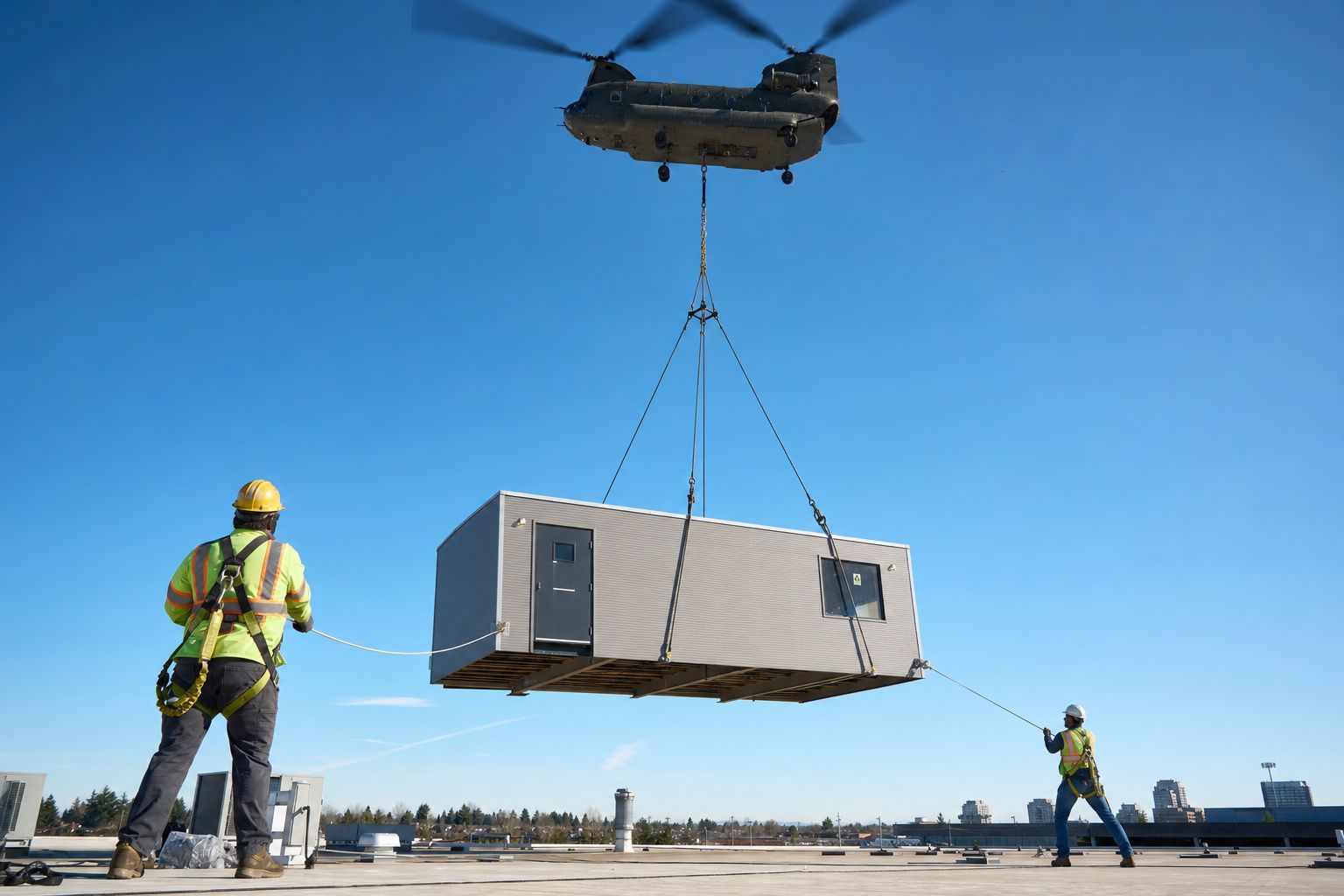
Helicopter modular building placement sets complete modular units, penthouses and equipment shelters where a crane setup would need a street closure, a crane pad or outrigger engineering. Vertical reports 28,000 pounds on the hook for Columbia's Model 234 UT/LR Chinook, and the allowable load for any set depends on the specific aircraft and the conditions on lift day. Part 133 operators plan each set around a certified module weight and a stamped rigging plan before the aircraft mobilizes. This analysis is written for modular builders, general contractors, and telecom and data infrastructure project managers studying how these sets work.
The set is the schedule
The Zero-Footprint Set: How Helicopter Modular Building Placement Works
Modular construction moves much of the labor into the factory, which concentrates the schedule risk at the set. That is where the module meets the crane's site requirements: lane-use permits, police details, ground-bearing analysis for outrigger loads and, on tower crane projects, assembly and teardown before the first pick.
A helicopter set replaces those items with a different group of site costs. The module stages in a laydown yard clear of the structure, flies on a longline to the set point and lands on its anchors. There is no crane pad to engineer, but the helicopter still needs a protected pickup area, a protected flight route and ground protection at the set point, and any closure needed to protect them belongs in its plan. On repetitive work such as equipment shelter campaigns, cycle time depends on the route and the work at both ends, so use the operator's estimate for the actual module schedule.
Put both sets of costs in the bid comparison. When a logistics appendix shows the set inside one flight window, check what it assumes about street closures, ground protection, ferry charges and weather standby, then put the crane's mobilization and closure costs beside those figures. A lift plan an estimator can carry into a master bid states those assumptions, and a contractor prequalifying an operator can reasonably ask for one. For the full crane-versus-rotorcraft economics, start at the aerial construction hub.
The governing rule
Certified Weight or It Does Not Fly
Weight discipline governs modular aerial placement. A helicopter's allowable load depends on the aircraft and the conditions, so an unexpected weight leaves little room to adjust at the set. Every module that flies does so against a certified weight: a scale ticket from the fabricator or an engineered weight takeoff stamped by the party that built it. Estimates, nameplate guesses and "about twenty thousand" do not go on the hook.
Lift planners then compare the certified module weight, plus rigging, with the aircraft's available payload for the conditions expected at the site. That comparison can change during the day. Density altitude expresses air density as an altitude; it rises with heat and humidity, and higher density altitude reduces helicopter performance, as the FAA Helicopter Flying Handbook, chapter 7, explains. Capacity depends on the specific aircraft and the lift-day conditions, so a module that fits the plan on a cool morning may not fit in afternoon heat. Heavy sets are often scheduled into the coolest air of the day for that reason, and the operator checks the load against the actual conditions before it flies.
The ways a module gains weight deserve their own checklist: MEP systems added after the factory weigh, skid and lifting steel, stored materials sealed inside the unit, and moisture absorbed by wood-framed modules left exposed to weather. The operator's lift planners check the certified weight against the as-rigged configuration before the aircraft launches. If the numbers do not close, the module is reweighed. That conversation is harder on lift day, with the aircraft already on site.
The first vetting question
Aircraft Certification Category Decides Who Can Fly Over a City
Not every heavy lifter can legally fly every site, so a modular lift proposal needs to show that the named aircraft fits the operation. Certification affects where an aircraft can work. For Part 133 external-load operations, §133.45(d) prohibits rotorcraft type certificated in the restricted category under §21.25 from operating over densely populated areas, in congested airways or near busy airports with passenger transport operations. Section 91.313(f) does not remove that restriction.
The practical consequence follows the individual aircraft rather than the model name. Because the prohibition concerns densely populated areas, congested airways and busy airports, a rural data-site pad and a downtown rooftop can have different answers for the same aircraft. An eligible aircraft still needs the operation-specific plan and FAA approval that §133.33(d) requires for a congested area, and an approved plan does not remove a certification restriction. When a proposal covers an urban set, check the specific aircraft's certification and operating limitations, and ask for them if the proposal does not show them.

| Aircraft | Max hook load (standard day, sea level) | Precision placement note | FAA category | Congested-area set eligible |
|---|---|---|---|---|
| Columbia BV-234UT / Model 234LR Chinook | 28,000 lb (Vertical: Model 234 UT/LR, on the hook) | Not published here | Not published here | Not published here |
| Boeing CH-47D Chinook | Not published here | Tandem-rotor stability; cycle rate not published here | Not published here | Not published here |
| Erickson S-64F Air Crane | 25,000 lb (Erickson: maximum external cargo) | Aft-facing pilot station for precision sets | Not published here | Not published here |
| Sikorsky S-61N Mk II | 10,000 lb (Helimax: S-61N external capacity at standard day, sea level) | Cycle rate not published here | Not published here | Not published here |
Certification category and congested-area eligibility are not published here. Both belong to the individual aircraft's certification record and the operation's FAA approval rather than to the model name. The capacity figures come from different sources with different bases, so they cannot be read as lift-day allowances, and the column's standard-day, sea-level basis applies only where the source states it. Cycle rate belongs to the operator's estimate against the actual module schedule. Where a cell reads not published here, this page has no source for that figure; take it from the aircraft's flight manual or the operator.
Aircraft selection checks the module weight, rigging, site conditions, elevation and set tolerance against a specific aircraft; a fleet preference does not settle it. The certification framework is covered on the Part 133 external load operations pillar page.
The paperwork that flies first
The Congested Area Plan: Filed Before Anything Flies
Modular sets over congested areas need an operation-specific plan and FAA approval under 14 CFR 133.33(d). The flight operator develops the plan and coordinates it with the responsible FAA Flight Standards office. It sets flight routes and altitudes that allow the load to be released, and the aircraft landed, in an emergency without hazard to people or property on the surface. It includes an agreement with local officials to exclude unauthorized people from the area beneath the operation, along with any arrangements with affected property owners. The emergency jettison plan identifies where a load can go if the aircraft must release it.
Establish review timing with the responsible office and carry approval as a milestone from notice to proceed, because the set cannot fly without it. The operator handles the plan and its FAA coordination; the contractor and property owner deliver the site control the plan depends on, including the access restrictions on lift day. Noise is a local question. Check the ordinances that apply to the property and municipality, including any that reference a measurement standard such as ANSI S12.9, and assign responsibility for permits and tenant notices.
Below the hook
Rigging a Module to Fly Level
A modular unit suspended clear of the surface and releasable during flight fits the Class B definition in 14 CFR §1.1. Unlike a compact HVAC unit, a module is long, wide and often top-light, so keeping it level on the hook is an engineering task rather than a field improvisation.
The rigging design starts with the module's actual center of gravity, calculated from the as-built drawings and checked against the certified weight. A multi-point bridle connects to engineered pick points specified by the module's structural engineer, never to whatever steel is convenient. Spreader bars control sling angles so compression loads do not rack the module frame or crack interior finishes. The rigging design should name the standard that applies to each component, with the inspection criteria that follow from it, and confirm that the named standard covers that part: ASME B30.20 addresses below-the-hook lifting devices and ASME B30.26 addresses rigging hardware. Tag lines control rotation as the module arrives at the set point.
The pilot in command has final authority over the operation of the aircraft under 14 CFR §91.3 and can decline any lift. A contractor's set schedule cannot override that authority. Pick-point design review belongs well before lift day, and settling the rigging plan with the module fabricator lets the lifting steel go into the unit before it ships. The same rigging principles apply to helicopter steel and infrastructure placement.

Hurricane on a schedule
Rotor Wash, Ground Crew, and the Set Window
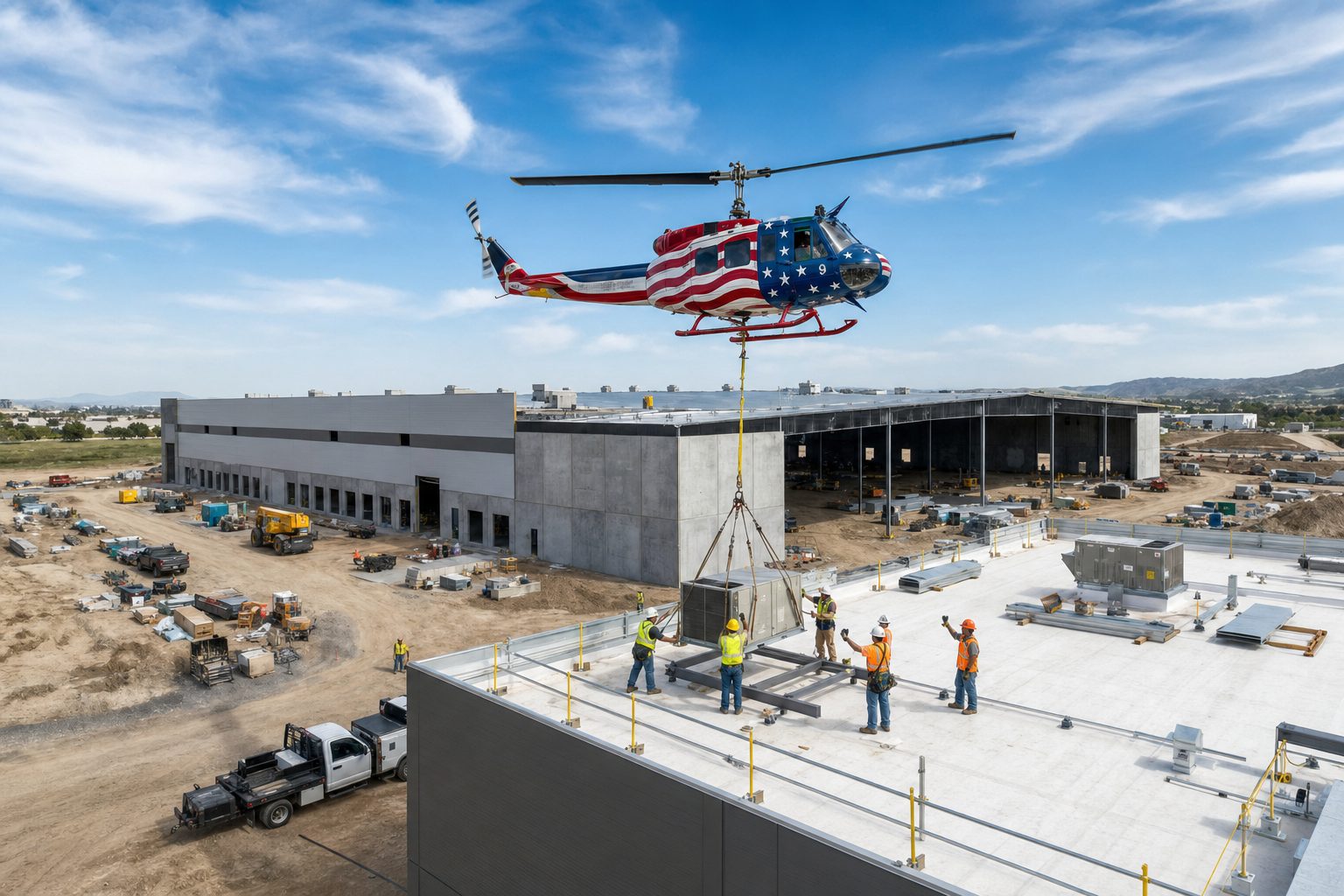
Downwash beneath a heavy helicopter at the set point is strong enough to move loose material, and the site must be secured for it: sheet goods banded or removed, dumpster lids latched, scaffold planks pinned, dust controlled and adjacent trades cleared from the wash zone. The lift plan should include a site-securing checklist, and the site is checked against it on the morning of the set.
OSHA 1926.551, the helicopter crane standard, requires daily briefings for helicopter construction work and addresses loose objects and static electricity. Receiving crews wear eye protection and secured hard hats, ground the static charge with a grounding device before touching hardware, handle loads by tag line rather than by hand, and stay out from under the load path. The flight crew briefs the receiving crew against the written lift plan before the first pick, covering hand signals, radio procedures and the abort procedure.
Wind and weather limits come from the aircraft flight manual and the applicable Rotorcraft-Load Combination Flight Manual, evaluated for the aircraft and the load. Gusts can decide a precision module set even when the steady wind is within limits, and the pilot in command makes the final go or no-go call at the set point. A postponed set costs schedule time and may carry standby charges, so check the proposal's weather and rescheduling terms before lift day.
The honest comparison
When a Ground Crane Wins
Compare the ground crane first. It is usually the better choice when the module sets at or near grade with clear street access and no closure costs, or when the project needs weeks of steady, repetitive lifting over which a crane's daily rate spreads well. It also wins when a single pick exceeds what any aircraft eligible for the site can carry; for scale, Vertical reports 28,000 pounds on the hook for Columbia's Model 234 UT/LR Chinook. The helicopter becomes worth comparing where access, closure costs or schedule make the crane setup expensive, as on occupied rooftops, infill sites and remote pads. Even there, put the helicopter's pickup area, route protection and ferry charges beside the crane's setup before choosing.
Who does what
Division of Responsibility on a Modular Set
| The Part 133 operator executes | The project team provides |
|---|---|
| Part 133 compliance and aircraft certification vetting | Certified as-built module weight (scale ticket or stamped takeoff) |
| Congested Area Plan filing and FSDO coordination | Engineered pick points on the module structure |
| Rigging engineering to ASME B30.20 / B30.26 | Receiving crew for anchor-down at the set point |
| Lift plan, load calculations, environmental buffers | Site control and rotor-wash securing per the operator's checklist |
| Pilot in command authority over every lift | Anchorage and connection design at the landing position |
Settling who does what before lift day keeps the set predictable. Programs that pair modules with rooftop mechanical equipment can run those picks in the same flight window when the approved plan covers both loads, which spreads the aircraft's mobilization across more of the work.
Keep reading
One Branch of the Aerial Construction Vertical
This page is one branch of the aerial construction vertical. The aerial construction hub compares crane and rotorcraft costs across lift types, and the Part 133 external load operations pillar explains the regulations cited on this page in plain language. New analyses in this series are announced through the mailing list.
Frequently asked questions
FAQ: Helicopter Modular Building Placement
From the technical library