Utility and infrastructure field study
Mining Helicopter Services: Drill Moves, Camp Logistics, and Remote Site Freight
Mining helicopter services move drill rigs, camp modules, fuel and mill components to sites without road access. Published maximum external loads for the aircraft on this page run from 6,000 pounds for the K-MAX to 28,000 pounds for Columbia's Model 234 UT/LR, and a high, hot pad takes some of that away. The work falls under FAA Part 133, and the operator checks each load against the aircraft's performance at the site's altitude and temperature before flying it. This page is written for exploration managers and mine project teams planning that work.
The problem set
Every Condition That Punishes a Lift, on One Site
Mine sites combine the conditions that make lifting hard: elevation, heat, distance from pavement and loads that do not break down into small pieces. A ground crane needs a road to reach the work. The road needs engineering, blasting, culverts, environmental review and a reclamation bond. A helicopter needs a staging pad, verified load weights and a load chart for the conditions it will fly in. This page explains how operators run that third option, when it saves a program money and when it does not.
Mining operation support is one part of the broader utility and infrastructure work covered on this site. The lifts described below are Class B external loads, carried free of the surface and releasable in flight; the Part 133 external load operations reference covers the regulatory detail.
The physics
High, Hot, and Heavy: Why Mine Sites Are the Hardest Environment for Mining Helicopter Services
Published payload figures are usually stated for sea level on a standard day. A mine pad is often neither. Density altitude, the air density at the site expressed as an altitude, rises with three conditions, and each reduces the load an aircraft can carry:
- Elevation. Air density falls as the site climbs, and rotor lift and engine output fall with it.
- Heat. Air warmer than standard for the elevation raises density altitude, so the aircraft performs as if the pad were higher than the survey shows.
- Humidity. Moist air is less dense than dry air and reduces performance further.
No single percentage converts those conditions into a payload loss for every aircraft. The effect depends on the specific aircraft and the lift-day conditions, and the FAA Helicopter Flying Handbook, chapter 7 explains how the operator works it out. The bid should state the site, season and time of day behind its payload figures. On lift day, the Rotorcraft-Load Combination Flight Manual for the specific aircraft governs; the estimate's figures are planning numbers until they are checked against it.
How much payload does a mine site actually take away?
Run the inputs for the actual pad before writing a lift schedule. Take a Sikorsky S-61N, for which Helimax publishes 10,000 pounds of external capacity at standard day and sea level, flying to a drill pad at 9,000 feet:
| Planning input | Value |
|---|---|
| Site elevation | 9,000 ft |
| Afternoon temperature | 75°F (standard temperature at 9,000 ft is roughly 27°F) |
| Temperature above standard | About 48°F, which raises density altitude above the pad's elevation |
| Effective density altitude | Computed from pressure altitude and temperature for the day; higher than the 9,000 ft pad |
| Rule-of-thumb power penalty | Not published here; the aircraft's performance charts give the effect for that aircraft |
| Planning consequence | The 10,000 lb figure is a sea-level, standard-day maximum; the operator's charts for the specific aircraft set the allowable load for that pad, that afternoon, subject to the RLCFM |
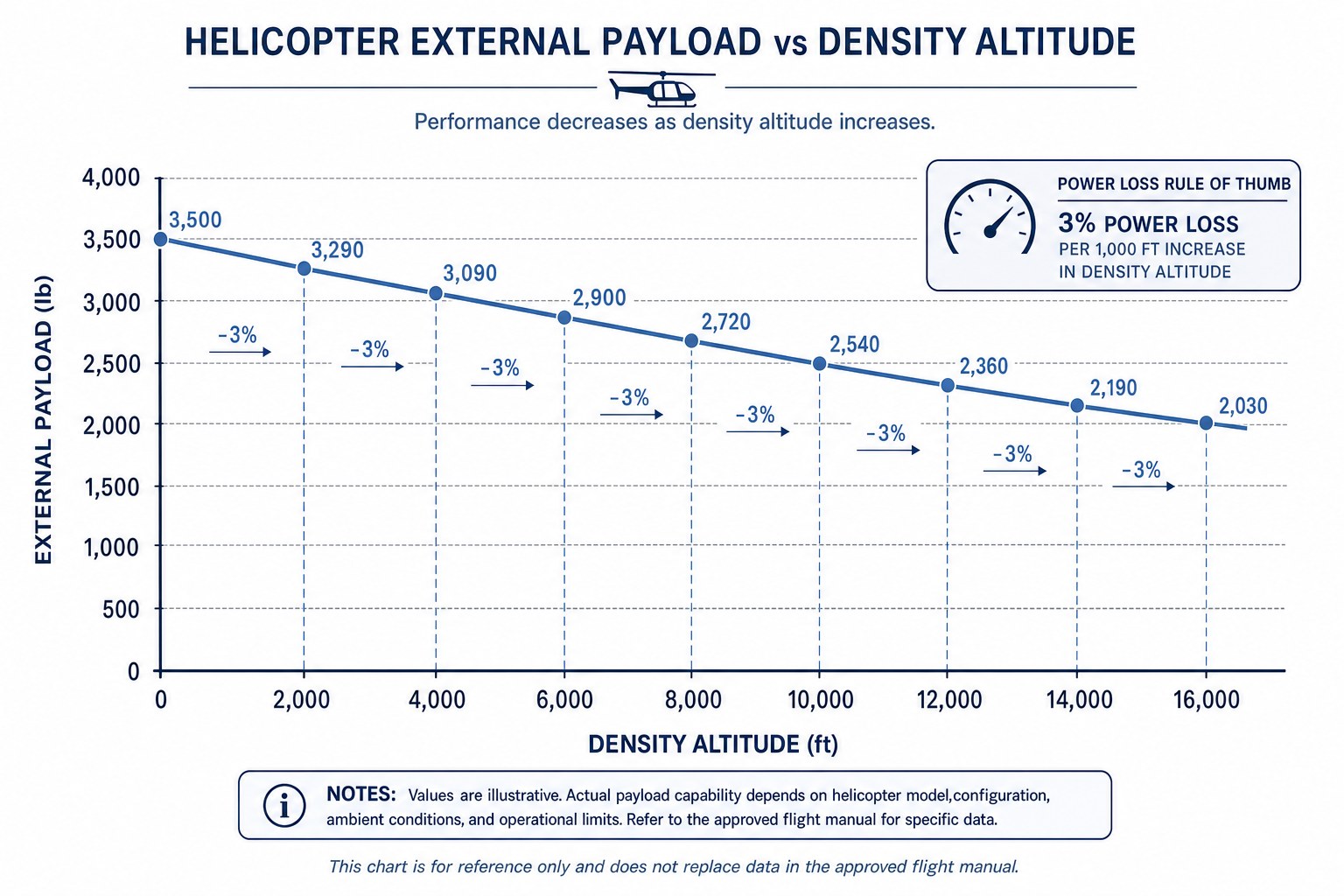
Two planning consequences follow. First, temperature changes through the day, and cooler morning air lowers density altitude at the same pad, so lift plans often put the heaviest modules into the first cycles of the day. The operator's charts show how much that gains for the assigned aircraft. Second, aircraft selection depends on performance at the site's density altitude as well as on the published maximum. An aircraft with a smaller published figure can be the better fit for a high pad than a heavier one, and the operator's performance data for the actual conditions settles which. McDermott Aviation lists a 3,636 kg (about 8,000 lb) maximum hook load for the Bell 214B; the profile linked below covers the type.
The cycle-rate business
Heli-Portable Drill Rig Moves and Exploration Drilling Support
Exploration drilling runs on the time between holes. A drill sitting disassembled is a crew on standby and a program losing calendar days. Heli-portable rigs are built for this: the manufacturer designs the rig to break down into modules that can be slung, and the aircraft moves it from hole to hole without a road being built between them. Each drill pad and the staging area still need clearing and preparation.
Operators fly drill moves as repetitive-cycle Class B operations:
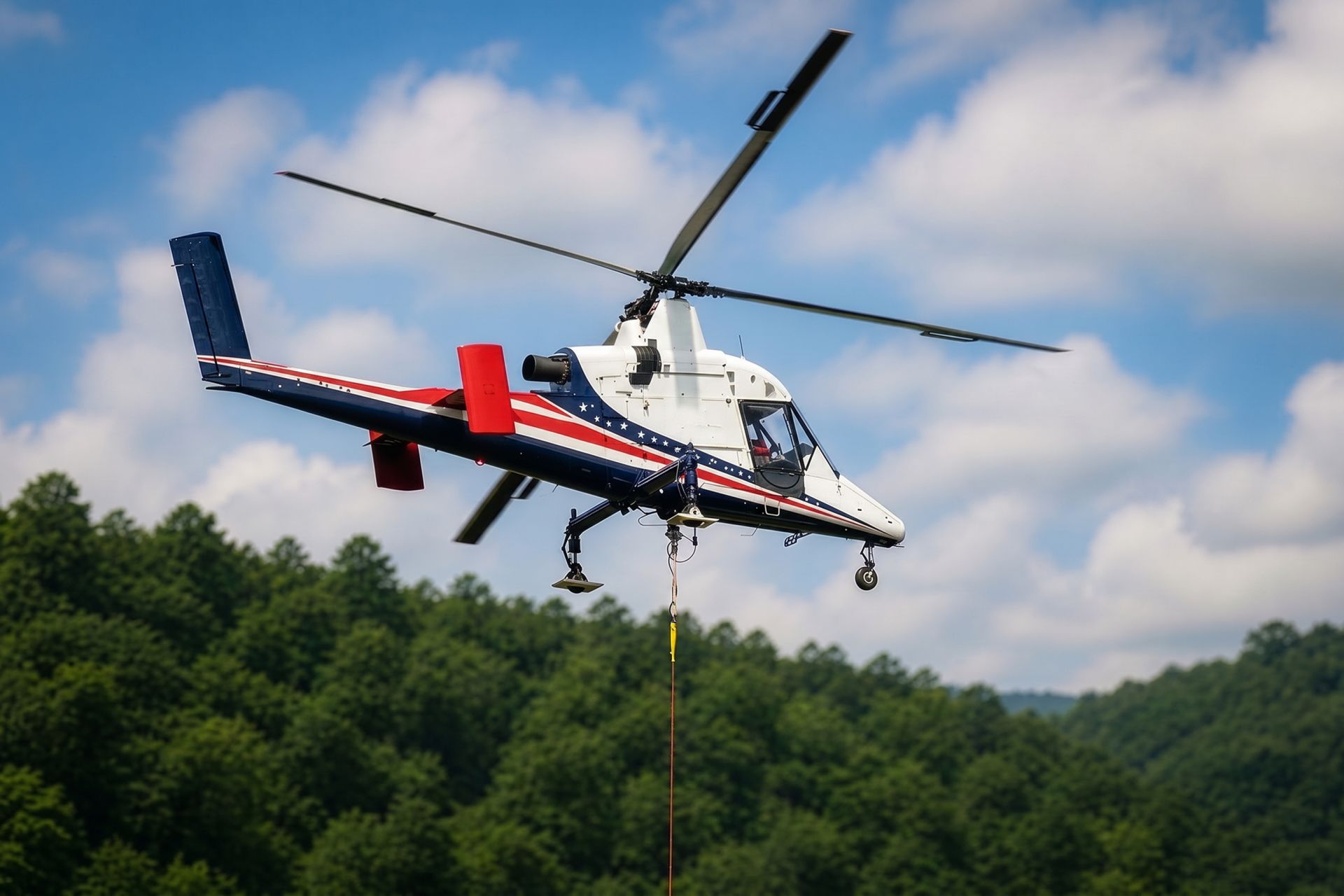
- The K-MAX K-1200 is a common drill-move aircraft. Kaman publishes a 6,000 pound lifting capacity for it. How long a move takes depends on the number of picks, the distance between pads and the work at each end, so the duration comes from the operator's plan for the actual pick list.
- Module weights are verified before they fly. The drill manufacturer's breakdown weights, plus rigging, are checked against the load chart at the pad's forecast density altitude. The pilot in command has final authority over the operation of the aircraft under 14 CFR §91.3 and can refuse any pick, which keeps a load with an uncertain weight off the hook.
- Ground crew duties are planned in advance. Hookup crews, tag lines, static discharge before anyone touches the load, and PPE follow OSHA 1926.551. The operator either briefs the mine's drillers for hookup duty or supplies its own riggers.
Exploration support also covers pad materials, casing, drill rod, water and mud systems, fuel cells and core retrieval. Core and ore samples can ride back on the cycles that deliver supplies, so return legs carry cargo instead of flying empty where the schedule allows. That backhaul is one of the ways to bring down the cost per ton flown.
The freight bench
Remote Mine Site Freight for Producing Mines
Producing operations use rotorcraft for loads where road transport is too costly or the road geometry will not take them: conveyor sections, mill and crusher components, camp and shop modules, generator sets, tank sections and bulk fuel. Aircraft assignment follows the verified load weight and the site's density altitude:
| Aircraft | Max external load | Certification category | Picks/hr | Mining role |
|---|---|---|---|---|
| Columbia BV-234 Chinook | 28,000 lb (Vertical: Columbia's Model 234 UT/LR) | Not published here | Not published here | Mill, crusher, and conveyor components; large camp modules |
| Boeing CH-47D Chinook | Not published here | Not published here | Not published here | Heavy freight; capacity comes from the civil operator's figures |
| Sikorsky S-61N Mk II | 10,000 lb (Helimax: external capacity at standard day, sea level) | Not published here | Not published here | Mid-weight freight, fuel cycling, camp resupply |
| Sikorsky S-70M Black Hawk | Not published here | Not published here | Not published here | Mid-weight freight; hover performance at the site elevation comes from the operator's data |
| Bell 214B Big Lifter | About 8,000 lb (McDermott Aviation: 3,636 kg maximum hook load) | Not published here | Not published here | Mid-weight freight and mountain work; performance at the site comes from the operator's charts |
| Kaman K-MAX K-1200 | 6,000 lb (Kaman: published lifting capacity) | Not published here | Not published here | Drill moves and repetitive shuttle work |
Capacity figures are published maximums from the linked sources, not lift-day allowances; the site's density altitude and the specific aircraft set the working number, and the lift plan should state it before a schedule depends on it. Certification category is not published here because it belongs to the individual aircraft. Cycle rate is not published here because it comes from the operator's plan for the actual pick list and route.
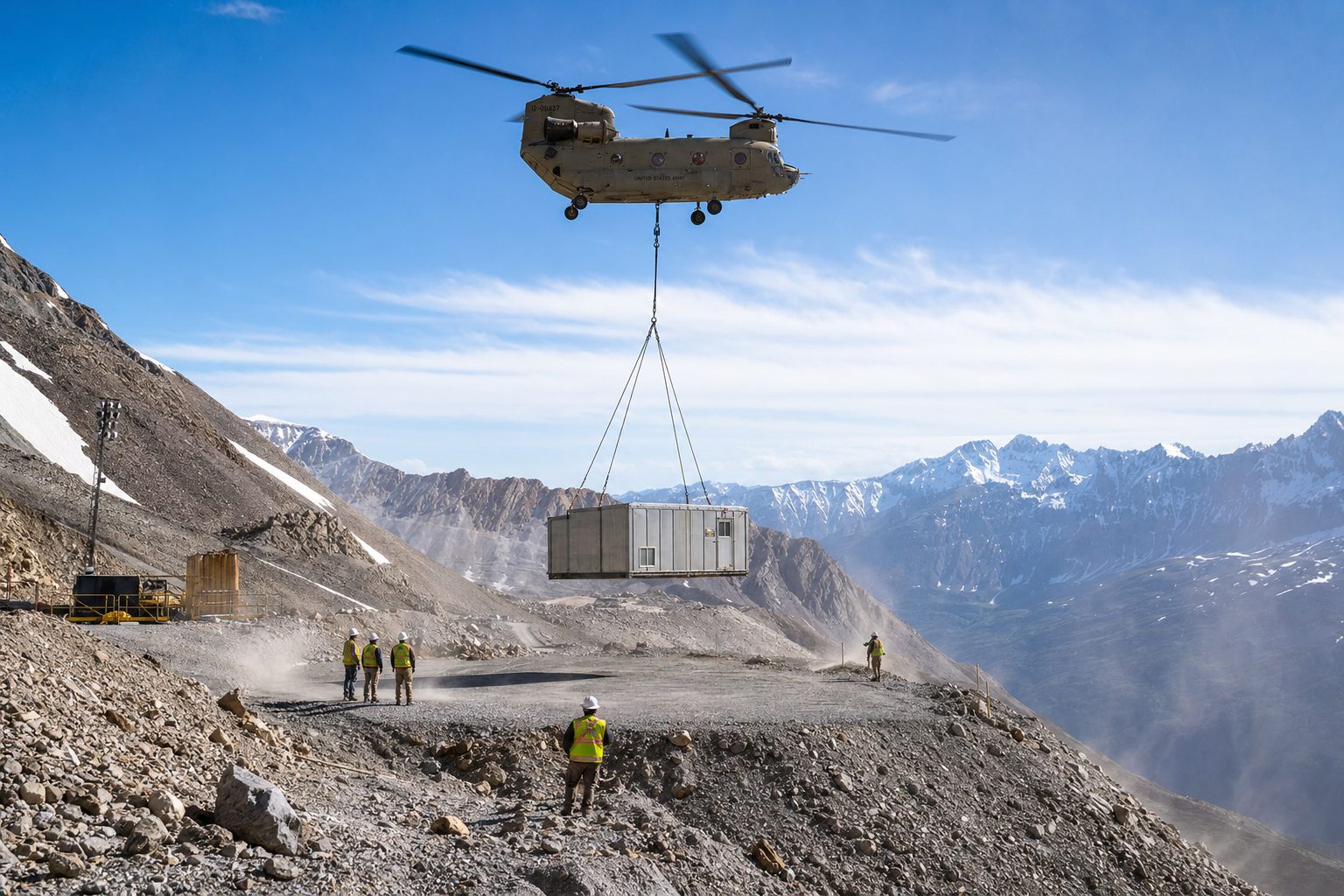
Certification still matters on a remote site. §133.45(d) prohibits external-load operations with rotorcraft type certificated in the restricted category under §21.25 over densely populated areas, in congested airways or near busy airports with passenger transport operations. Many remote claim blocks are far from all three, which can widen the choice of aircraft compared with urban work. Check the whole route from staging as well as the pad, since the flight path may pass a town or an airport, and check the specific aircraft's certification and operating limitations rather than assuming them from the model name.
For camp mobilization, fuel cycling and general roadless logistics beyond the mine gate, the remote site freight page covers the same planning at larger scale. For foundation pours at tower sites, substations or plant footings without truck access, see concrete bucketing.
The honest model
What Does Aerial Support Cost Compared to Building a Road?
The comparison needs a cost model on both sides.
Cost per ton flown is the figure that makes aerial logistics comparable with road construction:
| Model input | What it covers |
|---|---|
| Flight hour rate | Aircraft, crew, and direct operating cost per hour on the job |
| Ferry time | Repositioning the aircraft from its base to the staging area, disclosed in the lift plan before mobilization |
| Fuel and fuel positioning | Jet fuel burned plus getting fuel to the staging point |
| Standby | Weather days and hold days at a disclosed daily rate |
| Cycle math | Picks per hour × payload per pick at the site's density altitude = tons per flight hour |
Divide the total program flight cost by the tons delivered, and the result is a cost per ton flown that a mine planner can set against the road: survey and engineering, cut and fill, blasting, culverts and stream crossings, environmental review and permitting, seasonal maintenance, and the reclamation obligation that outlasts the road. An exploration campaign measured in months may not run long enough to recover the road's cost, and the comparison shows whether it does. The helicopter side carries site costs too: the staging pad, drill pad preparation, fuel positioning and any ground protection.
When the road wins, the analysis should say so. A producing mine hauling continuous heavy tonnage for a decade should usually build the road, because a haul truck moves bulk tonnage more cheaply than an aircraft over a long production life. Ground transport is also the better choice where an existing road needs only modest upgrades, or where a load exceeds the heaviest published hook figures, such as the 28,000 pounds Vertical reports for Columbia's Model 234 UT/LR. The aim is the method that fits the program, and the same comparison runs through every operation in the utility and infrastructure section.
Distance discipline
How far can the site be from staging before ferry time dominates?
Distance decides much of the cost of remote work. Every mile between the staging area and the pad is flown twice per cycle, so the tons delivered per flight hour fall as the leg lengthens. Mine programs can build these countermeasures into the plan from the start:
- Stage close. A staging pad at the nearest road-accessible clearing usually gives a shorter cycle than the nearest airport would. A shorter leg raises the tons delivered per flight hour.
- Position fuel forward. Fuel cells at staging keep the aircraft cycling instead of flying to a fuel stop.
- Fill every cycle both ways. Outbound freight, inbound core samples and backhaul.
- Batch the program. One mobilization serving a drill move, camp resupply and a component lift spreads ferry and positioning costs across the combined tonnage, instead of paying them three times.
When the leg grows long enough that ferry and cycle time exceed time on the hook, re-plan the staging location before committing the schedule. A plan built around a distant staging point carries that cost into every cycle of the program, so the staging geometry deserves a review before anything else is fixed.
Role clarity
MSHA, OSHA, and Part 133: Who Owns What in Helicopter Mining Support
Aviation on a mine site involves three sets of rules, and the lift plan should say who is responsible under each:
- FAA 14 CFR Part 133 governs the flight operation: the operator certificate, the Rotorcraft-Load Combination Flight Manual and Class B load requirements. The pilot in command has final authority over the operation of the aircraft under §91.3. The flight operator is responsible for this part.
- MSHA (30 CFR) governs the mine property. Operators coordinate with the mine's safety department on site-specific hazard training for aviation ground personnel under 30 CFR Parts 46 and 48 as applicable, traffic control around the lift zone, and ground control and blasting schedules. The lift plan should schedule flights around the shot schedule so no aircraft is cycling during a blast window.
- OSHA 1926.551 is the helicopter crane standard for construction ground crews: PPE, tag line use and static discharge before any crew member touches a suspended load. Where the work falls under MSHA jurisdiction instead, the mine's safety department identifies which requirements apply. The rigging design should name the standard covering each component, along with the inspection criteria that follow from it.

The lift plan should set out who delivers what. The mine supplies verified load weights and engineered pick points. The operator supplies the aircraft, the load check, the rigging plan, the flight crew and its Part 133 documentation for the project record. When a coordinator arranges the work, the certificate check follows the named flight operator, so the review stays with the company flying the load. Check the insurance certificates and endorsements (aviation liability, on-hook cargo coverage, and any waiver of subrogation or additional insured provisions) against the project's actual requirements, and collect them early enough that vendor qualification does not hold up the drill schedule.
The reading path
Where This Analysis Goes Next
Mining operation support shares its planning with other roadless industrial work. The Part 133 external load operations reference covers the regulations beneath every lift on this page, remote site freight covers the larger logistics picture, and utility and infrastructure covers the rest of the section. New analyses in this series are announced through the mailing list.
Frequently asked questions
What Mine Planners Ask First
From the technical library