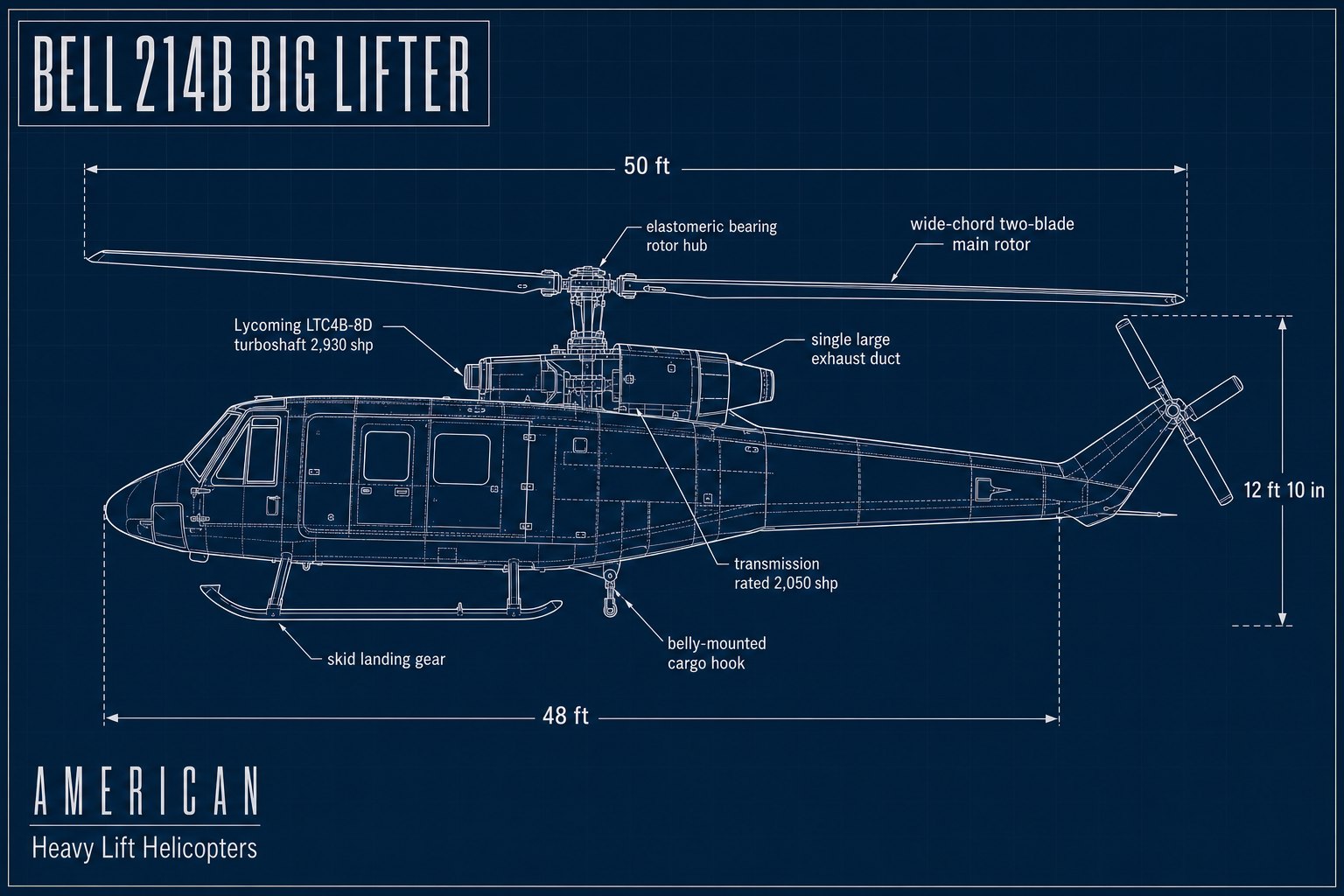
The Bell 214B Big Lifter is the most powerful single-engine helicopter Bell ever certified for civil work: a Huey-class airframe behind a 2,930 shaft horsepower Lycoming turboshaft, rated for an external load gross weight of 16,000 pounds and roughly 7,000 to 8,000 pounds on the hook at sea level. Certified in 1976 as the civil counterpart to Iran's military 214A Isfahan, it was built in a run of 70 aircraft, and those 70 frames still fly fire, logging, construction, and remote freight work on four continents. Erickson Inc. has owned the type certificate since 2021, which is why a fifty-year-old design remains supported, legal, and booked.
Every aircraft family has one variant that answers the question nobody quite asked out loud: what happens when you bolt the biggest engine that fits onto a proven airframe and certify it for honest work? For the Huey line, that variant is the 214B. It is not a stretched Huey and not a twin. It is a single-engine machine with nearly double the shaft horsepower of the Bell 205 it descends from, certificated in the standard category, which means it can legally work over congested areas where the surplus-military restricted-category fleet cannot. Understanding the 214B is understanding where the civil heavy lift market came from, and why a handful of operators still plan entire seasons around it.
This profile covers the full arc: the 1970 Huey Plus prototype, the Iranian order that built the production line, the civil conversion that became the BigLifter, the production run and its early end, the type certificate's passage to Erickson, and the missions the aircraft executes today. Specifications are published manufacturer, operator, and type certificate values, and capacity figures are sea level standard day numbers with the usual density altitude caveat: available payload falls roughly 3 percent per 1,000 feet of density altitude on lift day.
From Huey Plus to Isfahan: the development story
Bell announced the Model 214 in 1970 under the name Huey Plus. The first prototype was exactly what the name promised: a Bell 205 airframe re-engined with a Lycoming T53-L-702 turboshaft producing 1,900 shaft horsepower, a meaningful step up from the 205's 1,400. The prototype flew in 1970, and the concept's logic was obvious to anyone who operated Hueys in heat or at elevation. The airframe was trusted everywhere; it simply ran out of power when the air got thin.
The variant that secured the design's future was the 214A, evaluated in Iran during field exercises with the Imperial Iranian Armed Forces. The trials succeeded, and Iran ordered 287 aircraft under the designation Isfahan, with plans for Bell to build them at Dallas-Fort Worth and for Iran to subsequently produce a further 50 214As and 350 of the twin-engine 214ST domestically. History rewrote that plan. Bell delivered 296 Bell 214As and 39 Bell 214Cs, the latter fitted with a rescue hoist and search and rescue equipment for the Imperial Iranian Air Force, before the 1979 revolution ended Iranian production ambitions entirely. Dozens of those 214As remain in Iranian Army Aviation service decades later, the largest single fleet of the type anywhere.
Bell's response to losing its launch customer was to reorient the design toward the civil market, and that pivot produced the aircraft this profile is about. The civil variant took the military 214A's drivetrain and paired it with commercial avionics and a civil certification basis. In 1976 the Bell 214B BigLifter received its FAA type certificate.
What the BigLifter actually is
The 214B's heart is a single Lycoming LTC4B-8D turboshaft rated at 2,930 shaft horsepower, also referenced in Bell documentation as the T5508D. That figure matters more than any other on the page: it is roughly twice the power of the Bell 205 and well beyond anything else ever hung on a single-engine Huey airframe. The transmission, shared with the 214A, is rated at 2,050 shaft horsepower for takeoff and 1,850 maximum continuous, which means the drivetrain, not the engine, defines the working ceiling of the machine. The rotor head runs on elastomeric bearings rather than metal hinges, cutting the parts count and the maintenance hours per flight hour. An automatic flight control system with stability augmentation came standard, unusual equipment on a 1970s utility helicopter.
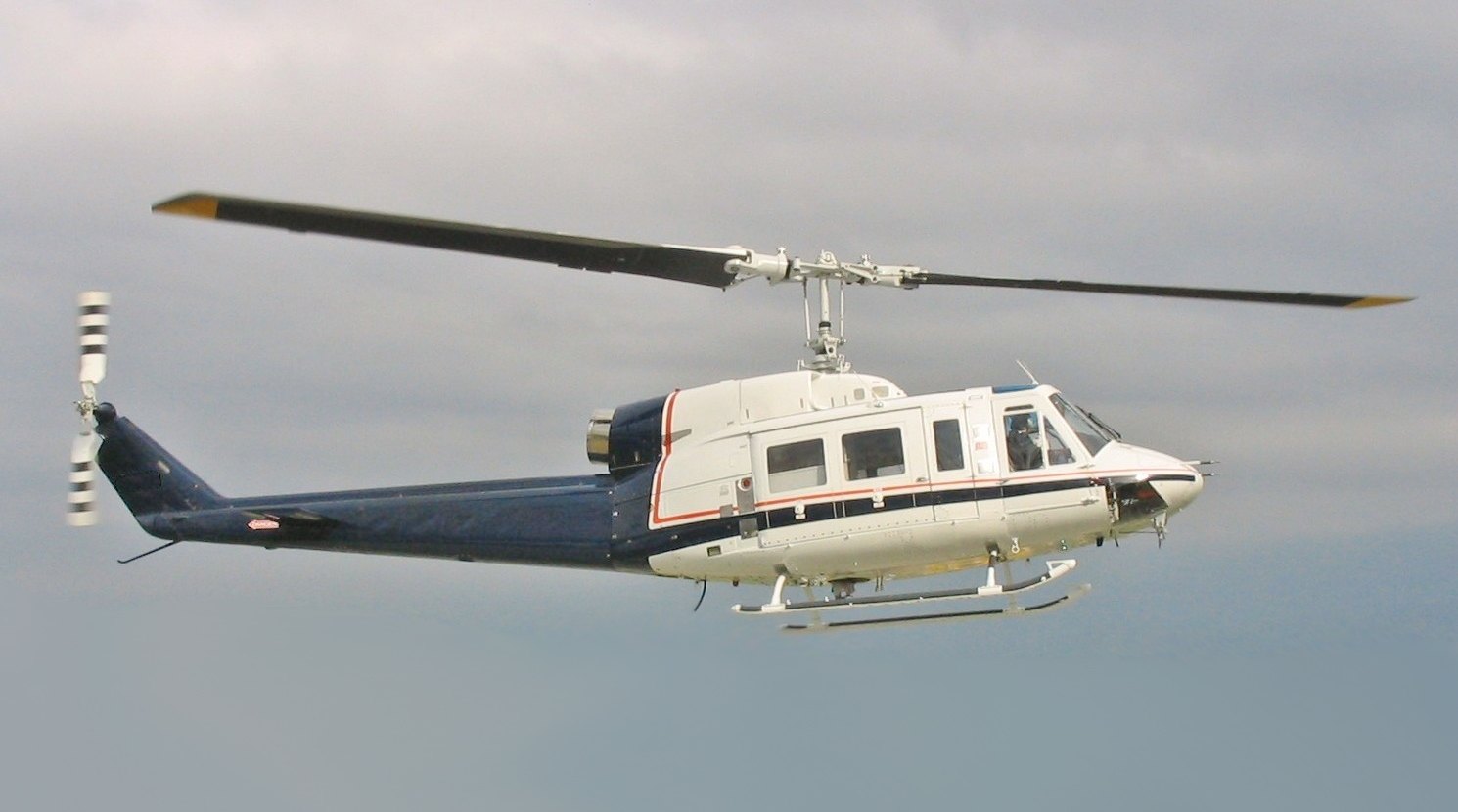
Two identification points separate the 214B from its 205 and 212 cousins at a glance: the single large exhaust duct behind the engine cowling, and wide-chord main rotor blades that carry no stabilizer bar. A third distinction is paperwork. The Bell 214B-1 is the same aircraft limited to a 12,500 pound maximum gross weight with an internal load under different certification standards; the type certificate data sheet itself notes that the 214B and 214B-1 are identical apart from the dataplate and the flight manual. External load capability is unaffected.
Specifications: Bell 214B BigLifter
The figures below are the published standard values. Three qualifiers belong with them. First, capacity figures are sea level standard day numbers; density altitude taxes them roughly 3 percent per 1,000 feet. Second, the external load gross weight of 16,000 pounds is the figure that generates the hook capacity operators actually plan with, roughly 7,000 to 8,000 pounds depending on configuration and conditions, with a precision placement figure of 6,614 pounds published by working operators. Third, range and ceiling figures vary between sources because they depend on load and temperature; the table states the most commonly published planning values.
| Item | Bell 214B BigLifter |
|---|---|
| Engine | 1 x Lycoming LTC4B-8D (T5508D) turboshaft, 2,930 shp |
| Transmission rating | 2,050 shp takeoff; 1,850 shp maximum continuous |
| Max takeoff weight (external load) | 16,000 lbs |
| Max takeoff weight (internal load) | 15,000 lbs (12,500 lbs on the 214B-1) |
| External load, hook | Roughly 7,000 to 8,000 lbs sea level standard day |
| Precision placement | 6,614 lbs (operator published) |
| Main rotor diameter | 50 ft |
| Fuselage length | 48 ft |
| Height | 12 ft 10 in |
| Crew | 2 (pilot in command plus crew as mission requires) |
| Cruise speed | 115 to 140 knots depending on source and load |
| Airworthiness category | Standard (congested area work legal with a CAP) |
| Production | 70 aircraft, 1976 to 1981 |
Figures are manufacturer, operator, and type certificate published values at sea level standard day. Lift-day capacity is always set by density altitude.
Seventy aircraft and the type certificate's second life
Bell built 70 BigLifters between 1976 and 1981, when production ended in favor of the twin-engine Bell 214ST Super Transporter, a larger and much-modified development that shared the model number but little of the original airframe's simplicity. Seventy aircraft is a small run by any measure, and it is the reason the 214B is talked about the way a limited production engine is talked about: everyone in the industry knows the type, and almost nobody has more than a few airframes to sell.
The type certificate's modern history is what keeps those 70 frames economically alive. In 2015 Bell entered a license agreement with Erickson Inc. for aftermarket support of the 214 platform, and in 2021 Erickson acquired the type certificates for the 214ST and the 214 B/B1 outright. The practical meaning for an evaluator is simple: parts, engineering support, and continued airworthiness documentation exist and are actively maintained by the same company that operates the S-64 Air Crane. A fifty-year-old design with a living type certificate holder is a very different ownership proposition than an orphaned airframe.
Where the 214B works today
Roughly 40 BigLifters remain in commercial service, concentrated in Australia, Canada, and the United States, with a handful elsewhere. The work clusters into four mission families, and each one maps directly onto the design's two strengths: single-engine power margin, and standard category certification.
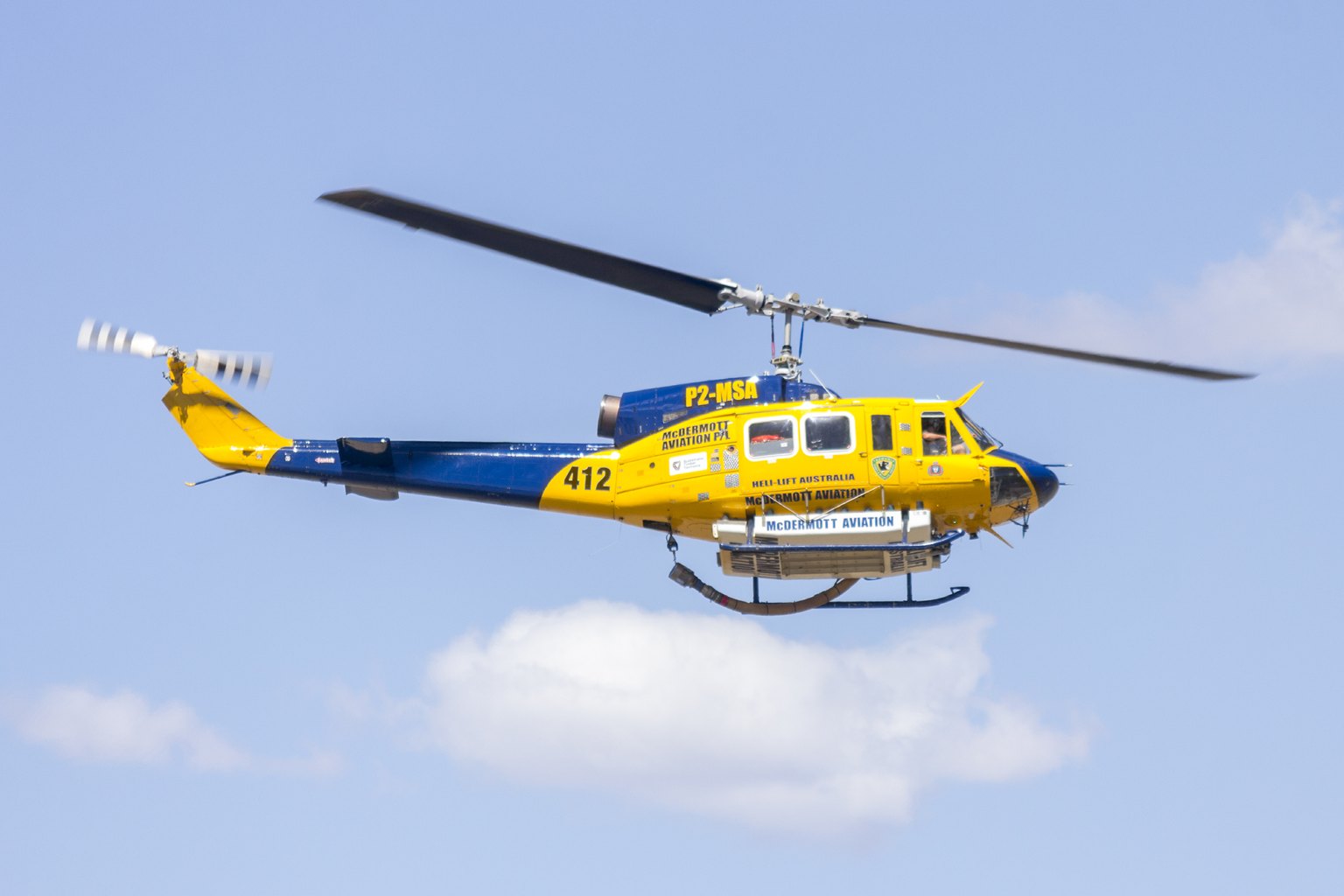
- Aerial firefighting. The 214B carries purpose-built belly tanks and drops large volumes of water or retardant with the fastest turnaround in its class. Australian operator McDermott Aviation built its reputation on the type, and 214Bs deploy to Southeast Asian fire seasons under contract. Power margin at density altitude is the whole game on a hot fire line, and 2,930 shaft horsepower is why the 214B still gets the call.
- Logging. Pulling logs from roadless terrain to a landing is repetitive external load work in hot, high country: exactly the design brief. The 214B does it without the fuel burn or the mobilization cost of a twin or a crane-class machine.
- Construction and industrial lifting. HVAC units, steel, prefab sections, and concrete in the 6,000 to 8,000 pound class. The standard category certificate lets the 214B execute urban rooftop work that restricted-category surplus aircraft legally cannot touch, with a precision placement rating that suits curb sets.
- Remote freight and utility support. Drill moves, exploration camps, pipeline hardware, and powerline work where the mission is the longline and the site has no road. The type's reliability record in remote conditions is the reason several operators standardized on it.
Reading the 214B against the fleet
Placement in the capacity hierarchy is where the 214B's spec sheet becomes a planning tool. Below it sit the light twins (Bell 212 and 412EP at 3,500 to 4,500 pounds) and the high-cycle Kaman K-MAX at 6,000 pounds with a faster pick rate, all of them charted against each other in the civil fleet lift capacity table. Above it, the Sikorsky S-61N carries 10,000 pounds as a twin, and the true heavy tier (S-64 Air Crane, BV-234 Chinook) begins at 20,000 pounds. The 214B occupies the largest single-engine niche in the middle: more hook than any light twin or the K-MAX, standard category legality that the restricted CH-47D and Black Hawk conversions lack, and single-engine operating economics that the S-61N cannot match. For a load in the 6,000 to 8,000 pound class over a congested area, the 214B is frequently the only single-aircraft answer before the price jumps to the heavy tier.
The density altitude caveat applies with special force here because the 214B's entire reason to exist is power in thin air: payload falls as the air thins, roughly 3 percent per 1,000 feet of density altitude, and the type's published 14,000 foot density altitude capability is the figure hot-and-high work is planned against. Mining benches in the Mountain West, tropical fire seasons, alpine tower sites: a 7,000 to 8,000 pound hook at sea level is a smaller number at 10,000 feet on a warm afternoon, and the honest lift plan prices the actual air, not the brochure.
The verdict of the market is the 70-aircraft production run. The BigLifter was expensive, and the twin-engine future arrived fast. But the aircraft that resulted from the Huey Plus brief did something no other single-engine helicopter of its era did: it made heavy single-engine external load work routine, legal over cities, and supportable half a century later. Operators still plan seasons around it because nothing newer has ever quite replaced what it does.