Sikorsky built 119 civil S-61 helicopters, and the S-61N hook is generally published at 10,000 pounds against a 12,336 pound empty weight. That is about four pounds of lift for every five pounds of airframe, a ratio set by a design that started as a passenger transport.
The S-61 is the aircraft most often named when a heavy-lift list needs something between a 6,000 pound single-seat specialist and a 28,000 pound tandem-rotor Chinook. It is a 1950s Navy anti-submarine helicopter turned into an airliner, then into a crane. That history explains what it does well and what a project pays for when it hires one.
This profile covers the three civil variants, what the published hook figures are, what the boat hull costs and buys, where the type works in the United States, and one 2025 FAA decision that shows the fleet is still being kept current.
From Sea King to civil S-61
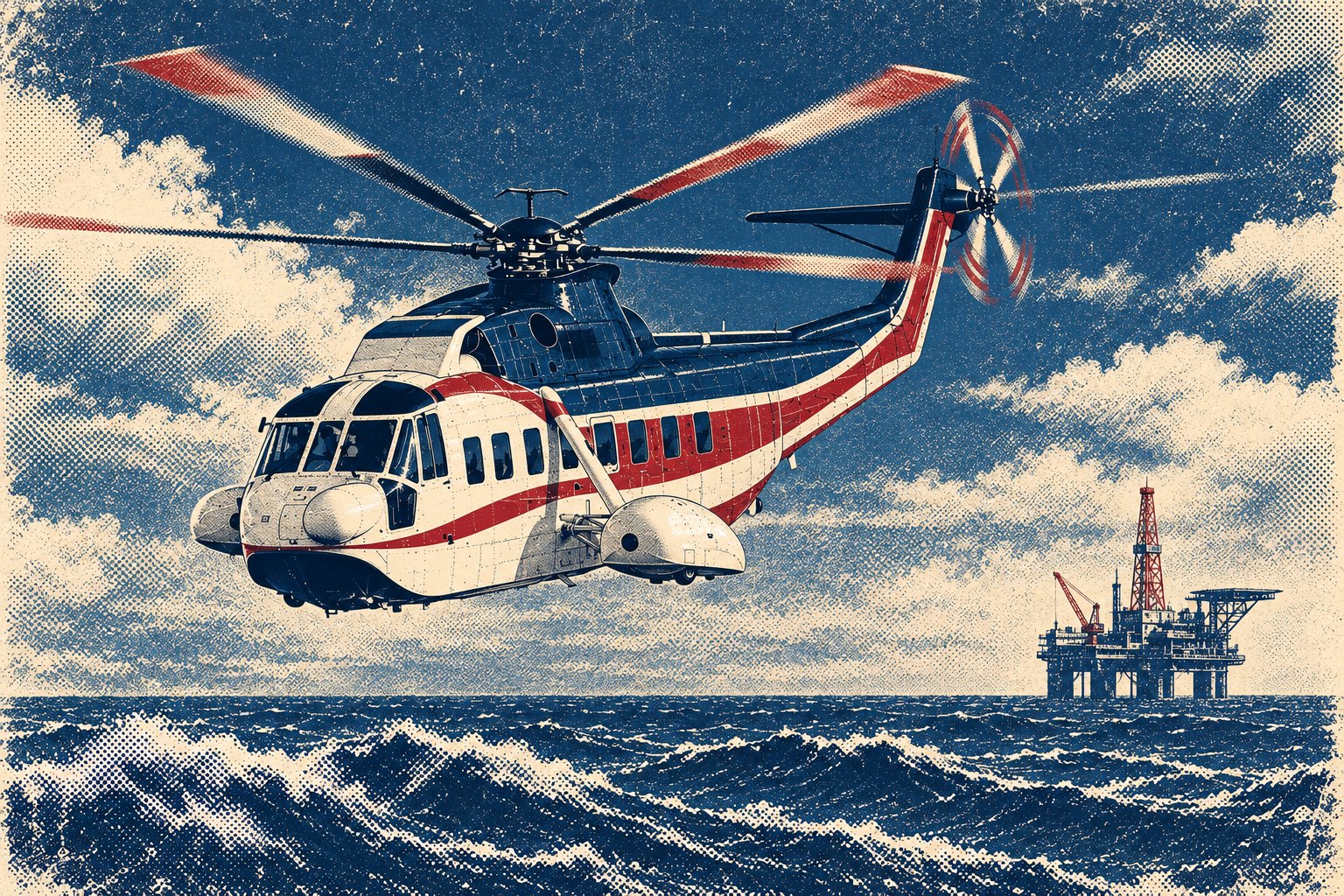
The military prototype, the XHSS-2 Sea King, first flew on 11 March 1959. Sikorsky then offered a commercial version in two forms. The land-based S-61L flew on 2 November 1961 with the fuselage lengthened 4 ft 3 in over the Navy aircraft for freight and passengers, and it dropped the military float stabilizers. The amphibious S-61N flew on 7 August 1962, otherwise identical to the S-61L and optimized for overwater work, with a sealed hull and sponsons that carry the wheels.
Sikorsky built 119 civil S-61s in total. Los Angeles Airways was the first operator of the S-61L, in 1962. The S-61N kept the Navy floats for oil rig support, and the same airframe is now also flown on cargo hooks, with firefighting, external load and logging work listed among its current uses.
A third civil model was built for the hook from the start. The Payloader was the third civil S-61 produced, a stripped-down version for aerial crane work. It kept the fixed undercarriage of the S-61L and gave up almost 2,000 pounds of empty weight against the standard S-61N.
| Civil model | First flight | Hull and gear | Built for |
|---|---|---|---|
| S-61L | 2 Nov 1961 | Lengthened 4 ft 3 in; no float stabilizers; fixed undercarriage | Land passenger and freight service |
| S-61N | 7 Aug 1962 | Same airframe as the S-61L; sealed amphibious hull with sponsons | Overwater and offshore passenger service |
| S-61 Payloader | Not published | S-61L fixed undercarriage; empty weight almost 2,000 lb below a standard S-61N | Aerial crane work, including logging and construction |
Dates and the Payloader weight difference are from the Wikipedia Sikorsky S-61 and SH-3 Sea King articles. A first-flight date for the Payloader is not published in the sources reviewed. Individual airframes vary by configuration, so the dataplate and flight manual are the authority on any aircraft.
What the hook gets
The S-61N Mk II has two General Electric CT58-140 turboshafts of 1,500 shaft horsepower each, a 62 ft main rotor, a 58 ft 11 in fuselage and a published empty weight of 12,336 pounds. Maximum takeoff weight is listed at 19,000 pounds by Wikipedia and 22,000 pounds by CHI Aviation, which fits the FAA's statement that the type is certificated between 19,000 and 22,000 pounds depending on configuration.
Operators publish the hook figure at 10,000 pounds. Croman lists a maximum external lift capacity of 10,000 pounds for its standard category S-61Ns, and CHI lists the same figure, with a 6,660 pound internal capacity. Those are sea level, standard day numbers. The working figure on a mountain job is lower, because thin air takes power before it takes anything else, and the rigging weight comes out of the same number as the freight.
The more useful comparison is the hook against the empty weight. The table sets the two civil lift variants beside the single-purpose lifters covered elsewhere on the site.
| Aircraft | Empty weight | Published hook figure | Hook as share of empty weight |
|---|---|---|---|
| S-61N, standard | 12,336 lb | 10,000 lb | About 81% |
| S-61 Payloader | About 10,400 lb (standard S-61N less almost 2,000 lb) | More than 11,000 lb, per one reference work | About 106% or more |
Ratios are AHLH arithmetic on the published figures cited above, not manufacturer ratings. The Payloader empty weight is derived from the Wikipedia statement that it is almost 2,000 lb lighter than a standard S-61N, so it is approximate, and the 11,000 lb figure is from Jane's Encyclopedia of Aviation. Hook limits depend on configuration, density altitude and the operator's approved load classes.
A standard S-61N carries about four fifths of its own empty weight on the hook. Taking weight out of the airframe moves that ratio past one on the Payloader, which is the same trade the K-MAX made more completely by removing the cabin altogether. The S-61 sits in the middle of that trade, with a real passenger cabin that can carry a crew to the job site and a hook that can still handle a two-ton pick. For a ranking of the whole US civil fleet, the top-10 comparison places it in that mid-heavy band, and the aircraft-by-aircraft capacity comparison shows the gap to the Chinook above it.

The hull is a lift penalty that buys something else
The sealed hull and sponsons of the S-61N exist for water. A helicopter that can float after a ditching is a requirement for flying passengers to offshore platforms, which is why the type became the standard offshore support aircraft for decades. Over land, the same structure is weight and drag that a lifter would delete. The Payloader is the direct evidence: A lighter, fixed-gear version was built for crane work, which marks the amphibious hull as a feature the hook does not use.
For a buyer this changes which S-61 matters. A proposal naming an S-61N may be a former offshore aircraft with an amphibious hull and cabin fit intact, and one naming a stripped aircraft may carry materially more. The model number alone does not settle it, so the empty weight and the configuration belong in writing before a lift is priced.
The airframe also carries a fuselage designed around a passenger cabin. That is useful when the crew and the load need to arrive together, and it is the reason the hook figure stays below the aircraft's own empty weight.
What the 1,000 gallon tank says about the class
Firefighting is one of the main current uses of the type in the United States. Siller Helicopters, which holds exclusive use firefighting contracts with the US Forest Service and CAL FIRE, employs a 1,000 gallon tank on its S-61V. Croman lists internal and external fire tank systems for its S-61Ns. Water weighs about 8.34 pounds per gallon, so a full tank is roughly 8,300 pounds of water. AHLH arithmetic: that sits inside the 10,000 pound hook figure and leaves about 1,700 pounds for the tank structure and plumbing.
For scale, the Type 2 Huey class carries roughly 300 gallons, and the modern S-70i Fire Hawk that replaced the Huey at CAL FIRE carries 1,000, the same tank size as the S-61V.
Carson also developed composite main rotor blades for its S-61s, which it states give a 10 knot increase in cruising speed using the same horsepower and a 1,750 pound increase in lift. That is a manufacturer's claim about one operator's modification, and it applies only to aircraft that carry it. It does show the kind of change operators make to keep a 1960s design competitive, and it is the same re-engine and re-blade pattern covered in the civil Huey profile.
Where the S-61 works as a lifter
CHI Aviation lists the S-61N for construction, power line, oil and gas, wildfire suppression and disaster relief work, and coordinator material names transmission tower and pole work, remote delivery of construction equipment, and ski lift tower placement. Those are the same picks documented in the ski lift tower article and the tower construction hub, where the typical lift is a few thousand pounds and the site has no road.
The S-61 also shows up on the equipment ladder in the solar and substation placement article, where a 3,700 kilogram central inverter lands in the S-61N tier. Stepping up to a Chinook or an S-64 multiplies the hourly rate for capacity the pick list does not use, which is why a medium-heavy twin has stayed in service.
The standard category matters for work near people. Croman lists its S-61Ns as standard category aircraft, so the restricted category bar in 14 CFR 91.313 does not apply to them. A lift over an occupied site still needs an approved congested area plan under Part 133, as described in the approval that clears a lift over an occupied area, but it starts from a plan rather than a prohibition.
14 CFR 133.33 Congested area plan 14 CFR 91.313 Restricted category limits
Keeping the fleet certificated
None of these aircraft is in production, so the regulator still shapes what they can carry. On 5 August 2025 the FAA published special conditions for the S-61A, S-61L and S-61N, including aircraft modified under Carson STC SH640NE, to allow an overload protection device in the hoist system. The FAA states the device must activate between 2.2 and 3.5 times the rated load and arrest cable unspooling, because the loss of an aircraft and crew from a hoist cable entanglement is the risk being addressed. The type certificates cited are H2EA and 1H15.
14 CFR 133 External load certificate
The practical reading for a buyer is that an S-61 on a job is a specific serial number with its own modification history. Match the aircraft to the proposal, and ask which STCs are installed, because weights, blades and hoist equipment may differ from the listing for the type. The Part 133 pillar article covers what the operator certificate itself does and does not confirm, and the Chinook profile and Bell 214B profile set the aircraft on either side of the S-61 against it.