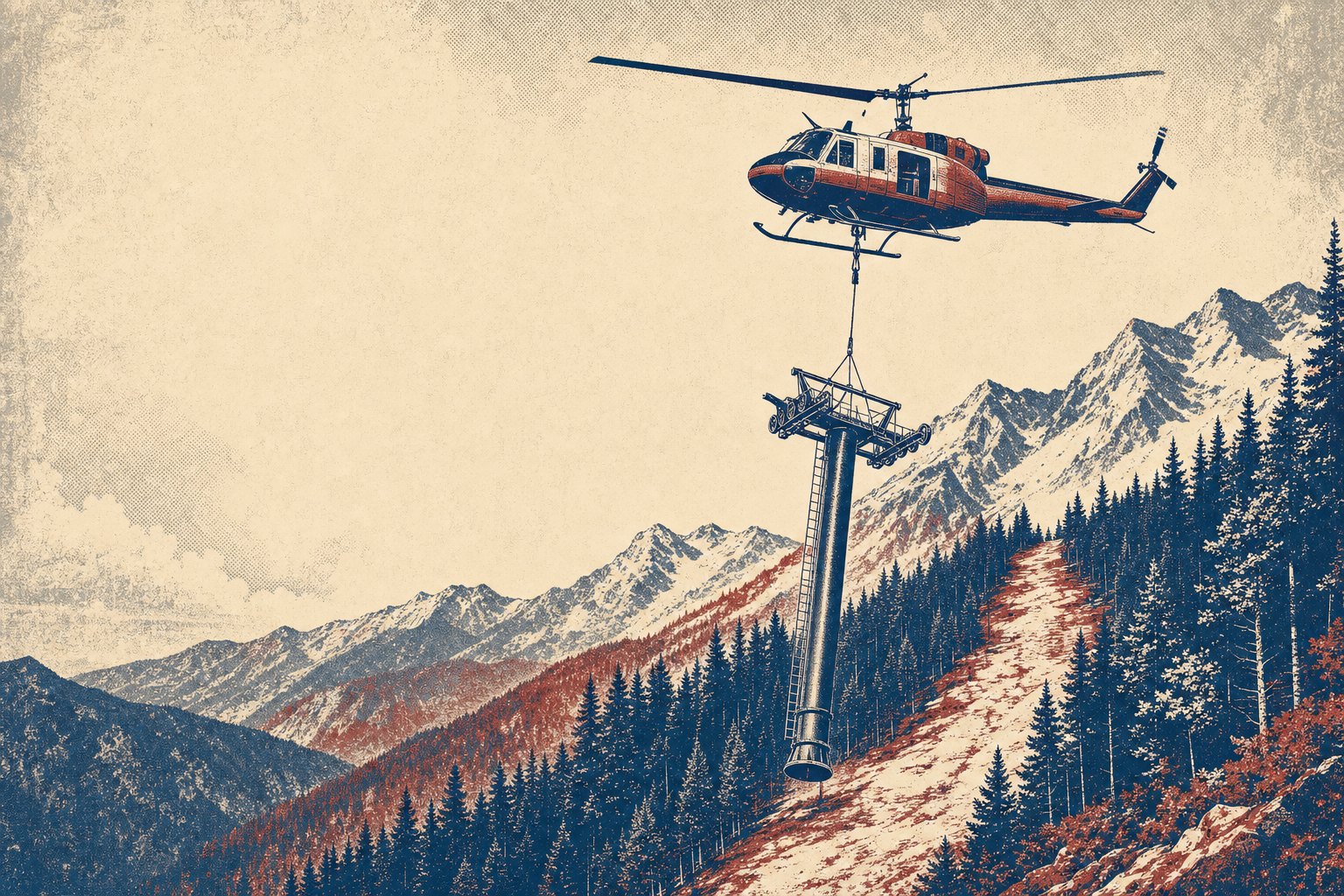
The towers that carry a chairlift up a mountain are almost always flown into place by helicopter. The lift line climbs steep, road-free terrain, each steel tower weighs roughly 6,500 to 12,000 pounds and is delivered in three to five sections, and a medium or heavy external-load helicopter can set an entire lift in a handful of flight days once the snow melts off the foundations.
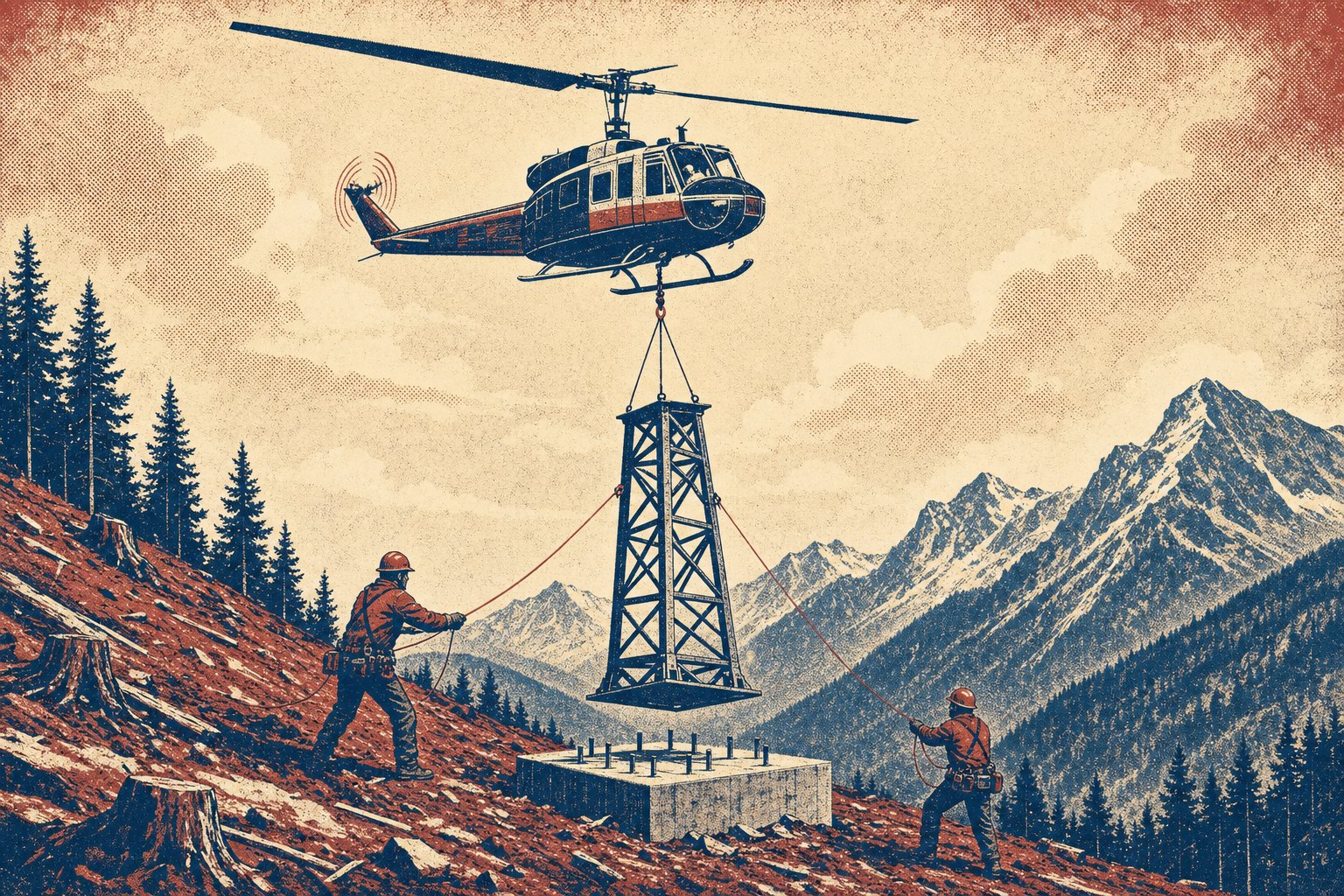
A modern detachable chairlift is a linear machine a mile or more long, anchored to a line of steel towers marching up a ski slope. Those towers stand where no crane can reach: on grades too steep for a boom, above the last switchback of any access road, in terrain a resort spends the rest of the year trying to keep wild. For decades the answer has been the same. The concrete comes first, poured in early summer, and then a helicopter flies the steel.
Ski-lift construction is one of the most demanding forms of external-load work in the country, and one of the least documented. It compresses a season of heavy lifting into a few weather-limited days, at density altitudes that punish payload, over a slope full of ground crew. This article walks the whole operation: why the mountain leaves no alternative, the narrow summer window that governs the schedule, the aircraft that do the flying, and the sequence that turns a line of empty foundations into a running lift.
Why the mountain rules out a crane
The case for the helicopter is written in the terrain. A chairlift is routed for skiers, not for trucks, so its towers land on the fall line of a slope that a loaded crane cannot climb and a service road cannot follow without carving a scar across the mountain the resort does not want. As the trade coverage of these builds puts it plainly, because the lift line crosses steep, road-free terrain, crews use helicopters to move concrete forms, steel, and tower sections directly to each build site (Ski Area Management).
The alternative is not a cheaper crane; it is a road. Cutting temporary access to every tower pad would mean grading, erosion control, and reclamation across protected alpine ground, on a permit timeline measured in seasons rather than weeks. The aircraft erases that entire work package. It also erases the schedule risk of a machine that can only build the towers it can drive to, which on a typical lift line is almost none of them. This is the same access-and-cycle-count logic that decides when a helicopter beats a crane on total lifted cost, pushed to its geographic extreme: on a lift line, ground access is not merely constrained, it is absent.
The summer window that sets the schedule
Ski-lift flying is seasonal work with a hard front edge. The tower foundations sit on the same slope that holds snow into early summer, so the concrete pads cannot be located, poured, and cured until the melt clears them. Once it does, the fly-in has to happen before autumn weather closes the high country and before the resort needs the lift turning for the coming season. In practice that leaves a window from roughly mid-summer into fall, and the heavy flying is scheduled inside it in single, intensely planned sessions.
The compression is the striking part. Coverage of a new chairlift build describes the helicopter flying the line's towers and the top terminal into place across a single midsummer day once snow melted off the foundations, and a Vermont build in 2025 saw crews make roughly fifty helicopter trips to set the eleven towers of a new twelve-million-dollar chairlift at Killington (Vermont Public; Unofficial Networks). A helicopter that turns fifty picks in a day is doing in one shift what a crane, if one could even reach the line, would spread across weeks.
That intensity puts a premium on planning the flight day against the weather and the air, exactly the discipline covered in how a helicopter lift is planned. It also collides with the calendar of the wider heavy-lift fleet: the same medium and heavy helicopters that fly lift towers are in demand for wildfire suppression through the western summer, so the aircraft has to be booked into a window that competes with fire season for airframes and pilots.
The aircraft that fly lift towers
Lift-tower work is medium-to-heavy external-load flying, and the airframes reflect it. A single tower section in the 6,500-to-12,000-pound range, split down further for the fly-in, sits comfortably inside the hook capacity of a medium utility helicopter, while the heaviest single pieces, terminal frames, bullwheels, and drive assemblies, can demand a heavy. The table below places the common ski-build aircraft against the published hook capacities the rest of the AHLH library uses.
| Aircraft | Hook capacity, sea level standard | Category | Role on a lift build |
|---|---|---|---|
| Kaman K-MAX | ~6,000 lb | Normal | High-cycle repetitive picks; tower sections split for weight |
| Sikorsky UH-60 / S-70 Black Hawk | 8,000-9,000 lb | Restricted | The common workhorse for tower sections and sheave assemblies |
| Sikorsky S-61N | 10,000 lb | Standard | Medium tower and terminal components within range |
| Boeing Vertol 107 / BV-234 Chinook | 20,000-28,000 lb | Standard / Restricted | Heavy terminals, drive frames, and bullwheels |
Capacities are sea level standard-day hook figures consistent with the AHLH fleet reference; available payload falls with density altitude, addressed below.
Reported projects bear the pattern out. A Timberline Helicopters Black Hawk flew the loads for the new high-speed Santa Fe Express at Ski Santa Fe, near Santa Fe, New Mexico, in 2025 (Santa Fe New Mexican); a Black Hawk airlifted the towers of Brundage Mountain's new Centennial lift in Idaho (Brundage Mountain); and at Camden Snow Bowl in Maine, a helicopter operated by CHI Aviation set fifteen towers plus the frame and bullwheel for one lift and eight towers and a bullwheel for another, and removed two old towers, in a single 2014 campaign (Knox County VillageSoup).
A detail worth drawing out: several of these aircraft are restricted-category types. The Black Hawk and the surplus Chinook conversions are barred from routine work over congested areas under the rule explained in how congested area plans clear urban lifts. On a closed mountainside that restriction rarely binds, which is precisely why those airframes concentrate in remote lifting, logging, and firefighting rather than downtown rooftops. The K-MAX is the exception in the table, a purpose-built civil design holding a normal category type certificate, and it works the mountain for cycle economics rather than because the law pushes it there. The ski slope is native ground for all of them.
Density altitude: the alpine payload penalty
The catch on a ski build is that the work happens where the air is thin. Resort base areas commonly sit between 6,000 and 9,000 feet, and lift lines climb from there, so the top terminal of a western lift can stand above 11,000 feet. Because a rotor lifts by moving a mass of air, thin mountain air directly cuts what the aircraft can carry, and the working rule is that available payload falls by roughly three percent for every 1,000 feet of density altitude, with heat adding to the elevation.
The consequence is concrete. A helicopter rated near 9,000 pounds at sea level may hold only six-to-seven thousand at a hot high-altitude tower pad, which is one of the reasons towers are broken into three-to-five sections for the fly-in rather than lifted whole (Ski Area Management). It is also why the heaviest picks are flown in the first cool hours after sunrise, when the air is densest and the payload margin is widest, and why the aircraft chosen for a mountain lift is often a size larger than the raw tower weight would suggest. The margin the operator is renting is the margin the mountain takes away.
The install sequence, pick by pick
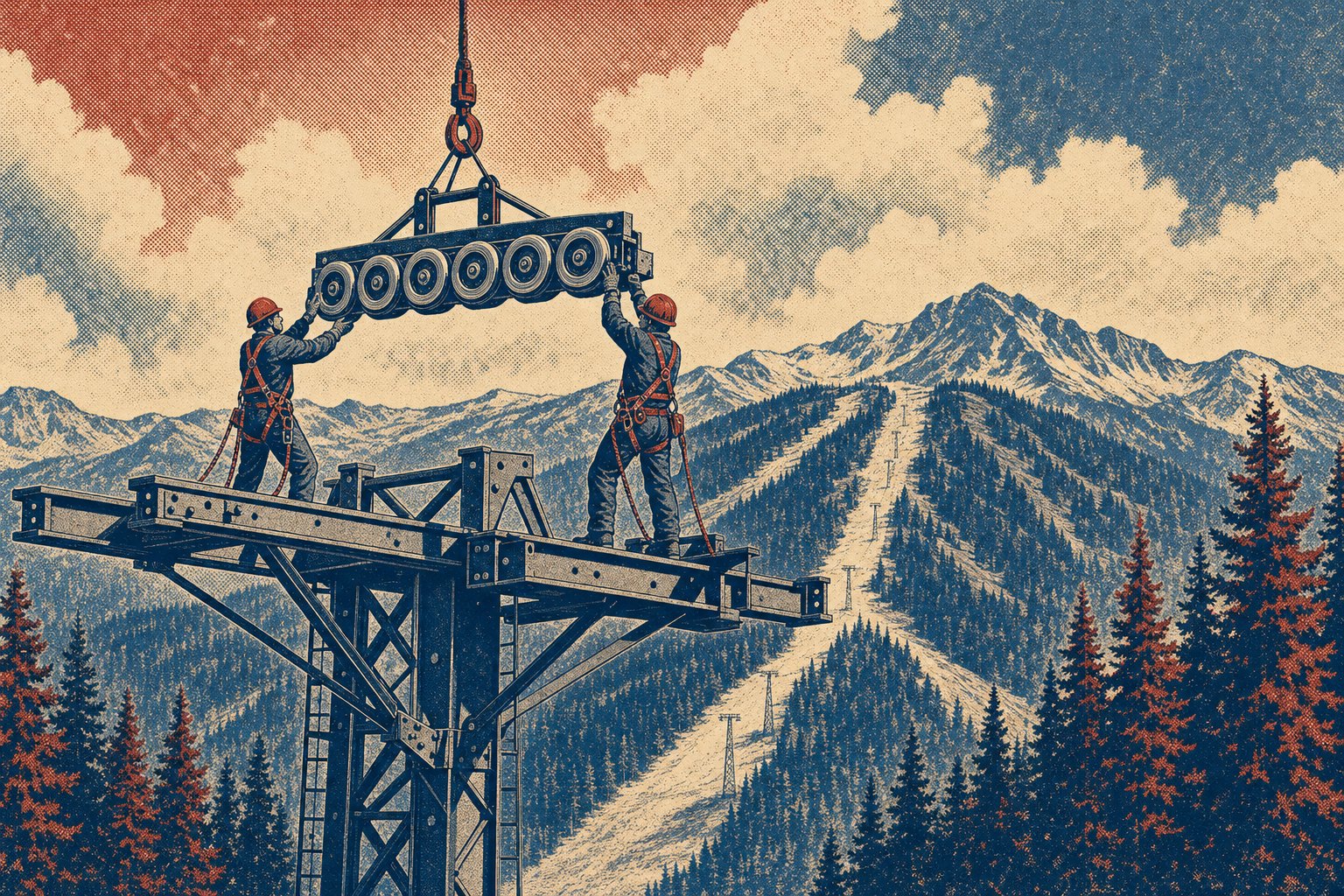
An erected lift tower is not flown in one piece. The sequence stacks it, and the choreography is consistent across projects. The foundations are poured and cured earlier in the summer, each with a pattern of anchor bolts cast into the concrete. On flight day the aircraft delivers the tower base first, and ground crew bolt it to the pad; they then climb the lower section to receive and fasten the upper sections flown up behind it, building each tower from the ground up before the sheave assemblies, the banks of wheels the haul rope rides on, are flown in and attached at the top (Ski Area Management). Terminals, bullwheels, and drive machinery follow as their own heavy picks.
Every one of those picks is a longline placement onto a live crew. The load hangs on a line beneath the aircraft and is set by vertical reference, the pilot looking straight down at the load through a bubble window or a belly camera and easing a multi-thousand-pound steel section onto a bolt pattern the crew is guiding by hand and tag line. The rigging is engineered to the same discipline as any external load, the sling angles, hardware ratings, and dynamic margins laid out in rigging a helicopter lift, and the ground crew works to the helicopter-crane provisions of OSHA 29 CFR 1926.551: static-discharge grounding before anyone touches a load, tag lines, and hard hats secured against rotor downwash. The pilot in command holds the final call on every pick and can wave off any load that will not fly clean.
OSHA 1926.551 Ground crew rule
Why it counts as Part 133 work
Flying steel onto a mountain for pay is a commercial external-load operation, and it runs under the same federal rule as every other lift in the country. The tower sections and sheave assemblies are jettisonable loads carried free of the ground on a hook or longline, which makes them Class B rotorcraft-load combinations under 14 CFR Part 133. The operator flying a resort's lift holds a Rotorcraft External-Load Operator Certificate listing the aircraft and the Class B authorization, carries the aviation and on-hook cargo insurance that pays if a load is dropped, and works to an approved flight manual for the exact aircraft-and-load combination. A resort or lift contractor engaging that operator is buying certificated, insured capability, not a favor from a pilot with a spare afternoon.
14 CFR 133 External load certificate
The result is a discipline the wider public rarely sees. In a few weather-limited days each summer, a medium or heavy helicopter turns a line of bare concrete pads into a running lift, setting steel by the ton onto crews working a slope no crane could climb. It is remote heavy lift at its purest, and it is the same external-load craft that AHLH tracks across tower construction and remote-site freight, applied to the one machine most people only ever ride.