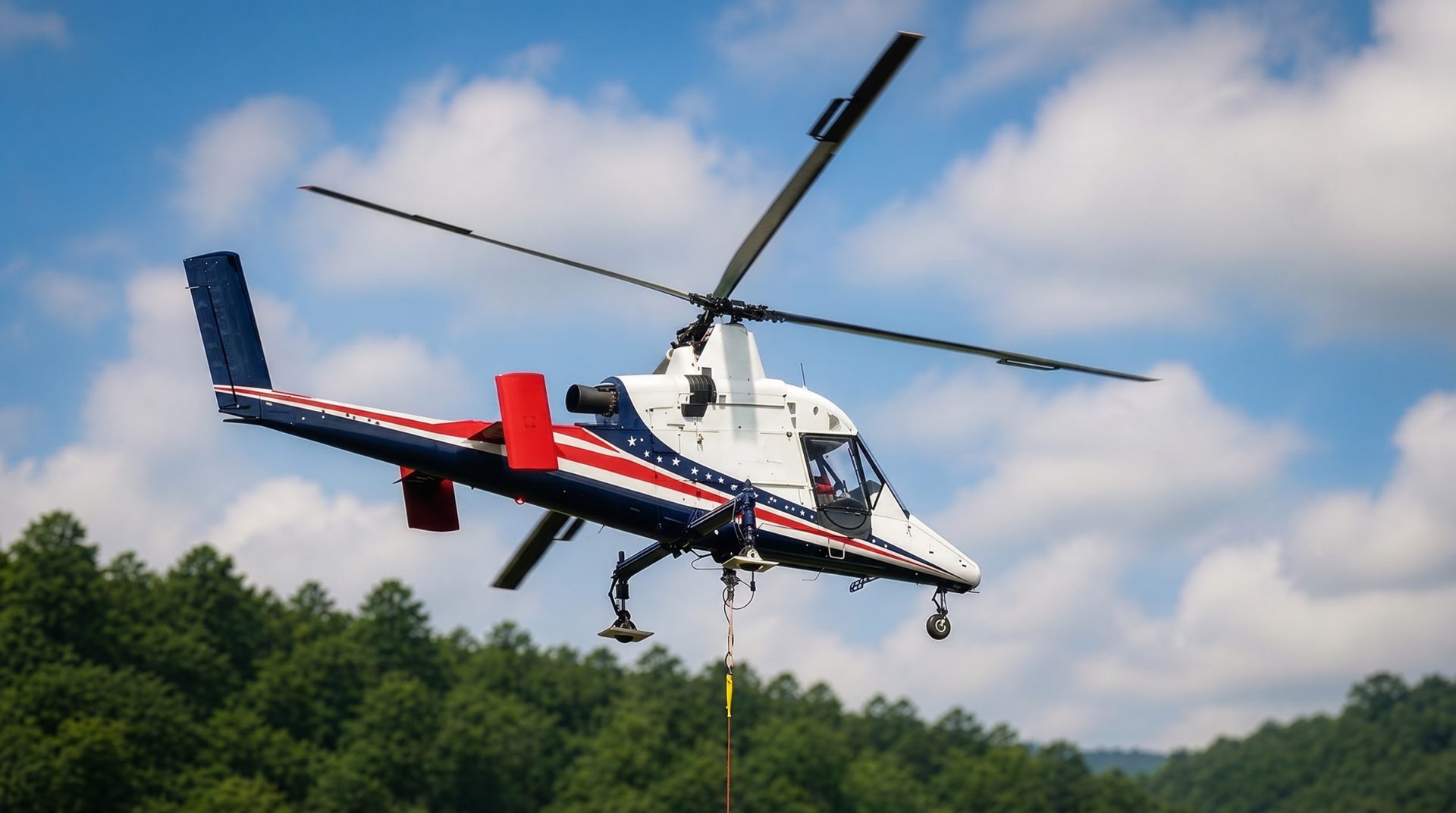
The external load rulebook
Helicopter External Load Operations: The Part 133 Reference
Helicopter external load operations, commercial lifts flown on a hook outside the aircraft, are governed in the United States by 14 CFR Part 133. The rule defines four load classes, A through D, and requires an operator certificate that is renewed every 24 months. This reference covers the certificate, the classes, congested area approval, rigging responsibility, and the conditions that decide what an aircraft can carry on the day.
The discipline
Helicopter external load operations carry cargo outside the aircraft, suspended from a certificated cargo hook rather than loaded into a cabin. In the United States that work is neither general aviation flying nor charter. It is a separate regulatory discipline under 14 CFR Part 133, with its own certificate, its own flight manual, its own load taxonomy, and its own rules for flying over people and property. Reading the framework is what separates a complete lift package from an incomplete one, and it settles an operator's authority against the work before the schedule depends on it. This reference covers the certificate, the four load classes, congested area authorization, rigging standards, and the conditions that decide what a helicopter can lift on a given day.
The rulebook
What Regulation Governs Helicopter External Load Operations?
14 CFR Part 133, Rotorcraft External-Load Operations, governs helicopter operations flown for compensation where the load is carried outside the fuselage. It sits apart from Part 91, the general operating rules, and Part 135, which covers air carrier and charter work. A Part 135 certificate authorizes the carriage of passengers and cargo inside the aircraft. It does not authorize a single revenue lift on the hook. That takes a Part 133 Rotorcraft External-Load Operator Certificate.
Certification runs through the FAA's five phases: application on FAA Form 8710-4, document compliance review, a demonstration of knowledge and skill to an FAA inspector, inspection of the aircraft and its external load attaching means, and issuance. The certificate is not permanent. It is renewed every 24 months, and each renewal puts the operator's aircraft, personnel, and procedures back against the current regulation, so the certificate's date says when that review last happened.
24 months Part 133 certificate renewal cycleTwo elements of the certificate matter most in technical vetting:
- The Rotorcraft-Load Combination Flight Manual (RLCFM). Part 133 requires the operator to develop and carry an FAA-accepted manual covering each rotorcraft-load combination it is authorized to fly. The manual holds the operating limitations, procedures, and performance data for external load work in that specific airframe. If no manual covers the proposed combination, the combination is not authorized, whatever the aircraft can physically lift.
- The knowledge and skill demonstration. The certificate goes to an operator whose pilots have demonstrated external load maneuvers to an FAA inspector, including precision hover work and load release procedures. That is a flown demonstration rather than a paperwork step.
For vendor qualification the check is narrow: obtain the Part 133 certificate number of the company that will fly the lift, then confirm the aircraft proposed for the job appears on it. When a coordinator assembles the package, the aircraft often belongs to a company other than the one that signed the proposal. That arrangement is ordinary and is not a problem in itself. The certificate review follows the named flight operator, so establish which company that is and read its certificate rather than the proposal's letterhead.
Part 133 runs longer than one page can carry. A section by section treatment covers the 24-month certificate, all four load classes, the 133.33 operating rules, congested area plans, and the Class D human external cargo requirements.
Read the Complete Part 133 GuideThe load taxonomy
What Are the Four FAA External Load Classes?
Part 133 sorts every external load into four classes. The class decides the required equipment, the operating rules that apply, and in some cases whether the mission is permitted at all. Classification follows how the load attaches and whether it can be jettisoned, not how much it weighs.
| Class | Definition | Jettisonable | Typical missions |
|---|---|---|---|
| Class A | Load fixed to the airframe, cannot be jettisoned, does not extend below the landing gear | No | External racks, fixed baskets, sensor pods |
| Class B | Load suspended from a cargo hook, jettisonable, lifted free of land or water | Yes | Construction picks, HVAC units, steel, concrete buckets, freight |
| Class C | Load suspended from a cargo hook, jettisonable, remains in contact with land or water | Yes | Wire and sock line stringing, towing, long line pulls |
| Class D | External load that is a person, carried on a hoist or line | Human external cargo rules apply | Powerline human external cargo, rescue-adjacent work |
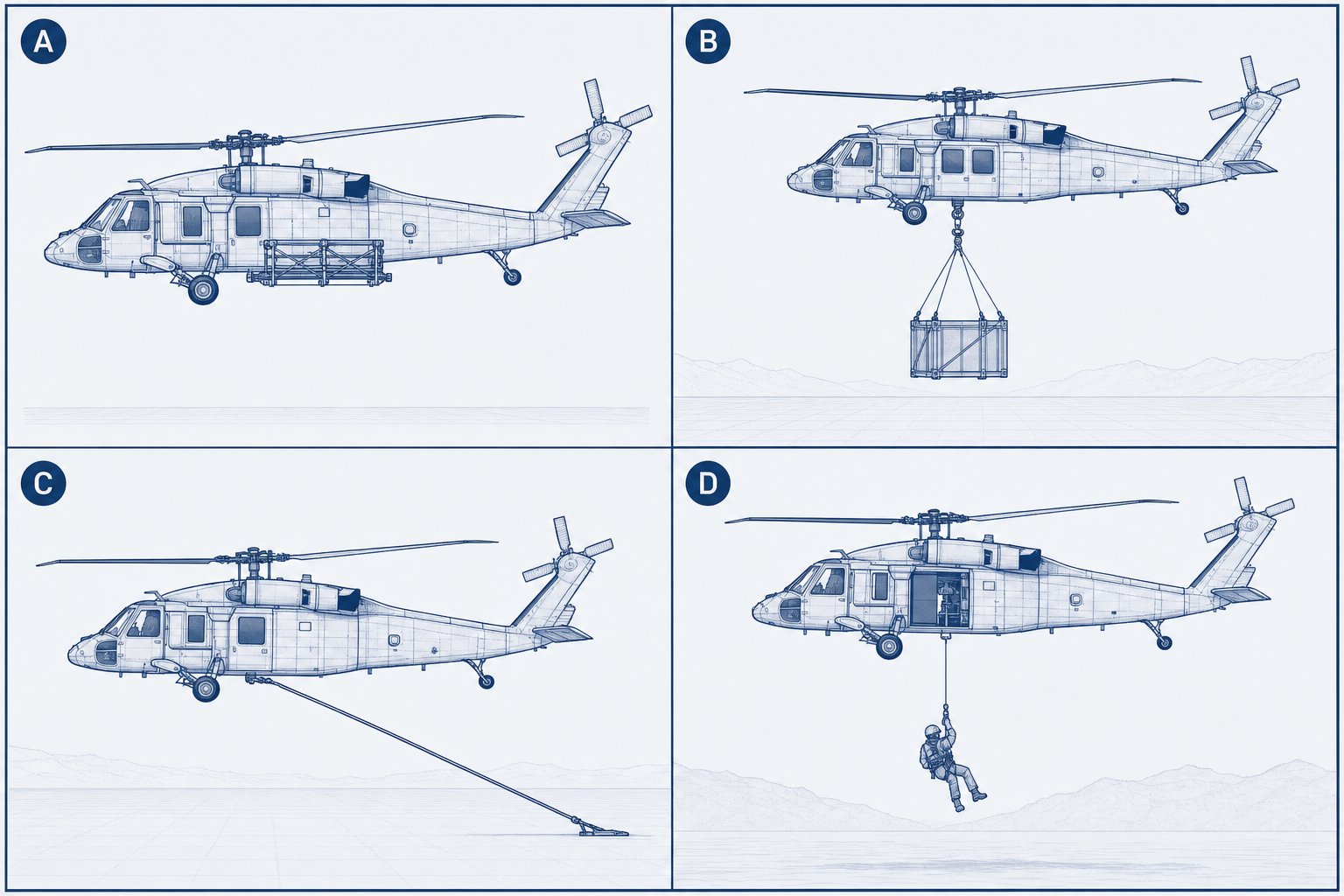
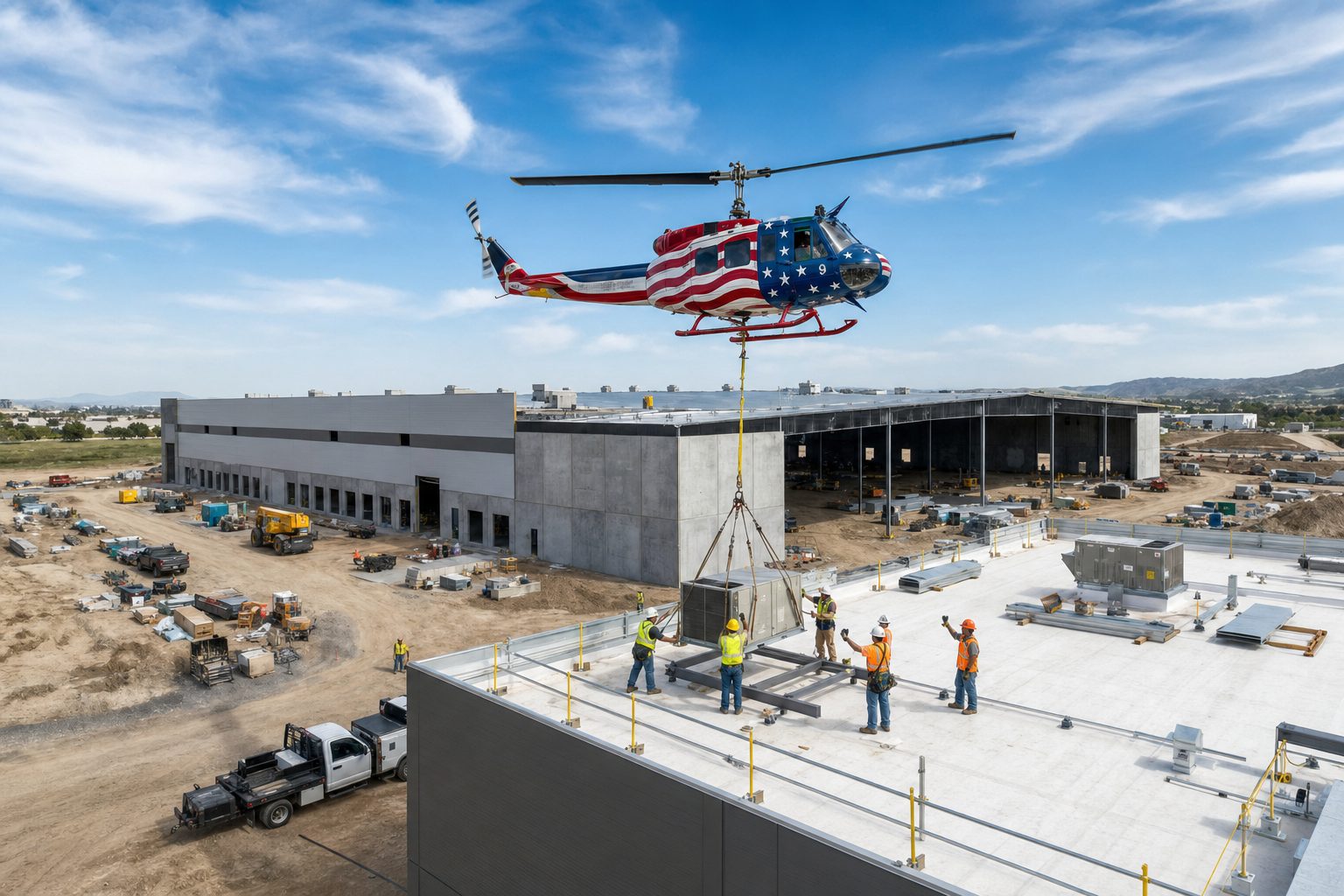
Class B is the workhorse of commercial construction. Nearly every lift described across this site, from rooftop HVAC placement to remote site freight, is a Class B operation: the load leaves the ground, flies on the hook, and can be released electrically by the pilot, with a manual mechanical release as backup. In industry shorthand, a Class B load flown on the cargo hook is a sling load, and the extended line that holds it below the aircraft is the longline. Its length belongs to the rigging design for the particular lift rather than to a standard figure. The release capability is not a convenience feature. It is the safety mechanism the class is built around, because a pilot who loses power or control has to be able to separate the aircraft from the load at once. Helicopter drop testing applies the same release system deliberately, under instrumentation.
Class C is the signature of utility work. Transmission line stringing is the canonical Class C operation: the sock line stays in contact with the earth through travelers and tensioning equipment while the helicopter pulls it. The load never flies free, and the operating rules account for that constant ground connection, static discharge management among them.
Class D covers human external cargo (HEC): a person carried outside the aircraft. It carries the strictest requirements in the regulation, including specific airworthiness approval for the aircraft and the equipment. A related distinction matters in utility work: Class B-HEC provisions, where authorized, allow essential crew such as linemen to be carried in the performance of the external load work. The dividing line is essential function. A worker who merely wants a ride to the job site is a passenger, and passengers are a Part 135 matter on a separate flight. No worker rides with a Class B cargo load, ever.
The urban gate
What Is a Congested Area Plan and When Is One Required?
Carrying an external load over a congested area, a populated urban or suburban environment, requires an operation-specific plan and FAA approval under 14 CFR 133.33(d). Advisory Circular AC 133-1A carries the FAA's implementation guidance. The plan is a mission-specific engineering and coordination document, and on urban work it is usually the longest lead item on the schedule.
A compliant CAP package includes:
- Charted flight routes into and out of the lift site, planned so that a load released anywhere along the route can come down without hazard to people or property on the surface.
- Fall-zone security agreements with the local officials responsible for the area, so that the streets, sidewalks, and property under the route stay clear of unauthorized people during lift windows.
- An emergency jettison plan naming where the load goes if power is lost on each segment of the route.
- Coordination evidence with the agencies and property owners inside the fall zone, along with any air traffic control coordination the route requires.
The regulation sets no fixed review period, and the time an office needs varies with the operation and its complexity. Establish the review schedule with the responsible Flight Standards office early and carry approval as a dated milestone, the way a crane bid carries street-use permits and police details. The flight operator develops the plan and coordinates the approval; the site team has to be able to deliver the access restrictions the plan relies on. Say in the subcontract which party owns each of those, because a plan that assumes a street closure nobody arranged does not survive lift day.
133.33(d) Operation-specific plan and FAA approval
The airworthiness gate
Why Can't Some Heavy Lift Helicopters Fly Over Cities?
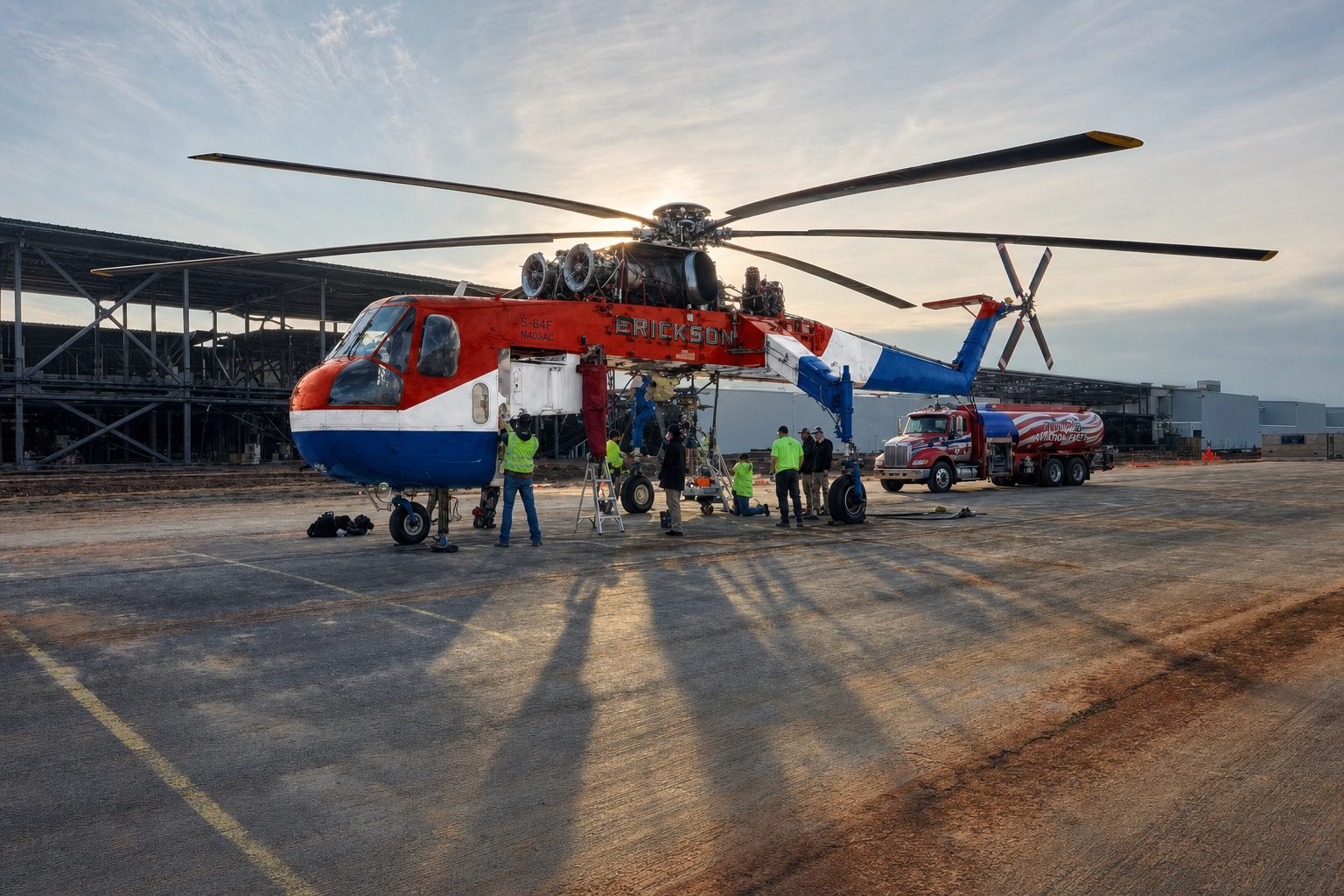
Certification decides where an aircraft can work, and the answer belongs to the individual aircraft rather than to the model name. Section 133.45(d) prohibits external load operations with rotorcraft type certificated in the restricted category under 21.25 over densely populated areas, in congested airways, or near a busy airport with passenger transport operations. Section 91.313(f) excludes nonpassenger-carrying Part 133 external load work from that section of Part 91, which is not the same as removing the Part 133 prohibition.
The consequence runs against intuition: some of the most capable lifting aircraft in the country are kept out of the urban mission by their certification rather than by their capability. The plan does not change that. Section 133.33(d) sets the operation-specific plan and the approval that congested-area work requires, coordinated with the responsible Flight Standards office, and an approved plan does not remove an aircraft's certification restrictions. The two checks are separate, and both have to pass.
Aircraft selection for an urban lift is therefore a two-variable problem: the load the aircraft can carry in the day's conditions, and what its certification permits over the ground beneath the route. Settle the second against the aircraft's own certification record rather than against a model's reputation, because variants of one model do not all carry the same category. Where the proposed aircraft carries a restriction, the specific FAA authorization belongs on the table before the schedule depends on the lift.
The rigging stack
Rigging Standards: Hardware, Design Factors, and Who Holds Authority
Rigging for rotorcraft external loads runs on the consensus standards estimators already know from crane work, applied in a flight environment where the load moves.
- ASME B30.12 covers handling loads suspended from rotorcraft, the rotorcraft-specific volume of the B30 safety standard series.
- ASME B30.20 governs below-the-hook lifting devices: spreader bars, lifting beams, and load-specific fixtures.
- ASME B30.26 governs rigging hardware: shackles, links, rings, and swivels.
- OSHA 29 CFR 1926.551 sets the ground-crew rules for helicopter cranes on construction sites: personal protective equipment, static discharge protocol before touching a suspended load, tag line usage, rigging inspection, and signalman requirements.
Design factors are where rotorcraft rigging departs from ground-crane practice, because flight adds loading a static pick never sees: rotor-induced oscillation, gust response, and the transient forces of load pickup and release. The margin that applies is not one ratio carried across the whole assembly. Each component answers to the standard covering that component, and human external cargo is held to requirements of its own. Have the rigging design name the standard it works to for each component, along with the inspection criteria that follow from it, and check that the named standard actually covers the part it is attached to.
OSHA 1926.551 Ground crew rule
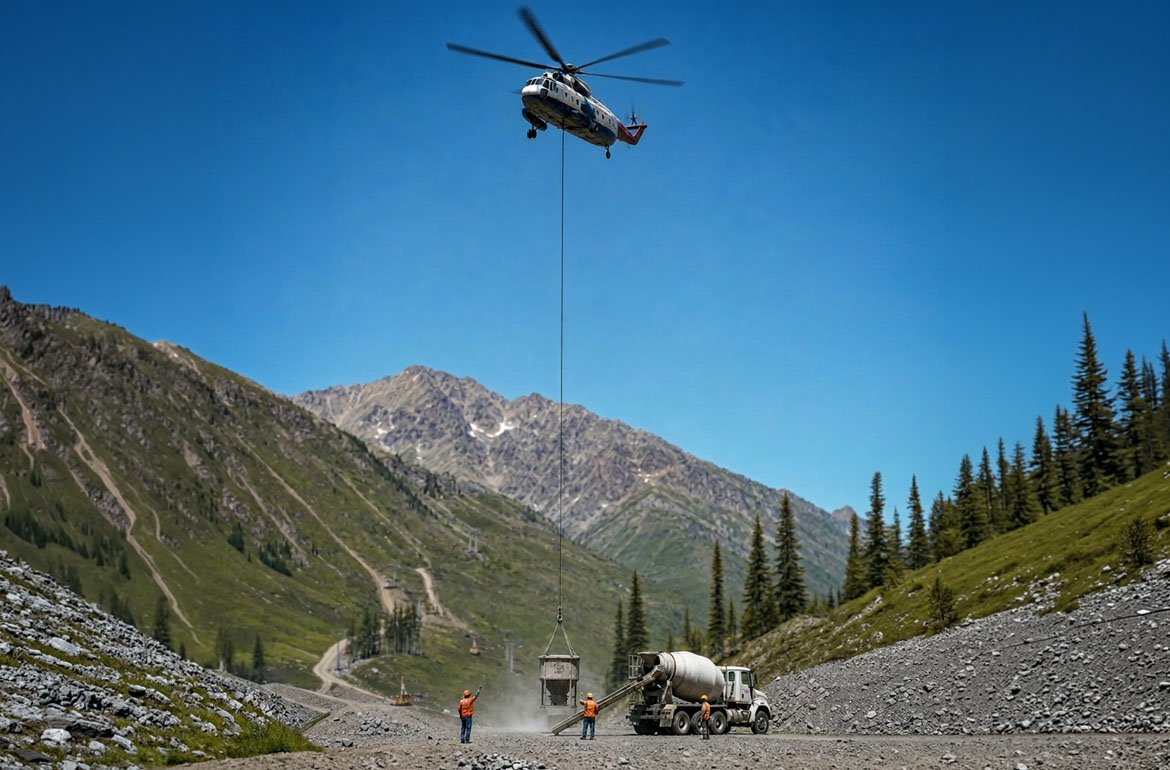
Two operational practices complete the rigging picture. First, static discharge: a helicopter in flight builds a significant electrostatic charge, and ground personnel must allow the longline or a grounding device to contact the earth before touching any part of the load or rigging. OSHA 1926.551 makes this mandatory, not advisory. Second, rotation control: aerodynamically unstable loads such as flat panels, long steel, and ductwork require tag lines, drogues, or swivels to prevent spin, because a rotating load destabilizes the aircraft and defeats precision placement.
Authority over the flight terminates in one seat. Under 14 CFR 91.3, the pilot in command is directly responsible for, and is the final authority as to, the operation of the aircraft, and can decline a lift that fails inspection. An installation deadline does not overrule that. The client's obligations are precise and limited: certified load weights, a scale ticket or an engineered weight statement rather than an estimate, and engineered pick points on each load. The operator engineers the rigging plan, validates the hardware, and flies the lift. Write that division into the subcontract, because settling it after the aircraft is on site is late.
The physics
The Physics: Density Altitude, HOGE, and Why Payload Is Never One Number
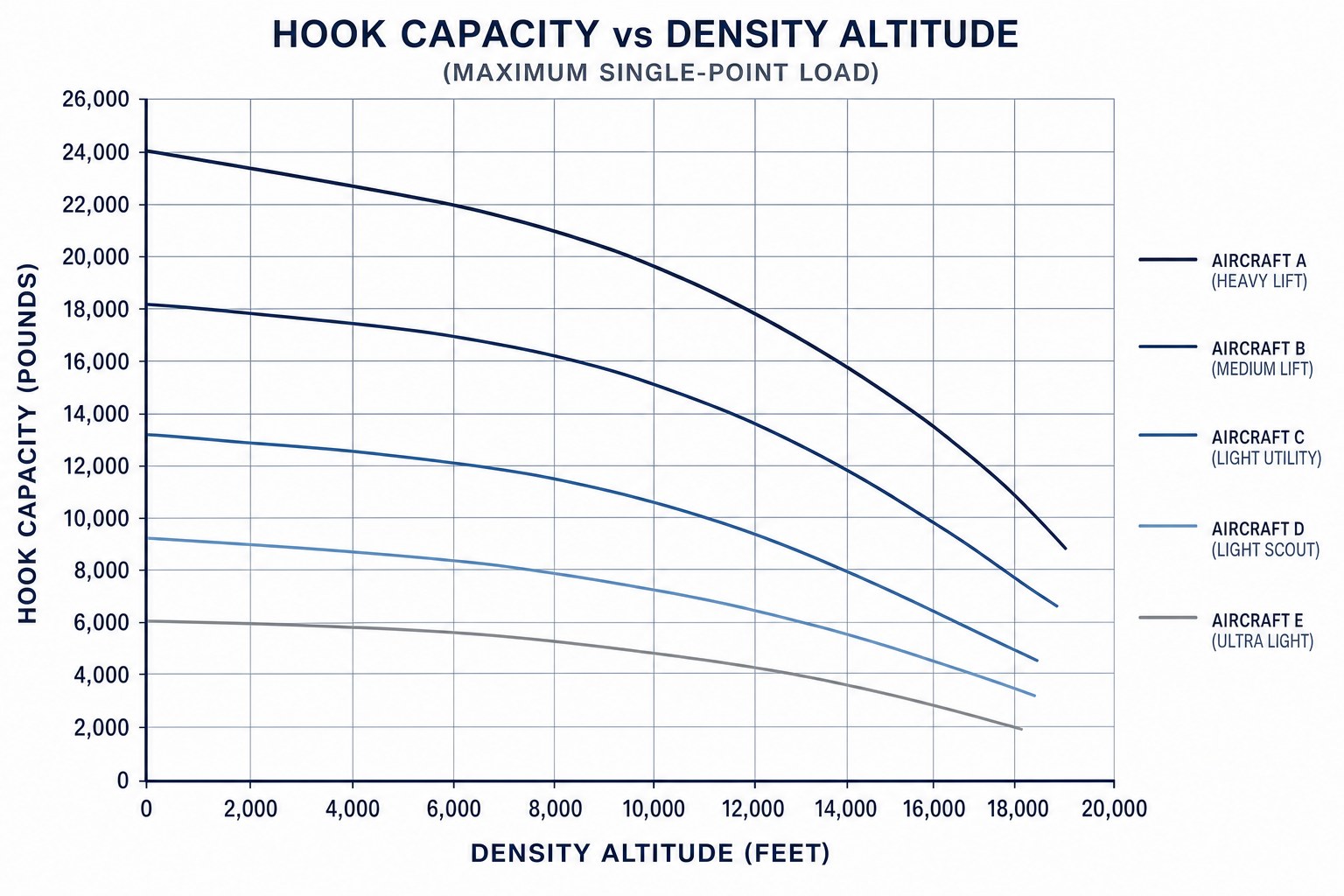
A single payload figure does not describe an aircraft's capacity, because lift depends on air density and air density changes with the conditions at the site.
Density altitude is air density expressed as an altitude, after correction for temperature and humidity: the altitude the engines and rotor system behave as though they are working at. Heat, elevation, and humidity all push it up and take capacity with it. No single percentage describes that effect across airframes, so the planning figure comes from the specific aircraft's performance data for the expected conditions, checked again against the conditions on lift day. The FAA Helicopter Flying Handbook, chapter 7 explains how conditions change performance. The mining support and tower construction pages treat the same problem in mission-specific depth.
HOGE versus HIGE is the second qualifier. Hover in ground effect (HIGE) borrows lift from the cushion of air compressed between the rotor disc and the ground. Hover out of ground effect (HOGE) gets no such help, and every meaningful external load maneuver, holding a unit steady over a rooftop curb or a tower stub, is a HOGE maneuver. The number that governs the lift plan is HOGE capability in the conditions forecast for the day, not a published maximum.
Translational lift explains the flight profile contractors observe on lift day. A helicopter gains efficiency as it moves into forward flight and the rotor system works in clean air, which is why an aircraft can carry a load down a route that it could only just hold in a hover. Mission planning uses that: heavy picks are flown on routes that keep HOGE time short.
The practical output of all three is the load chart: for each aircraft, the hook load available across a range of conditions. Ask for the chart covering the assigned aircraft during bid support, so feasibility is settled before the work is priced.
The fleet reference
Aircraft Reference: External Load Capacity by Type
Each capacity below is the published hook or longline figure its named source states. The sources measure different things, so the figures are not interchangeable lift-day allowances. Allowable load comes from the specific aircraft and the conditions on the day.
| Aircraft | Max longline / hook | Airworthiness category | Typical picks/hr | Key operational note |
|---|---|---|---|---|
| Columbia BV-234UT / 234LR Chinook | 28,000 lb (Vertical: Model 234 UT/LR, on the hook) | Not published here | Not published here | Tandem rotor |
| Boeing CH-47D Chinook | Not published here | Not published here | Not published here | Tandem rotor |
| Erickson S-64F Air Crane | 25,000 lb (Erickson: maximum external cargo) | Not published here | Not published here | Aft-facing pilot station for precision placement |
| Erickson S-64E Air Crane | 20,000 lb (Erickson: maximum external cargo) | Not published here | Not published here | Aft-facing pilot station for precision placement |
| Sikorsky CH-53D | Not published here | Not published here | Not published here | Not published here |
| Sikorsky S-61N Mk II | 10,000 lb (Helimax: external capacity, standard day at sea level) | Not published here | Not published here | Twin-engine medium-heavy type |
| Sikorsky S-70M Black Hawk | Not published here | Not published here | Not published here | Not published here |
| Bell 214B Big Lifter | About 8,000 lb (McDermott Aviation: 3,636 kg maximum hook load) | Not published here | Not published here | Not published here |
| Kaman K-MAX K-1200 | 6,000 lb (Kaman: published lifting capacity) | Not published here | Not published here | Not published here |
| Bell 212 Eagle Single | Not published here | Not published here | Not published here | Not published here |
| Bell 412EP | 4,500 lb (Avincis specifications, page 4: maximum hook load) | Not published here | Not published here | Twin-engine redundancy near energized lines |
Airworthiness category and cycle rate are not published here. Category belongs to the individual aircraft's certification record rather than to the model name, and cycle rate belongs to the operator's estimate against the actual pick list. Where any other cell reads not published here, this page has no source for that figure; take it from the aircraft's flight manual or the operator.
The heaviest hook figure in this table is 28,000 pounds, on Columbia's Model 234, as published by Vertical. A load above the capacity of the aircraft available for the job is a ground-crane problem rather than a rotorcraft one. The Specialized Heavy Lift hub covers the missions at the top of this table.
The honest limits
When Is a Helicopter the Wrong Tool?
A Part 133 reference is worth less if it does not state the limits of the method. A ground crane wins on long-duration steady lifting, where a machine that holds a load for hours costs a fraction of flight time. It wins on a single pick beyond the capacity of any aircraft available for the job. And it frequently wins where street access is clear and no closure costs apply, because cheap crane mobilization is hard to beat. The helicopter earns its place where access is the obstacle: a site with no road, a roof no crane can reach from a workable setup position, a pick list that would otherwise wait on a crane repositioning around a building. Neither method arrives without a site footprint. The aerial plan still needs a pickup area, a protected route, and ground protection, and those costs belong in the comparison beside the crane's setup. Run both against the same scope before pricing either.
The planning checklist
Planning an External Load Operation
A contractor preparing a bid that includes helicopter work can settle feasibility from the material on this page: confirm the load class, check certified weights against the aircraft's performance for the conditions expected, flag any congested-area exposure early so the plan and its approval sit on the schedule, and assign rigging responsibilities in the subcontract. For mission-specific depth, continue with the transmission line stringing and remote site freight analyses, or step back to the Specialized Heavy Lift hub for the full vertical. New analyses in this series reach the mailing list first; the signup opens in a modal from any page.
Frequently asked questions
What Contractors Ask About Part 133
From the technical library