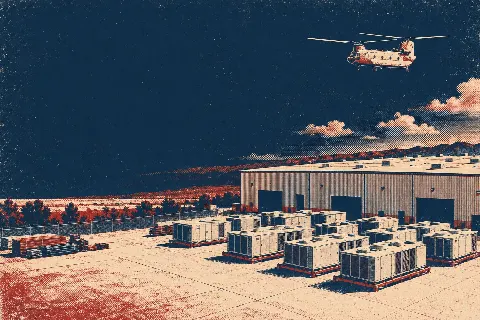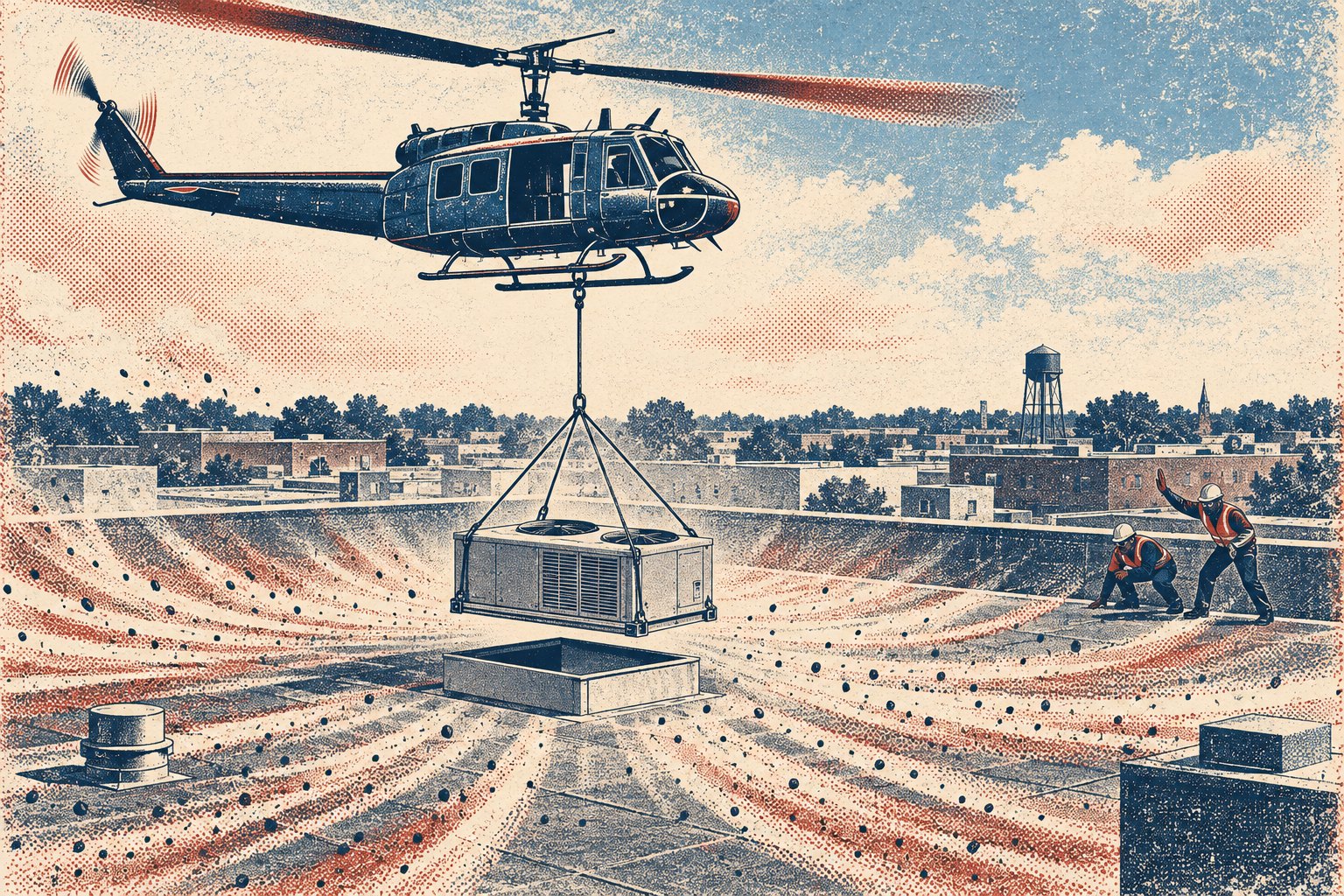
Rotor wash is the wind a hovering helicopter pushes down and out across the ground. OSHA requires loose gear within 100 feet of the pick and set points to be secured or removed, but published outwash estimates put the 34 mph caution contour of a 12.6 tonne helicopter near 200 feet out, so the prepared area usually needs to be larger.
Every helicopter lift moves a great deal of air. To hold a hover, the main rotor pushes a column of air downward with a force equal to the aircraft's weight, and when that column reaches the ground it turns and spreads outward in every direction as a turbulent sheet of wind. Ground crews call it rotor wash; engineers split it into downwash under the disc and outwash across the surface. On an open field it is a nuisance. On a construction site, with stacked plywood, tarps, roofing debris and a crowd of trades nearby, it decides what has to be tied down, where people can stand and how far the cleanup perimeter has to run.
This guide covers the hazard itself: how strong the wind gets, how far it reaches, what the federal helicopter rule requires on the ground and how sites prepare loose material, roofs and dusty pads. What the receiving crew wears is covered separately in the guide to ground crew PPE for helicopter lifts.
How strong rotor wash gets
The strength of the wind follows disk loading, the aircraft's weight divided by the area its rotor sweeps. A heavier aircraft on the same rotor has to push air down faster to stay up. Draft heliport outwash guidance built on the FAA's 1994 Rotorwash Analysis Handbook gives the theoretical peak downwash under a hovering rotor as twice the induced velocity through the disc, and tabulates it by type (draft downwash and outwash guidance). A Bell 412 at maximum weight comes out near 85 km/h (53 mph). A Sikorsky S-92 or Airbus H225 comes out near 106 km/h (66 mph). The heavy military CH-53E, at about 70 kilograms per square meter of disk, comes out near 65 knots, about 75 mph.
Outwash is not strongest directly beneath the aircraft. The same guidance places the highest outwash velocity about two rotor radii from the mast, where the downward column has turned and accelerated along the ground, with mean velocity falling away beyond that point. The flow is also unsteady. It carries vortices that produce the buffeting crews feel as gusts, and the guidance notes that practical trials found the onset of outwash on people "can be extremely rapid, is unpredictable, does not remain constant in strength, and can be destructive in force."
Ambient wind and the site reshape the pattern. On the downwind side, the outwash and the breeze add together. Slopes, surface features and surrounding structures can funnel the flow and extend the hazard area; the guidance names this explicitly, along with the opposite effect, that hedges and fencing can break up outwash and shrink the zone. A site between two buildings or beside a parapet wall should be expected to behave differently from the flat, open ground the published estimates assume.
What OSHA requires on the ground
The construction helicopter rule, 29 CFR 1926.551, addresses rotor wash in several separate paragraphs rather than in one section. Read together, they set the floor for any site receiving an external load.
| Paragraph | What it requires | What it means on site |
|---|---|---|
| (b) Briefing | A briefing before each day's operations, setting out the plan for pilot and ground personnel | Downwash zones, staging and sweep duties belong in that briefing, not left to the crew's judgment on the day |
| (f) Loose gear and objects | Every practical precaution against flying objects in the rotor downwash; all loose gear within 100 feet of the pick and set points, and in all other areas susceptible to downwash, secured or removed | The 100 foot radius is a minimum; the second clause extends the duty to anywhere the wind actually reaches, including flight paths |
| (g) Housekeeping | Good housekeeping in all helicopter loading and unloading areas | Debris control is a safety requirement, enforceable as such |
| (m) Visibility | When dust or other conditions reduce visibility, ground personnel exercise special caution to keep clear of main and tail rotors; the employer reduces the condition as far as practical | Dust suppression on bare ground is an employer duty, not an aircrew courtesy |
| (o) Approach distance | No unauthorized person within 50 feet of the helicopter while the blades are turning | A controlled perimeter is required whether or not anyone is working inside it |
| (p) Approaching helicopter | Anyone approaching or leaving a helicopter with blades turning stays in full view of the pilot and in a crouched position | The crouch lowers the body's profile in the outwash as well as keeping clear of the rotor |
| (s) Fires | No open fires where the downwash could spread them | Burn barrels, welding and torch work near the zone stop for the lift |
Paraphrased from 29 CFR 1926.551; consult the regulation for exact wording. The general industry rule at 29 CFR 1910.183 carries parallel provisions. Federal Aviation Administration rules under 14 CFR Part 133 govern the aircraft and its operator; the OSHA rule governs the employer's ground site.
The 100 foot figure in paragraph (f) is the number most often quoted, and it is frequently read as the boundary of the problem. The text does not support that reading. The radius applies to the pick and set points, and the paragraph separately reaches "all other areas susceptible to rotor downwash", which on a real job includes the route between them, the staging yard and any neighboring property the aircraft hovers near.
OSHA 1926.551 Ground crew rule

How far the wind reaches
The draft heliport guidance publishes estimated outwash radii by aircraft type, generated with the Army-developed Rotorwash Operational Footprint model. Its personnel thresholds come from Ferguson's work for the FAA: a caution limit of 15 meters per second (about 34 mph) and a hazard limit of 20 meters per second (about 45 mph), both peak velocities based on the force needed to overturn a standing person. The table below converts six of the published rows to US units.
| Type (max mass) | Rotor diameter | Peak downwash | Radius to 45 mph peak (hazard) | Radius to 34 mph peak (caution) | Radius to 25 mph peak |
|---|---|---|---|---|---|
| Airbus EC135 (6,570 lb) | 34 ft | 53 mph | 69 ft | 98 ft | 135 ft |
| Airbus H145 (8,378 lb) | 36 ft | 57 mph | 79 ft | 112 ft | 148 ft |
| Bell 412 (11,900 lb) | 46 ft | 53 mph | 92 ft | 135 ft | 180 ft |
| Airbus H225 (24,692 lb) | 53 ft | 66 mph | 138 ft | 187 ft | 233 ft |
| Sikorsky S-92 (27,700 lb) | 56 ft | 66 mph | 148 ft | 197 ft | 246 ft |
| Leonardo AW101 (34,392 lb) | 61 ft | 68 mph | 167 ft | 220 ft | 272 ft |
Source: Tables II-3-E 1 and II-3-E 4 of the draft downwash and outwash guidance (72, 54 and 40 km/h boundaries). Radii are from the rotor mast for a steady hover at a height of one rotor radius over flat, unobstructed ground in still air, at maximum mass and sea level standard density. The document is a draft, warns that the 40 km/h figures should be treated with caution and does not cover ambient wind, surrounding structures or elevated sites. Metric-to-US conversions are AHLH arithmetic. No dedicated civil heavy-lift crane type is tabulated.
Three practical readings follow. First, for anything heavier than a light twin, the published caution contour sits beyond OSHA's 100 foot radius, in the S-92 case by about double. A site that clears exactly 100 feet has complied with the minimum text while leaving people and material inside winds the research treats as a caution condition. Second, the contours scale with the aircraft, so the prepared area should be drawn after the operator names the type, not before. Third, the estimates describe a low hover near the ground. An aircraft on a 100 or 150 foot longline hovers far higher, and the published model does not describe that case; the wind at the hook point then depends on the aircraft's height, weight and the breeze, and the operator's experience with that type is the better guide.
The human threshold is lower than many people expect. The same guidance summarizes research by Jordan and colleagues in which half of average test subjects were displaced by a sudden 40 km/h (25 mph) gust and all were displaced at 55 km/h (34 mph), with measurable effects on balance for people over 50 in gusts above 30 km/h (19 mph). That is the reason the controlled perimeter matters for neighbors, delivery drivers and the public, not only for the lift crew.
Loose material on a working site
Construction sites are dense with the kind of objects outwash moves easily. The NTSB's safety alert on landing-site debris lists towels, ropes, tarps, bags, equipment covers and hats worn by ground personnel as light enough to migrate in rotor wash and foul a main or tail rotor (NTSB SA-057). Its accident summaries include a tarp from a secured trash bundle that rose into a light helicopter's main rotor and caused a blade to separate, and tarps held down with boards and stones that were lifted into a tail rotor as a pilot prepared to shut down. The alert's first recommendation is to avoid landing near construction activity and trash storage, which is exactly where a construction lift has to work.
The control for each item follows from how it fails in the wind.
| Site item | How outwash affects it | Usual control before the lift |
|---|---|---|
| Tarps, poly sheeting, wrap and bags | Large surface, low weight; can rise to rotor height, as in the NTSB cases | Remove from the zone; weights alone are not a reliable hold |
| Plywood, OSB and rigid insulation boards | Top sheets lift off a stack and travel edge first | Strap the stack to its pallet or move it outside the zone |
| Roofing felt, membrane rolls and loose flashing | Unrolls or peels at free edges | Secure or stage below; finish or weight exposed seams |
| Portable toilets, signs, barricades and cones | Light enclosures and flat panels tip or slide | Tie down to stakes or anchors, or relocate |
| Dumpsters and debris piles | Contents lift out of open containers | Close and secure lids; cover or wet piles |
| Scaffold netting and debris screens | Acts as a sail on the scaffold or tears loose | Inspect ties; furl or remove sections facing the aircraft where the scaffold design allows |
| Hats, gloves, clipboards and loose PPE | The most common migrating object in the NTSB list | Chinstraps on hard hats; nothing loose in hands or pockets |
Failure modes drawn from NTSB SA-057 and the duties in 29 CFR 1926.551(f) and (g). Controls are general planning practice; the operator's site requirements govern on the day.
A final sweep after securing matters as much as the securing itself. The NTSB alert recommends that available personnel walk the landing site for debris before the aircraft arrives, and it notes that wind and drainage can carry new debris into a cleared area. On a site where other trades keep working until the lift window, the sweep belongs as close to arrival as the schedule allows, and the helicopter lift site survey checklist carries the earlier walk that identifies what needs moving.
OSHA 1926.551 Ground crew rule
Rooftop preparation
Roof work concentrates the hazard. The set point sits on the roof, the crew works close to the edge, and the outwash spreads across a surface that may be covered with loose ballast, stored materials and the debris of an active reroof. Rooftop HVAC unit sets are the most common case.
The structural load from the wind itself is usually not the concern. The FAA's heliport design circular states that rotor downwash loads are approximately equal to the helicopter's weight spread uniformly over the rotor disk, and that they are generally less than the building-code loads for snow, rain or wind used in structural design (FAA AC 150/5390-2D). The concern is what the wind can move. A ballasted single-ply roof is held down by loose stone. The ANSI/SPRI RP-4 standard, which the International Building Code references for these roofs, ballasts its basic system with #4 stone, graded from about 1.5 inches down to 0.75 inch, and calls for larger #2 stone in the corner and perimeter zones of its second system, with the choice set by building height and design wind speed (SPRI overview of RP-4). Those ballast tables are built for building-code wind flowing over a roof. A rotor jet arriving from above and spreading from a point on the roof is a different load case, and the standard's tables cannot be read as a clearance for a hovering aircraft.
Rooftop planning therefore usually covers a short list of checks:
- Loose ballast, gravel and pavers within the contour for the named aircraft, and whether they need to be swept, covered or temporarily relocated.
- Membrane condition: open seams, unadhered edges and partially installed sections on a roof under construction.
- Stored materials and debris: insulation board, membrane rolls, old unit panels, filters and packaging from the unit being set.
- Neighboring roofs, yards and parked cars inside the contour, because paragraph (f) follows the downwash beyond the property line.
- Rooftop openings and intakes, including hatches, skylights and outdoor air intakes that could draw in dust, which the building owner may choose to close or shut down for the window.
- Where the crew stands: a position the pilot can see, out of the load's path and clear of the roof edge, with fall protection where the edge requires it.
Each item depends on the aircraft named for the job, which is why rooftop prep appears in the sequence described in how a helicopter lift is planned after aircraft selection rather than before it.
Dust, snow and visibility
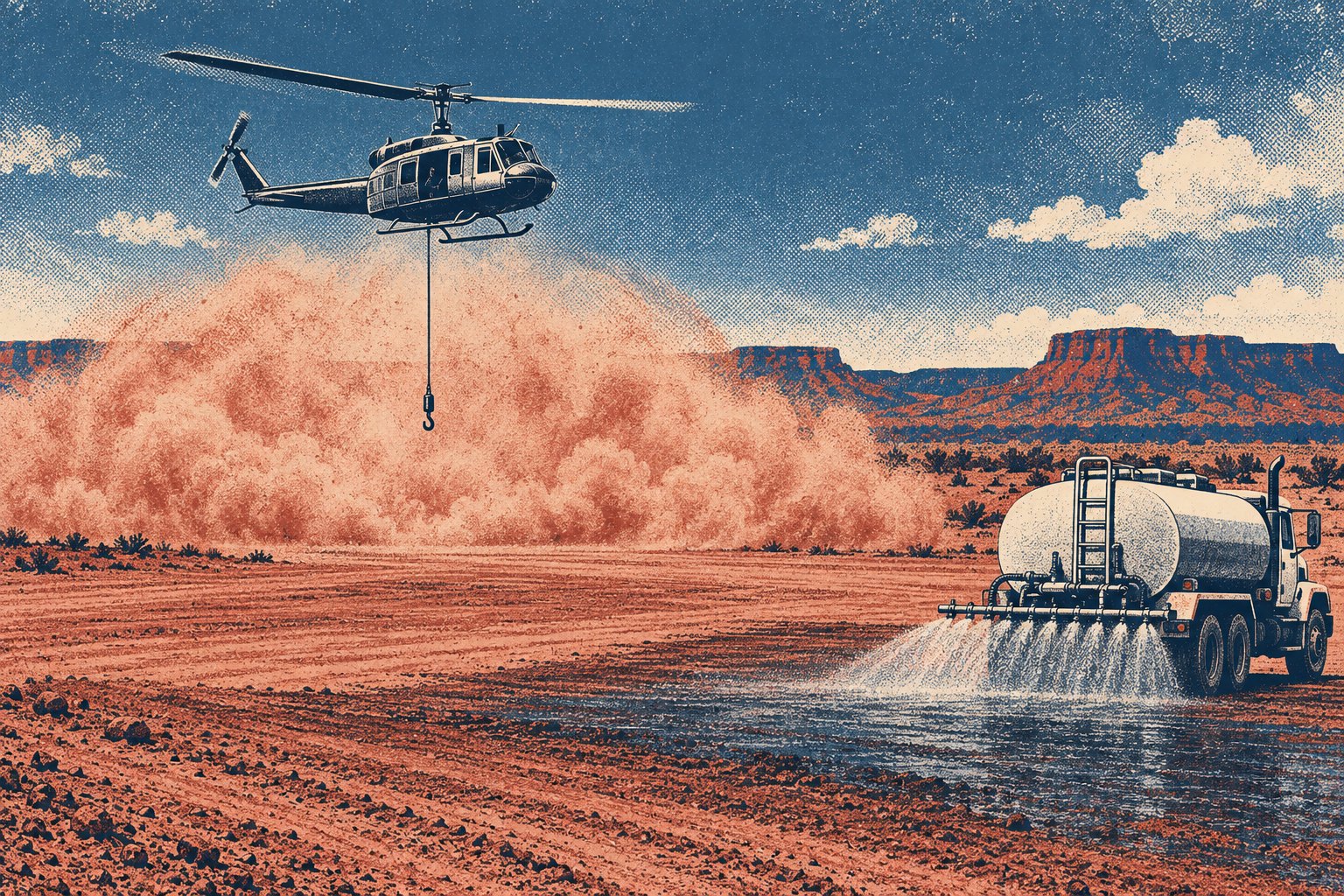
On bare ground, rotor wash raises dust, and dust removes the visual references the pilot and the crew depend on. Paragraph (m) of the OSHA rule addresses this directly: when dust or other conditions reduce visibility, ground personnel take special care to keep clear of the main and tail rotors, and the employer is required to reduce the condition as far as practical. On a graded pad, a laydown yard or a mine site, that usually means wetting the pick and set areas with a water truck before the aircraft arrives and again during long sessions, or placing the pick point on gravel, pavement or matting.
Snow behaves the same way. The FAA's heliport design circular notes that swirling snow dispersed by rotor wash can cause the pilot to lose sight of the intended landing point and hide objects that need to be avoided. Loose, dry snow over a winter site can produce a whiteout at the hook point; packing or clearing the pick and set areas reduces it. Fine material settles back over the site after each cycle, so a pad wetted at the start of a long day may need attention again before the last loads.
OSHA 1926.551 Ground crew rule
People, perimeters and responsibilities
Two distances in the OSHA rule govern people. Paragraph (o) keeps unauthorized persons at least 50 feet from the helicopter while its blades turn, and paragraph (p) requires anyone approaching or leaving it to stay in the pilot's view and crouched. Neither distance is derived from outwash strength. The outwash table above shows that the wind can stay at caution levels well beyond 50 feet, so the practical perimeter for the public is usually set by the contour for the named aircraft, the flight path and local street or property controls, with the OSHA figures as the floor.
Responsibility splits along the usual lines. The flight operator knows the aircraft's downwash and sets the requirements for the pick and set areas; the site employer controls the ground, secures loose material, manages dust and keeps unauthorized people out; the general contractor coordinates the other trades on site so that material is not restaged into the zone after the sweep. The division is laid out in more detail in who is responsible for what during a helicopter lift. When the operator's requirements, the site plan and paragraph (f) are written into the daily briefing that paragraph (b) already requires, the crew on the ground starts the lift knowing where the wind will reach and what has been done about it.
Rotor wash is one hazard among several on a lift day, and it is one of the few that can be planned almost entirely in advance. The aircraft type fixes the strength of the wind, and the site layout decides where it goes. With both known, everything inside the contour can be removed, secured, wetted or kept clear before the aircraft arrives. Related reading covers the external-load operating requirements that govern the aircraft side of the same work.