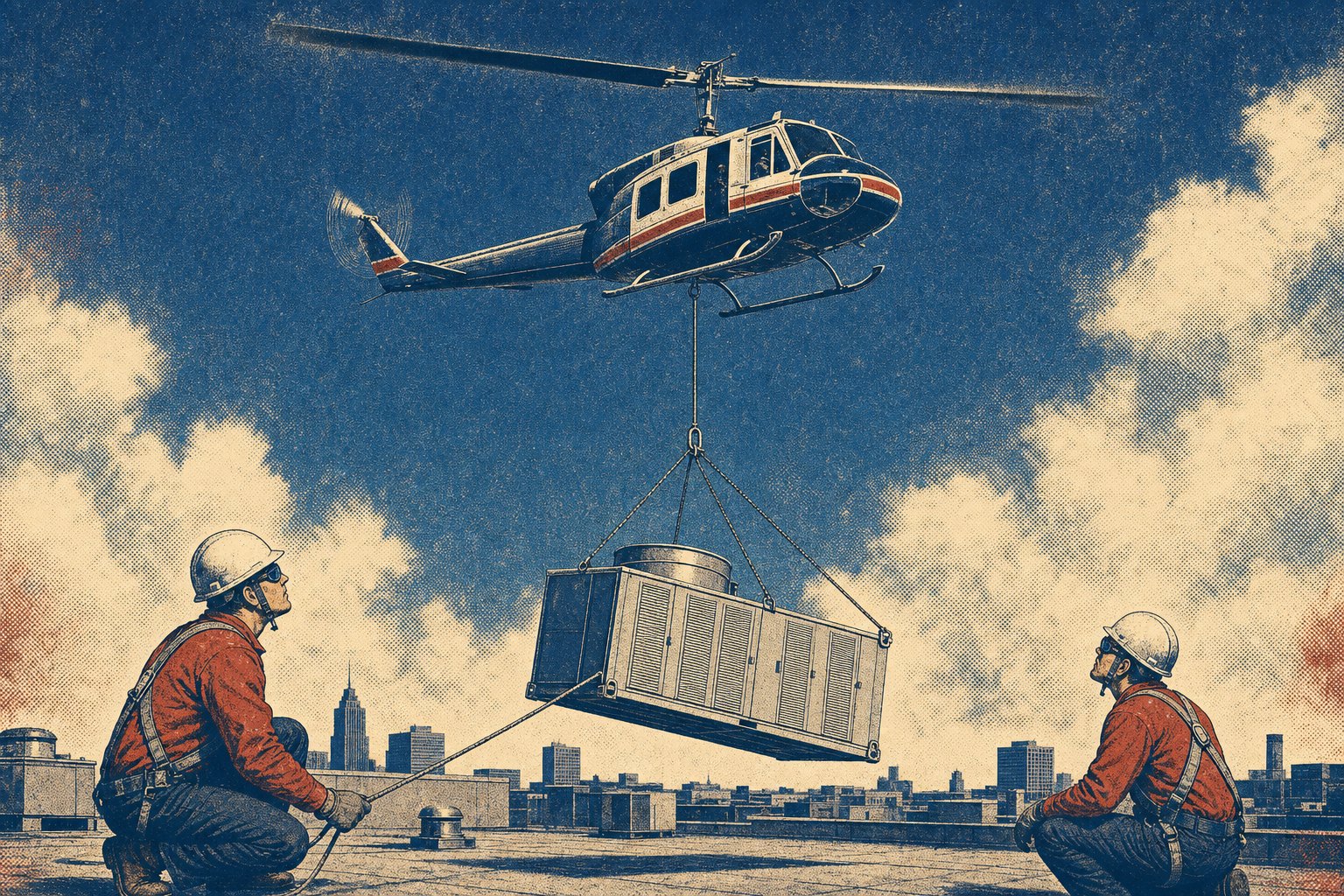
OSHA names exactly two pieces of personal protective equipment for the crew receiving a helicopter load: complete eye protection, and hard hats secured by chinstraps. That clause at 29 CFR 1926.551(e) runs under forty words and is the entire PPE requirement. Everything else a receiving crew wears is required by other paragraphs of the same rule or by three separate standards.
The paragraph is short enough to miss. A contractor reading 1926.551 for the first time finds nineteen lettered paragraphs covering briefings, cargo hooks, tag lines, static charge, approach distances, and open fires, and one of them, paragraph (e), is the only place the words "personal protective equipment" appear. It names two items and prohibits one category of clothing. Then it stops.
That brevity is the source of most of the confusion on lift sites. Crews show up in the standard construction kit of a hard hat and safety glasses and are told they are compliant, when the rule asks for something narrower on the eyes and something extra on the head, and says nothing at all about the loudest and most persistent hazard on the pad. This article works through what paragraph (e) actually demands, what the rest of 1926.551 adds, and which of the remaining hazards a receiving crew faces are governed somewhere else entirely.
The clause, in full
OSHA's helicopter PPE requirement for construction work reads as follows. Paragraph (e)(1): "Personal protective equipment for employees receiving the load shall consist of complete eye protection and hard hats secured by chinstraps." Paragraph (e)(2): "Loose-fitting clothing likely to flap in the downwash, and thus be snagged on hoist line, shall not be worn."
Two observations follow immediately. First, the requirement is written for a specific population, the employees receiving the load, not for everyone on the project. Second, it is a floor and not a kit list. The word "consist" invites a reading that the two named items are exhaustive, but 1926.551 is a section inside Subpart N, and the construction PPE standards in Subpart E apply to the same worksite on their own terms. Nothing in paragraph (e) displaces them.
OSHA 1926.551 Ground crew rule
"Complete eye protection" is a wind specification
The adjective is doing real work. The general construction eye standard at 29 CFR 1926.102 requires "appropriate eye or face protection" against flying particles and, in paragraph (a)(2), side protection where flying objects are a hazard. It never uses the word "complete." That word appears in the helicopter standards specifically, and OSHA has published no interpretation letter defining it.
The hazard the word is answering explains it. Ordinary construction eye protection is designed around debris arriving from a work piece in front of the worker, which is why detachable side shields are an accepted solution. Rotor downwash inverts that geometry. Grit, sand, roofing granules, and torn sheeting arrive on a horizontal wind from whatever bearing the aircraft happens to sit on, and the crew is looking up into it. Spectacles with side shields leave the brow and lower orbital gaps open to exactly that flow. A sealed or indirectly vented goggle, marked to one of the ANSI/ISEA Z87.1 editions incorporated by 1926.102(b)(1), closes the perimeter and is the reading that survives an inspection argument.
29 CFR 1926.102 Eye and face protection
The chinstrap requirement lives here and nowhere else
The construction head-protection standard, 29 CFR 1926.100, requires protective helmets wherever there is a possible danger of head injury from impact or from falling or flying objects, and paragraph (b)(1) accepts head protection meeting ANSI Z89.1-2009, ANSI Z89.1-2003, or ANSI Z89.1-1997. None of those consensus editions requires a retention strap, and 1926.100 does not require one either. The chinstrap obligation on a lift site comes from 1926.551(e)(1) alone.
That matters for procurement, because a helmet that satisfies 1926.100 on Monday does not satisfy 1926.551 on lift day if it has no strap. The International Safety Equipment Association, which serves as secretariat for the standard, notes that Z89.1 does not mandate a chin strap but sets dimensional requirements where one is fitted: at least half an inch wide, with strap elongation held under one inch. Type II helmets, which add lateral impact protection to the crown protection a Type I offers, are commonly supplied with a retention system already fitted, which is why they show up on lift crews even though OSHA's incorporation by reference does not compel the type.
29 CFR 1926.100 Head protection
The clothing prohibition is a snag rule, not a comfort rule
Paragraph (e)(2) states its own reason: loose-fitting clothing is barred because it is "likely to flap in the downwash, and thus be snagged on hoist line." The concern is entanglement with the line, not heat, abrasion, or appearance. Read against paragraph (c), which requires tag lines short enough that they cannot be drawn up into the rotors, and paragraph (f), which requires all loose gear within 100 feet of the pick and set points to be secured or removed, a consistent doctrine emerges. Anything on the site that can be lifted by moving air and carried into a rotating or moving component is either restrained or gone, and a jacket hem counts.
There is a payment wrinkle worth knowing. Under 29 CFR 1926.95(d), PPE used to comply with Part 1926 is provided by the employer at no cost, which covers the goggles and the chinstrap-equipped helmet. The same paragraph excepts everyday clothing such as long-sleeve shirts, long pants, and normal work boots. So the close-fitting clothing that (e)(2) effectively requires is the worker's own, while the two items paragraph (e) names are the employer's expense.
The PPE stack, mapped to what actually requires it
The table below separates the equipment a receiving crew wears from the legal instrument that requires it. Only the first two rows come from the helicopter PPE paragraph. The rest are hazard-triggered obligations under other standards that happen to be triggered on every external-load site, which is why they are so often assumed to be part of 1926.551 and are not.
| Item | Hazard it answers | What actually requires it | Named in 1926.551? |
|---|---|---|---|
| Complete eye protection (sealed or indirectly vented goggle) | Horizontal debris in rotor outwash | 1926.551(e)(1); construction criteria at 1926.102(b)(1), ANSI/ISEA Z87.1 | Yes, by name |
| Hard hat with chinstrap | Falling and flying objects; helmet loss to downwash | 1926.551(e)(1) for the strap; 1926.100 and ANSI Z89.1 for the helmet | Yes, by name |
| Close-fitting clothing | Snagging on the hoist line | 1926.551(e)(2), stated as a prohibition rather than a requirement | Yes, as a prohibition |
| Rubber gloves | Static discharge through the hookup crew | 1926.551(j), and only as the alternative to grounding the load | Yes, conditionally |
| Hearing protection | Sustained levels above 90 dBA at the pad | 1926.52 Table D-2 and 1926.101 | No, not mentioned |
| Safety-toe footwear | Dropped rigging hardware, set-down crush | 1926.96, hazard-triggered | No, not mentioned |
| Cut-resistant or leather gloves | Broken wire rope strands, pinch points | 1926.95(a), general PPE duty; no helicopter-specific rule | No, not mentioned |
| A distinguishing vest on the signalman | Misidentification of the person giving signals | 1926.551(r), which requires distinguishability, not conspicuity | Yes, indirectly |
Standards cited are the construction versions in 29 CFR Part 1926. General industry lifts fall under 29 CFR 1910.183, whose PPE wording differs slightly and is compared later in this article. Selection of a specific goggle, glove, or helmet type remains a hazard-assessment decision under 1926.95(a) and is not prescribed by the helicopter standard.
Hearing protection is the largest gap in the rule
Search 1926.551 for noise and nothing comes back. The standard governs the loudest routine operation on a construction site and contains no acoustic requirement, no exposure limit, and no reference to hearing protectors. The obligation is real, but it arrives through the general noise standards.
The measured picture is unambiguous. In a study of ground operations around a UH-60 Black Hawk published in Aerospace Medicine and Human Performance, Jones and colleagues reported A-weighted levels of 105 dB or greater in all operating conditions tested, with the 85 dBA contour extending beyond 100 feet from the aircraft and the highest risk at the left rear near the auxiliary power unit. The authors' recommendation was to wear hearing protection whenever the aircraft is running, regardless of distance.
Set that against Table D-2 of 29 CFR 1926.52, which permits 90 dBA for eight hours, 100 dBA for two, and 105 dBA for one. A crew standing on the pad through a four-hour set sequence is well past the permissible dose before lunch. Where levels cannot be reduced, 29 CFR 1926.101 requires ear protective devices, requires that inserted devices be individually fitted by a competent person, and states plainly that plain cotton is not acceptable.
29 CFR 1926.52 Permissible noise exposure 29 CFR 1926.101 Hearing protection
Nameplate attenuation does not close the gap by itself. OSHA's own field method derates a protector's Noise Reduction Rating by subtracting 7 and halving the remainder, so a 30 NRR earplug is credited with roughly 11.5 dB in practice rather than 30. The table below runs that arithmetic against the measured level.
| Condition at the receiving position | A-weighted level | Permissible daily duration, Table D-2 |
|---|---|---|
| Construction eight-hour limit | 90 dBA | 8 hours |
| Measured around a UH-60 in ground operations | 105 dBA or greater | 1 hour |
| Same exposure behind a 30 NRR earplug, OSHA-derated to about 11.5 dB | About 93.5 dBA | Between the 6-hour and 4-hour rows |
| Same exposure behind plug and muff together, crediting about 5 dB for the second device | About 88.5 dBA | Beyond 8 hours |
Levels are the Jones et al. UH-60 ground-operations measurements and are aircraft-specific and condition-specific; a lighter single or a quieter intermeshing-rotor type will read differently, and no reading substitutes for site monitoring. Derating follows OSHA's method of (NRR minus 7) divided by 2. Dual protection is not additive because sound reaches the inner ear by bone conduction, which is why the second device is credited with roughly 5 dB rather than its full rating.
One practical conflict deserves naming. Paragraph (r) of 1926.551 requires constant reliable communication between the pilot and a designated signalman, which in modern practice means a radio. Foam plugs and a handheld radio work against each other. Communication headsets with integrated attenuation resolve both obligations in one device, and their selection belongs in the pre-lift briefing paragraph (b) already requires, alongside the pre-lift sequence from site survey to load sign-off.
The static charge paragraph, and what it leaves undefined

Paragraph (j) reads: "Static charge on the suspended load shall be dissipated with a grounding device before ground personnel touch the suspended load, or protective rubber gloves shall be worn by all ground personnel touching the suspended load." Two compliance paths, and the rule accepts either.
The hazard is not theoretical. A helicopter in flight accumulates charge, and US multiservice sling-load doctrine identifies the drivers plainly: stored energy rises with aircraft weight, with low humidity, and with the volume of dust, sand, or snow the rotor system is moving. The hookup crew member who reaches for the apex fitting becomes the path to ground. Field doctrine backs the grounding path with hardware practice that OSHA does not specify, including a grounding stake driven six to eight inches into firm ground, twenty-four inches in sandy or loose soil, and set at a 45 degree angle away from the load.
What the rule leaves undefined is the glove. "Protective rubber gloves" carries no insulating class, no test voltage, no retest interval, and no reference to a consensus standard, in sharp contrast to the electrical protective equipment rules that specify class ratings and periodic testing. A contractor choosing the glove path is therefore choosing an undefined specification, which is one reason the grounding path is the more defensible of the two on any site where conductor work near energized circuits puts a second source of potential into the picture. The same paragraph is silent on mechanical hand protection, so the leather or cut-resistant gloves a crew needs for handling wire rope slings are required by the general PPE duty and by the hardware standards governing the rigging itself, not by the helicopter rule.
ASME B30 Rigging hardware standard
Glove selection is downstream of the rigging decision, and both belong in the same conversation as how slings, shackles, and tag lines get selected and inspected before a lift.
Why the eye rule is really a wind rule

Paragraph (f) draws a 100 foot radius around the pick and set points and requires everything loose inside it to be secured or removed. That number is not arbitrary. Rotorcraft outwash research conducted by NASA Ames and the US Army has measured peak outwash velocities in flight test near 90 knots for the CH-47D, 95 knots for the CH-53E, and 100 knots for the MV-22, which is roughly 104, 109, and 115 miles per hour respectively. Those are heavy types, and a medium single moves far less air, but the mechanism scales with disc loading rather than disappearing.
The distribution matters as much as the magnitude. Work presented at the American Helicopter Society's 71st Annual Forum found that maximum average outwash velocities occur around a radial station of roughly 1.5 rotor radii at a rotor height of one radius, not directly under the aircraft. The strongest wind on the site is therefore outboard of the disc, which is precisely where a crew stands to receive a load. It is also the reason housekeeping under paragraph (g) is written as a safety requirement rather than a tidiness one, and why walking the site in advance for staging space, flight paths, and loose material is the step that makes the PPE survivable rather than the last line of defense.
Two identical rules, two different enforcement postures
The same helicopter standard appears twice in OSHA's rules. 29 CFR 1926.551 governs construction work; 29 CFR 1910.183 governs general industry. They are usually described as identical. They are not, and the differences all run in the same direction: the general industry version assigns duties to the employer where the construction version states passive requirements.
| Paragraph | 1926.551 (construction) | 1910.183 (general industry) |
|---|---|---|
| (e)(1) PPE | PPE "shall consist of" complete eye protection and hard hats secured by chinstraps | Adds an affirmative duty: PPE "shall be provided and the employer shall ensure its use" |
| (d) Cargo hooks | Hooks tested prior to each day's operation | Employer shall ensure hooks are tested by a competent person |
| (j) Static charge | Grounding device, or rubber gloves worn by all ground personnel touching the load | Grounding device, unless rubber gloves are worn by all who "may be required to touch" the load |
| (m) Visibility | Ground personnel "shall exercise special caution" in reduced visibility | Employer shall instruct personnel and shall ensure the caution is exercised |
| (o) Approach distance | No unauthorized person within 50 feet of turning rotors | No employee within 50 feet unless work duties require presence in that area |
| (p) Approaching the aircraft | Employees shall remain in full view of the pilot and keep in a crouched position | Employer shall instruct employees and shall ensure they do so |
| (r) Communications | Signalman "distinctly recognizable from other ground personnel" | Signalman "clearly distinguishable from other ground personnel" |
Comparison drawn from the current published text of both sections. A commercial lift onto an occupied building normally sits in construction jurisdiction under Part 1926, while the same aircraft delivering to a working industrial facility can fall under Part 1910; the substance of the PPE requirement is the same either way, but the general industry text puts the provision and enforcement duty on the employer in explicit terms.
One further point on paragraph (r). The requirement that the signalman be distinguishable from other ground personnel is a differentiation requirement, not a conspicuity requirement. High-visibility apparel on the whole crew satisfies neither the letter nor the purpose of the paragraph, because a signalman in the same vest as everyone else is exactly what the rule is written to prevent. The compliant answer is a distinct color reserved for the one person authorized to give signals, which pairs with the exclusion of unauthorized people from the operating area that an urban lift plan has to secure in advance.
Where the crew stands, and when it may stand there
The positioning paragraphs are as much a control as the equipment ones, and they belong in the same briefing. Paragraph (o) keeps unauthorized people beyond 50 feet of turning rotor blades. Paragraph (p) requires anyone approaching or leaving the aircraft with blades rotating to remain in full view of the pilot and to keep in a crouched position, and bars work in the area from the cockpit or cabin rearward unless the operator authorizes it. Paragraph (i) permits work under a hovering aircraft only when necessary to hook or unhook loads, and requires a safe means of access to reach the hoist line hook.
Paragraph (b) requires a briefing before each day's operation setting the plan for the pilot and ground personnel, and paragraph (n) requires the signal system, radio or hand, to be understood and checked before the first load is hoisted. Those two paragraphs are where the PPE selection, the grounding method, the hearing-protection and radio arrangement, and the signalman's distinguishing color are all fixed for the day. None of it is a decision to make at the hook.
The regulatory stack above the crew is separate and belongs to the operator, whose external-load authority runs through the federal certificate governing rotorcraft external-load work, not through OSHA. The receiving crew works for the contractor, and the contractor owns paragraph (e).
What a compliant receiving crew carries
- Sealed or indirectly vented goggles marked to an ANSI/ISEA Z87.1 edition incorporated by 1926.102(b)(1), not spectacles with side shields.
- A hard hat meeting an ANSI Z89.1 edition accepted by 1926.100(b)(1), with a chinstrap fitted and fastened, because 1926.551(e)(1) requires the strap that the head-protection standard does not.
- Clothing that cannot flap, with hems, cuffs, and high-visibility apparel restrained so nothing can reach the hoist line.
- Hearing protection selected against a measured site level rather than a nameplate rating, integrated with the radio the signalman needs under paragraph (r).
- Rubber gloves for anyone who may touch a suspended load, unless the load is grounded first, plus mechanical hand protection for handling the rigging.
- A distinguishing color worn only by the designated signalman.
The list is short because the rule is short. What makes an external-load site safe is not the length of the PPE clause but the fact that the two items OSHA does name, complete eye protection and a strapped hard hat, are the two that fail first in a 100 mile per hour horizontal wind. Everything else on the list is an ordinary construction obligation that a helicopter happens to intensify, and the sites that treat it that way, from rooftop mechanical unit sets to remote steel, are the ones where the receiving crew never becomes the story.