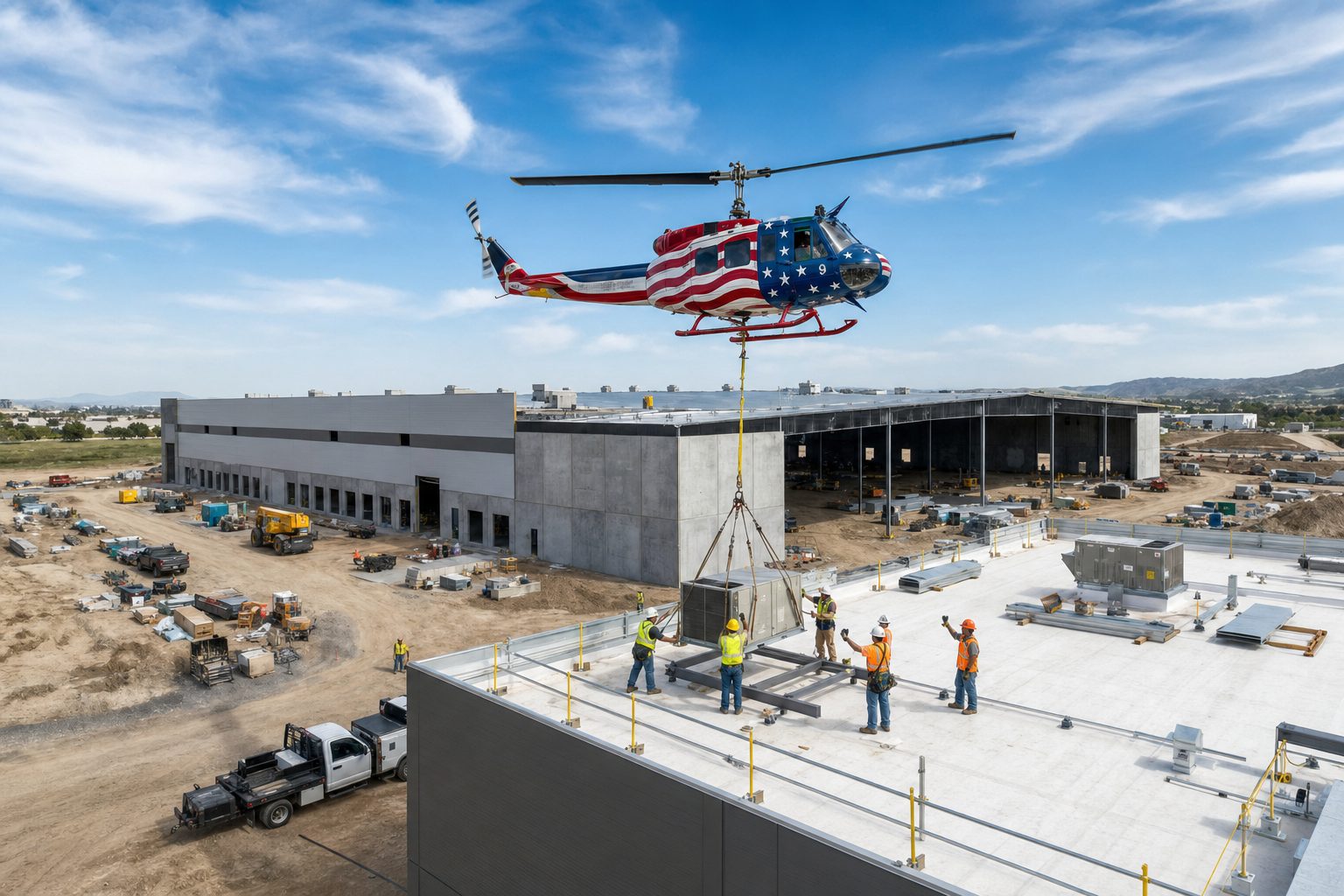
Aerial construction field study
Helicopter HVAC Lifts: How Rooftop Unit Placement Actually Works
A helicopter HVAC lift can reach rooftop units beyond a practical crane setup. Whether it belongs in the bid depends on the equipment weight and the site, including where crews can stage loads and keep people clear. This page explains the flight sequence, the full cost comparison with a crane, and the information a mechanical estimator needs before carrying either method into a bid.
The bid decision
Why Mechanical Contractors Put a Helicopter HVAC Lift in the Bid
Start with the ground crane. If it can reach the curbs from a workable setup position, it gives the estimator a useful baseline. Check the required reach against capacity, then account for getting the crane onto the property and supporting it there. A low equipment rate means little if the setup requires substantial ground preparation or a street closure.
The helicopter becomes worth comparing when those access costs grow. It can carry a unit across a roof without moving a crane around the building. But its own plan still needs a pickup area, a flight route and ground protection. A building or parking lot staying open is a site-specific planning question. It cannot be promised from the lifting method alone.
Carry the whole equipment schedule into the comparison. A short flight window only helps if the old units are ready to come off and the replacement curbs are ready to receive them. Include that preparation in the labor plan, along with the consequences of a weather delay.
The estimator's questions, and how the industry answers them
| The question at bid time | What the written package should establish |
|---|---|
| Can the estimator carry a fixed number? | The pricing basis, included work and exclusions. Identify ferry charges, flight time, standby and cancellation terms even when the total is fixed. |
| Who deals with the FAA? | The named flight operator handles its aviation approvals. The package assigns site access and local coordination to the people responsible for delivering them. |
| What if the replacement is a different weight? | Use its actual lift configuration and rigging weight. Check the roof and curb against the selected equipment. |
| What insurance documents reach the GC? | Policies and endorsements relevant to this lift, including the scope of cargo coverage while the unit is on the hook. |
| What does the installing crew do? | Named receiving and ground roles, required preparation, and a briefing plan. Crew size follows the work. |
| What happens if weather stops the lift? | The operator's operating limits, the rescheduling process and which standby costs remain payable. |
The operational sequence
How a Helicopter HVAC Lift Works
A rooftop unit suspended clear of the surface and releasable during flight fits the Class B definition in 14 CFR §1.1. That describes the routine HVAC lift discussed here. The external load operations reference explains the other load classes and Part 133.
1. Technical vetting
The contractor supplies the equipment schedule and submittals, with a roof plan showing each destination. The operator needs a reliable weight for each pick, one lift of a load, plus its dimensions and lifting points. Identify the weight basis: shipping weight, operating weight and the weight actually being lifted may differ. Resolve missing data before assigning an aircraft.
2. Lift engineering
The operator checks the load and rigging against aircraft performance and plans the route. A longline is the line suspending the load below the aircraft. Its selection belongs with the rest of the rigging design and the aircraft's approved limitations. Confirm that each component suits the load and its place in the lifting system.
Density altitude describes air density as an altitude. Higher density altitude means thinner air and affects aircraft performance. Use the aircraft's performance information for the expected conditions, then check conditions again on lift day. The FAA's helicopter performance guidance explains how conditions affect performance.
3. Regulatory execution
For congested-area work, the operator develops the operation-specific plan and coordinates approval with the responsible FAA Flight Standards office. Put that approval into the schedule alongside equipment delivery. Establish review timing with the responsible office and make approval a milestone in the lift schedule.
4. Flight operations
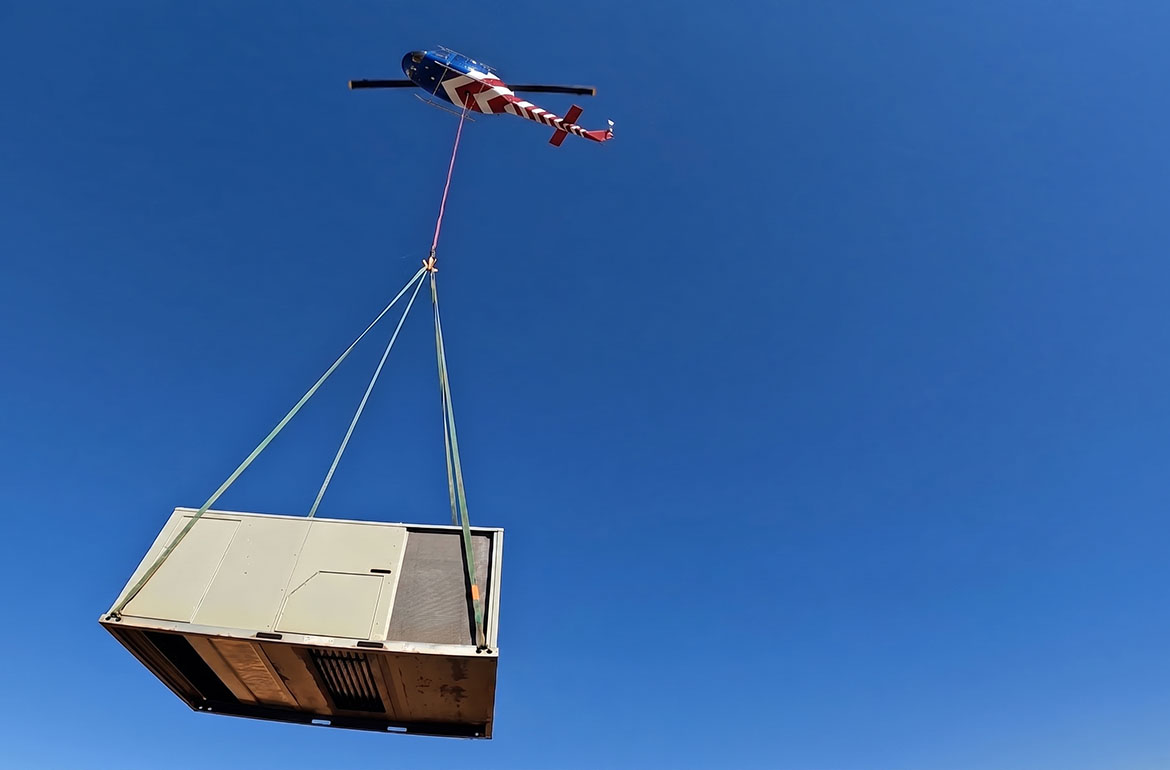
Crews stage the units in the planned order inside the controlled pickup area. Each cycle includes attachment, flight to the roof, placement and release, followed by the return for another load. The roof crew communicates with the pilot using the agreed signals or radio procedure. The time per cycle depends on the route and the work at both ends. Use the operator's cycle estimate to plan the receiving work and flight window.
5. Demobilization
After flying ends, crews remove the lifting equipment and clear the staging area. Site controls come down when the responsible people confirm the area can reopen. Mechanical connections and commissioning have their own schedule. Finishing the last pick does not finish the HVAC installation.

Comparing costs
Crane vs. Helicopter for HVAC Rooftop Units: Run the Total Lifted Cost
Compare the cost of moving the complete equipment schedule to its final positions. Both estimates need the same scope, including removal of the old units where required. A crane day rate and a helicopter flight-hour rate cover different work. Put mobilization and site costs beside them before deciding which is lower.
| Cost factor | Ground crane | Helicopter HVAC lift |
|---|---|---|
| Pricing basis | Crane size, operating time, crew and minimum charges | Aircraft, flight time, crew and minimum charges |
| Mobilization and demobilization | Transport, permits and assembly required by the selected crane | Ferry flight, support arrangements and travel charges |
| Reach and capacity | Capacity at the actual radius and configuration | Capacity for the load under site conditions and aircraft limitations |
| Site preparation | Access route, ground-bearing assessment and any mats or shoring | Load staging, pickup area and route protection |
| Public access | Any lane closures, permits and traffic control needed for the setup | Any closures or access restrictions needed to protect the operation |
| Lift duration | Pick sequence, repositioning and installation pace | Flight route, load handling and roof readiness |
| Delay exposure | Standby, permit delays and operating limits | Weather, approval timing, standby and rescheduling terms |
| Closeout | Teardown, mat removal and any agreed restoration | Equipment removal, staging cleanup and release of site controls |
For a roof with units spread well beyond one crane position, repositioning belongs in the crane estimate. For an aircraft based far away, ferry time belongs in the helicopter estimate. Neither cost disappears because the lift itself is brief. The Helicopter vs. Crane: Total Lifted Cost Analysis develops the comparison further.
When the ground crane wins
- A few units with workable access. If a mobile crane can reach the curbs without expensive setup work, compare that proposal before assuming an aircraft saves money.
- Placement needs extended positioning time. Include the time required to align and secure equipment. A crane may fit that positioning sequence better.
- The proposed aircraft cannot carry the load. Compare another lifting method or an engineered change to the equipment package. A published fleet maximum does not establish capacity at this site.
- The flight route cannot be protected. If the operation cannot meet its ground-protection requirements, the helicopter plan needs to change before cost matters.
Aircraft selection
Aircraft Selection for Rooftop Unit Placement: Match the Airframe to the Lift Weight
Start with the actual suspended weight, including rigging. Then check the aircraft's performance and whether its certification permits the proposed operation. The figures below show the scale of published capacities. Their bases differ, so they cannot be read as interchangeable lift-day allowances.
| Aircraft | Published capacity | Figure basis and source |
|---|---|---|
| Erickson S-64F Air Crane | 25,000 lb | Erickson: maximum external cargo. |
| Erickson S-64E Air Crane | 20,000 lb | Erickson: maximum external cargo. |
| Sikorsky S-61N | 10,000 lb | Helimax: external capacity at standard day, sea level. |
| Bell 214B Big Lifter | About 8,000 lb | McDermott Aviation: 3,636 kg maximum hook load. |
| Kaman K-MAX | 6,000 lb | Kaman: published lifting capacity. |
| Bell 412EP | 4,500 lb | Avincis specifications, page 4: maximum hook load. |
Certification needs a separate check. §133.45(d) prohibits rotorcraft type certificated in the restricted category under §21.25 from operating over densely populated areas, in congested airways or near busy airports with passenger transport operations. An approved congested-area plan does not remove those restrictions. Check the specific aircraft's certification and limitations early.
If the roof work also includes penthouse steel or a prefab mechanical room, include that scope in the planning discussion. See steel and infrastructure placement and modular building placement, or the aerial construction hub for related methods.
Replacement unit weights
Replacement Rooftop Units: Verify the Actual Weight and Curb Fit
A replacement unit is not automatically heavier. Daikin, for example, describes Rebel Applied configurations that weigh less than legacy equipment. An efficiency label does not tell the lift planner what is on the hook.
Use the selected unit's submittal, including its ordered options. Matching cooling tonnage does not establish matching weight or fit. Carry these checks through the equipment schedule:
- Confirm the lift configuration. Identify what is attached when the unit flies, and add the rigging weight. Resolve differences between shipping data and the planned load with the manufacturer and operator.
- Verify the roof and curb. Have the responsible engineer check the selected equipment against the actual support conditions. A lighter unit can still have a different footprint or load distribution.
- Account for curb adapters. If one is required, identify its weight and decide how it reaches the roof. Put it in the sequence before the unit that needs it.
- Use the equipment's handling instructions. Confirm the refrigerant and charge condition from the actual manufacturer documentation. The operator must resolve applicable transport requirements; a refrigerant name alone does not clear equipment for flight.
- Follow the revised equipment schedule. Where the mechanical engineer's commercial load calculation changes unit selection, carry the new models into the lift plan. ACCA Manual N addresses commercial load calculation; Manual J is the residential reference.
FAA and OSHA requirements
Who Handles the FAA: Part 133, the Congested Area Plan, and Noise
The flight operator handles its aviation compliance. The contractor and property owner still have work to do on the ground. When a coordinator arranges the lift, identify the company that will fly it and keep the certificate review attached to that operator.
Part 133 and the aircraft. Match the operator's authority and approved load classes to the work. The aircraft and load combination must comply with the applicable Rotorcraft-Load Combination Flight Manual. §133.33 sets these operating requirements.
Congested Area Plan. Section 133.33(d) requires an operation-specific plan and FAA approval. It includes an agreement with local officials to exclude unauthorized people, any necessary air traffic control coordination, and mapped flight routes and altitudes. Flights need routes that permit emergency load release and landing without hazard on the surface. The site team must be able to deliver the access restrictions supporting that plan.
Ground operations. OSHA 1926.551 requires daily briefings for helicopter construction work. It also addresses loose objects and static electricity. Put the planned static-electricity procedure into that briefing. It must comply with the standard, and personnel need to understand it before contact with the hook or load.
Noise and local arrangements. Check the requirements that apply to the property and municipality. Assign responsibility for any permits and tenant notices, then agree the proposed work window. FAA approval does not settle every local site issue, and a short flight estimate does not establish an allowable noise window.
Crew roles
The Contractor's Crew on the Roof
The lift plan needs named responsibilities at both ends of the flight. Crew numbers follow the load and site conditions, with enough personnel for the assigned receiving work and access controls.
The operator's role covers aircraft operation and the flight plan, including the rigging arrangements and communication procedure. The pilot in command has final authority over aircraft operation under 14 CFR §91.3. A contractor's installation deadline cannot override that authority.
The contractor's role includes supplying the equipment information and completing the site work assigned in the plan. That can include disconnecting old units, preparing curbs and providing receiving personnel. Agree who supplies and inspects lifting equipment instead of assuming it follows a job title.
A planned sequence might assign work this way:
- Ground personnel stage the units in order and carry out their assigned attachment duties inside the controlled pickup area.
- Roof personnel receive each unit using the operator's agreed positioning and communication procedures. They confirm the placement is ready for release before the aircraft leaves with the lifting gear.
- Site control personnel maintain the agreed access restrictions while flying is underway.
- Everyone involved attends the daily briefing and understands the stop signal. If the sequence changes, resolve it before the next load arrives.
Additional receiving personnel can prepare another curb while a set unit is secured, if the site plan allows it. Match that staffing decision to the roof layout and the time needed at each curb.


The lift package
What a Complete Lift Package Contains
The package should let the estimator carry the lifting scope into the bid and show the installation team what must be ready. Look for:
- A defined price basis. Included flight time and ferry charges, support costs, exclusions, and the terms for standby or cancellation.
- A project-specific sequence. The equipment manifest, expected duration and assumptions about pickup distance and roof readiness.
- Insurance documentation. Relevant policies and endorsements, including any cargo coverage while the load is on the hook. Check the actual additional-insured and waiver-of-subrogation provisions against the project's requirements.
- Approval milestones. The operator's FAA coordination and any site permits placed against equipment delivery and the proposed flight date.
- Division 23 scope language. Clear boundaries for removal, rigging responsibilities, curb work and receiving duties, with the remaining installation work assigned.
Put those assumptions in the logistics appendix. If a curb adapter arrives late or a roof area cannot be cleared, the project team can see which part of the sequence changes and which costs need revisiting.
Keep studying the method
Keep Studying the Method
The aerial construction hub covers related rooftop and structural work. The external load operations reference explains Part 133 and the load classes. New articles in this series are announced through the mailing list.
Frequently asked questions
What Estimators Ask About Helicopter HVAC Lifts
From the technical library