Utility and infrastructure field study
Offshore Helicopter Support: Crew Change, Deck Cargo, and the Rules Over Water
Most offshore rotorcraft support is not external load work. The aircraft that serve platforms and offshore wind fields usually fly under a different certificate, carry over-water equipment that onshore lifts do not need, and are limited by the receiving deck before payload becomes the question. This page separates offshore transport from the external load work it is often confused with, and explains which certificate and which aircraft each mission calls for.
Start here
Two Different Certificates, Two Different Missions
A heavy lift operator and an offshore transport operator are often different companies, and sourcing offshore aviation starts with knowing which one the work needs.
14 CFR Part 133 governs rotorcraft external-load operations, where the load is carried outside the fuselage on a hook or sling. It is the rule behind every lift described elsewhere on this site. The work requires a Part 133 operator certificate, and each aircraft and load combination is flown under its Rotorcraft-Load Combination Flight Manual (RLCFM).
Most offshore rotorcraft activity is something else. Crew rotation to a platform, cargo carried in the cabin or a belly compartment, and technician movement across a field all carry persons and property inside the aircraft for compensation. That work falls under 14 CFR Part 135, the commuter and on-demand air carrier rule. Part 135 brings its own requirements: operations specifications naming each authorized area, duty and rest limits, dispatch or flight-following requirements, and maintenance program obligations.
External load work does occur offshore. Setting a compressor skid or a package on a deck, moving components during platform construction or decommissioning, and handling offshore wind components are Part 133 missions, flown by operators holding that certificate. The distinction matters when the vendor is selected, well before flight planning. A Part 133 certificate does not authorize a crew change, so an operator with a strong external-load record and no Part 135 certificate cannot legally fly one. An offshore transport specialist, for its part, may hold no external-load authority at all.
When qualifying an offshore vendor, describe the mission first and let the certificate follow. If personnel ride in the aircraft, check Part 135 and the operations specifications. If a load hangs beneath it, check Part 133 and the RLCFM for that specific aircraft and load combination. A program that needs both is buying two capability sets, whether one company holds them or two.
Read the Operator Vetting GuideThe work
What Actually Moves, and On What Cycle
Offshore aviation works more like a scheduled logistics service than a project. The cycle repeats whether or not anything is being built.
Crew rotation
Crew rotation is the core of the work. Offshore facilities run continuous shifts and personnel rotate on fixed hitches, so demand for seats repeats on a schedule measured in weeks rather than in lift days. That pattern is why offshore aviation is typically contracted as a term agreement with dedicated aircraft instead of being priced lift by lift.
Deck cargo and freight
Parts, consumables, samples and time-critical components travel inside the aircraft, so cabin and door dimensions limit them before hook capacity does. When an item will not fit through the door or inside the cabin, the mission becomes an external load under a different certificate. That is where the two halves of offshore aviation meet.
Construction and decommissioning
Platform build-out and removal generate real external load work: skids, packages and structural components set on deck where a marine crane cannot reach or cannot be scheduled. The work comes in episodes rather than a continuous cycle. It is planned like any other Part 133 lift, with one added constraint: the receiving surface is small, elevated and surrounded by water.
Offshore wind
Offshore wind has its own pattern: technicians transferred to individual turbines, hoist operations where no deck landing is available, and component handling during construction. The over-water equipment rules and the twin-engine reasoning carry across from oil and gas. The receiving structure does not; a turbine is a very different target from a platform helideck.
The equipment
Why the Offshore Fleet Looks Nothing Like a Lift Fleet
Over open water there is no forced-landing option, so performance class selects the aircraft before hook capacity does.
An onshore utility program can fly single-engine aircraft because an engine failure can end in an autorotation to a field, a road or a clearing. Offshore, the same failure ends in the water. The offshore fleet is therefore built around medium and heavy twins. A twin with the performance to continue flight on one engine at its operating weight turns an engine failure from an immediate ditching into a diversion to a deck or a shoreline.
That requirement shapes the other choices. Twins carry more weight in engines, gearboxes and required equipment, so useful load per seat is lower than on a comparable onshore aircraft. Range has to cover the trip out, the trip back and a reserve that allows for the destination deck closing in fog with no alternate within reach. Health and usage monitoring systems are standard equipment rather than options, because over water a component trend is worth catching before the next scheduled inspection.
Heavy lift planning asks a different question. A Part 133 program asks what the aircraft can carry on the hook at the day's density altitude. An offshore program asks how many people it can carry, how far, on one engine, with the required reserve, onto a deck of a specified size.
| Aircraft | Class | Configuration | Typical offshore role |
|---|---|---|---|
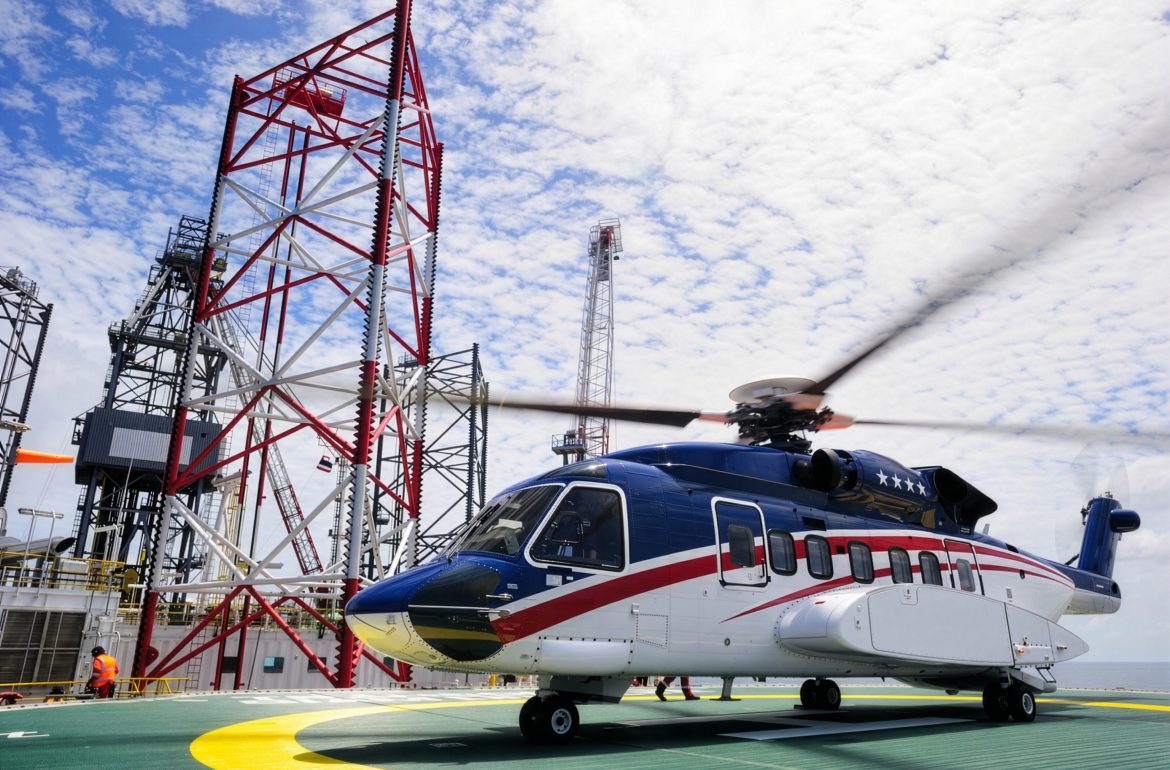
| Sikorsky S-92 | Heavy twin | Two engines, retractable gear | Long-range crew change to deepwater and floating facilities |
| Leonardo AW189 | Heavy twin | Two engines | Long-range crew transport; search and rescue variants |
| Sikorsky S-76D | Medium twin | Two engines, retractable gear | Shelf and mid-range crew transport |
| Leonardo AW139 | Medium twin | Two engines | General-purpose offshore transport across field distances |
| Bell 412 series | Medium twin | Two engines | Shorter-range field work and shelf transport |
| Airbus H175 | Medium-heavy twin | Two engines | Medium to long-range crew transport |
The aircraft are listed by configuration and role rather than hook rating, because offshore selection turns on performance class, range with reserves and the receiving helideck. Payload for a specific mission comes from the operator's performance data for the day's conditions.
The rulebook
Equipment the Water Requires
Each item below matters because survival in an offshore emergency depends on what was aboard before it started.
For extended over-water operations, 14 CFR 135.167 sets the federal minimum: an approved life preserver with a survivor locator light, accessible to every occupant; enough approved life rafts to carry everyone aboard; survival equipment appropriate to the route; and a survival-type emergency locator transmitter in one of the rafts. Offshore aircraft also carry emergency flotation systems on the gear or fuselage, armed for the over-water part of the flight, so that after a controlled ditching the aircraft stays upright long enough to evacuate.
Industry practice adds requirements beyond the federal minimum. Operators and the energy companies chartering them require underwater escape training before anyone rides offshore, because getting out of an inverted, flooding cabin is a trained skill. Immersion suits are issued when water temperature, rather than flotation, limits survival time. Personal locator beacons are commonly carried on each person rather than only in the aircraft, so a survivor separated from the aircraft can still be located.
Manifesting is stricter than onshore practice and serves a second purpose. Every occupant and every pound is recorded before departure, for weight and balance and because an accurate count of who is over the water is the first input to any search. Cargo follows the same rule. Undeclared weight in the cabin is a weight-and-balance problem onshore; offshore it also affects survivability.
The equipment list assumes an emergency has already happened, so it does not replace performance planning. Twins with one-engine-inoperative capability are chosen to keep that emergency from happening.
14 CFR 135.167 Over-water equipment 14 CFR Part 135 On-demand operations 14 CFR Part 133 External load
The receiving structure
The Deck Decides the Aircraft
A platform helideck is a small, elevated, obstructed landing surface with a fixed design envelope. A larger aircraft being available does not change it.
Every helideck is designed around a D-value, the overall length of the largest rotorcraft it is rated to accept, along with a maximum landing weight and a defined obstacle-free approach and departure sector. Those three figures, rather than the payload requirement, determine which aircraft can serve a facility. A deck sized and rated for a medium twin cannot take a heavy twin. If the payload needed exceeds what a suitable aircraft carries, the answer on that facility is more flights rather than a larger aircraft.
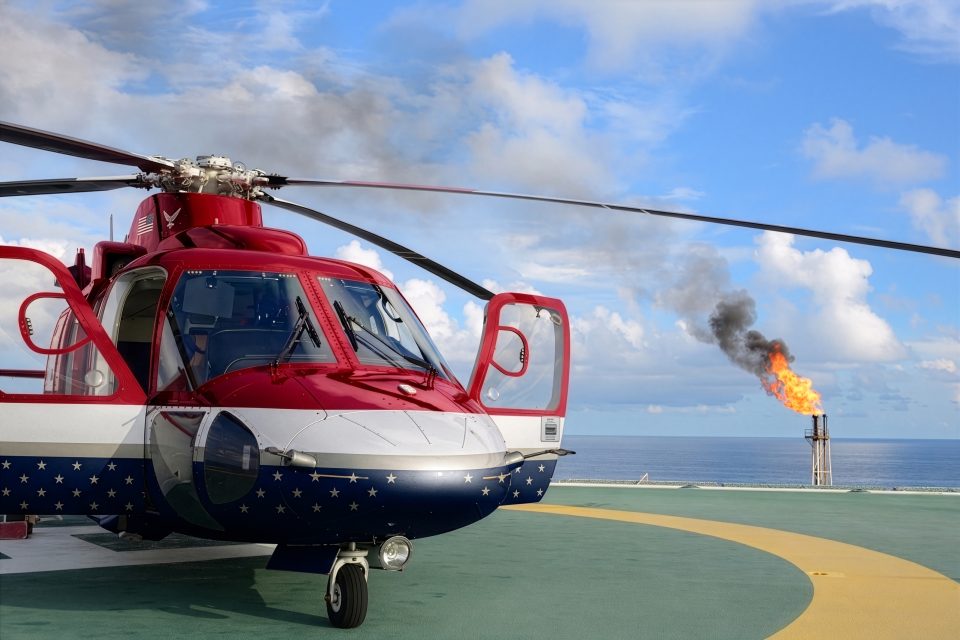
The surroundings matter as much as the deck. Platform structures create turbulence, and flare stacks and exhausts send up hot plumes that change the air on short final. On floating facilities the landing surface also moves in three axes. Night operations need deck lighting and perimeter marking. Refueling capability decides whether the aircraft can refuel on the deck or must carry fuel for the return leg, and carrying return fuel reduces useful load outbound.
Onshore, the equivalent is the set-point analysis for a lift, with one difference. An onshore set point can often be moved, staged differently or approached from another direction. A helideck stays where it was built, at the size it was built, for the life of the facility.
The constraint stack
What binds first, in order
- D-value. Overall rotorcraft length the deck accepts.
- Maximum landing weight. Structural rating of the deck.
- Obstacle-free sector. The approach and departure path.
- Refueling. Whether the aircraft turns on deck or carries return fuel.
- Lighting. Whether the deck is usable after dark at all.
- Payload. Last, and only within everything above.
The variable
Weather Removes the Alternates
Onshore, marginal weather delays a lift. Offshore, it can halt a program, because the diversion options that make an onshore delay tolerable are missing. Marine fog can cover a whole field at once, closing the destination deck and every nearby deck together. Low ceilings over featureless water remove the visual references a pilot would use onshore. Offshore programs are therefore planned around instrument capability and fuel reserves rather than waiting for a clear hour.
In the Gulf of Mexico, hurricane season adds a pattern with no onshore equivalent. Evacuations move large numbers of personnel off facilities within a window set by the storm track, and demand for aircraft peaks across the region at the same time. Programs that run aviation as a scheduled service for the rest of the year plan hurricane season around surge capacity contracted before it is needed.
The planning follows the same principles as any weather-sensitive aerial operation, without a nearby alternate to fall back on. The analysis of density altitude and lift capacity explains how atmospheric conditions become a performance figure for the day rather than a contract number.
Related reading
The rules beneath the hook
Where offshore work involves an external load, it runs under the same Part 133 rules as every other lift on this site.
The reading path
Where This Analysis Goes Next
Offshore support sits at the edge of external load work, and knowing where that edge falls is the point of this page. The rule behind every hook operation is explained in the Part 133 external load operations reference. The same roadless-logistics problem in a different setting is covered under mining operation support, and the full section is at utility and infrastructure. New analyses are announced through the mailing list.
Frequently asked questions
What Offshore Planners Ask First
From the technical library