
A helicopter lift is planned, not improvised. Working operators run a structured pre-lift process that moves from a site survey and load engineering through an FAA-recognized lift plan to a load sign-off and crew briefing before the aircraft ever lifts a hook. The flight is the shortest part. The plan is where the weight is verified, the rigging is engineered, the airspace is cleared, and the go or no-go decision is made. Understanding that process is how a project manager reads an operator's competence before a single blade turns.
Most people picture a helicopter lift as the moment the load leaves the ground. That moment is the last one percent of the work. Everything that decides whether the lift is safe, legal, on schedule, and on budget happens in the days and weeks before, on paper and on site. For a contractor planning a first aerial lift, the single most useful thing to understand is the sequence of that planning, because the quality of an operator shows in how thoroughly they run it.
This is the operator's-eye walkthrough of that sequence: the phases a competent Part 133 operation moves through, what gets decided in each, who is accountable for what, and where a lift plan reveals that a helicopter is the wrong tool. The regulatory architecture underneath it all is covered in the external load operations reference; this article is the process that architecture governs.
Why the plan, not the flight, is where the risk lives
An external load operation compresses enormous force into a short window over an occupied or high-value site. The margins are engineered in advance or they are not there at all. A pilot in command cannot solve on the hook a problem that should have been solved on the drawing: an unknown load weight, an unsurveyed obstacle, a rigging angle that overloads a sling, a density altitude that strips the aircraft's lift on a hot afternoon. The plan exists to remove those unknowns one at a time, so that on lift day the crew is executing a rehearsed sequence rather than discovering conditions.
That is also why the planning process is the best due-diligence tool a buyer has. An operator who asks for certified load weights, requests a site survey, files early, and briefs the ground crew is demonstrating the discipline that keeps the lift uneventful. An operator who quotes a price over the phone without any of that is quoting a number, not a plan.
Phase one: the site survey and feasibility study
The process opens with a question that has nothing to do with the aircraft: can this site be worked from the air at all? A site survey, done from drawings and then confirmed on the ground, establishes the physical envelope of the operation.
- Pick and set points. Where the load starts, where it must land, and the flight line between them. Both points need clear vertical approaches free of wires, antennas, and crane booms.
- Obstructions. Power lines, guy wires, light poles, adjacent structures, and other cranes on the site. Wires are the defining hazard of low-level external load work, and they are mapped before anything else.
- The fall zone. The ground area beneath the flight path that must be cleared of non-essential personnel for the duration of the lift. Establishing and securing it is a planning deliverable, not a lift-day afterthought.
- Staging and landing zones. Space for the ground crew, the load build area, fueling, and the aircraft's own approach and departure corridors.
- Density altitude. The site elevation and the forecast lift-day temperature, which together determine how much of the aircraft's rated capacity is actually available. Payload falls by roughly three percent per 1,000 feet of density altitude, so a high or hot site changes which aircraft in the civil fleet capacity table can do the job.
The survey answers feasibility before it answers method. Sometimes it ends the aerial conversation entirely: a site with no clear approach, or a density altitude that no available airframe can overcome at the required weight, is a ground-equipment job. A competent operator says so at this stage rather than discovering it on the hook.
Phase two: load engineering and rigging design
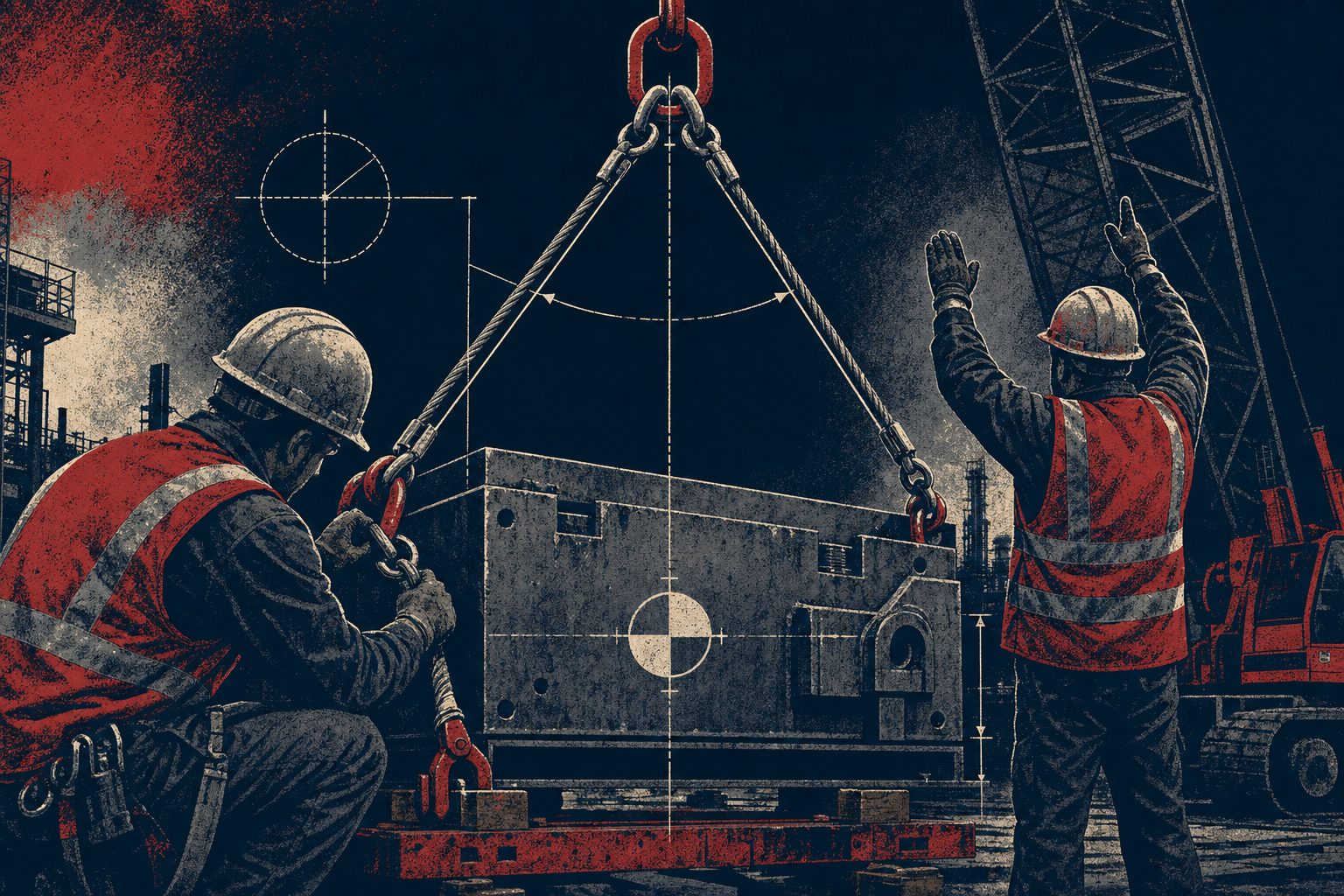
Once feasibility is settled, the load itself is engineered. This is the phase that demands operating knowledge, because every decision in it depends on what the aircraft and the rigging will actually do.
It begins with a number that must be certified, not estimated: the load weight. Every downstream decision, aircraft selection, sling sizing, and go or no-go margin, rests on it. The contractor is responsible for supplying certified weights and engineered pick points; guessing here is the most common way a lift plan goes wrong. With the weight fixed, the operator adds the weight of the rigging itself and any spreader hardware, then compares the total against the aircraft's available capacity at the site's density altitude, not against the brochure figure.
Rigging design follows. The center of gravity is located so the load flies level and stable rather than tipping under the hook. Sling angles are calculated, because the tension in a sling climbs sharply as the angle from vertical increases, and a shallow bridle can overload a sling that looked adequate on paper. Below-the-hook devices and rigging hardware are selected under the ASME B30 standards, with slings carrying a minimum five-to-one design factor. The pilot in command holds final legal authority over rigging integrity and can refuse any load that does not meet it.
The output of this phase is a specific aircraft matched to a specific load with a specific rigging arrangement and a real margin, all of it documented. That margin is the difference between a routine pick and an emergency load release.
Phase three: the regulatory package
External load work is a certificated activity under 14 CFR Part 133, and the regulatory package is assembled in parallel with the engineering. The operator carries this burden, and a contractor should expect to see it handled, not hear it hand-waved.
14 CFR 133 External load certificate
| Element | What it establishes | Who owns it |
|---|---|---|
| Part 133 certificate and load class | The operator's authority to conduct external load ops and the load class (A through D) that matches the lift | Operator |
| Rotorcraft-Load Combination Flight Manual | That the specific aircraft and load arrangement are an approved combination | Operator |
| Congested Area Plan (14 CFR 133.33) | Approval to operate over a congested area: routes, fall zones, jettison corridors | Operator, reviewed by the local FSDO |
| Airspace coordination and NOTAM | Deconfliction with other traffic and controlled airspace where required | Operator |
| Certified load weights and pick points | The engineering inputs the whole plan depends on | Contractor |
The Congested Area Plan is the element most likely to affect a contractor's schedule. Lifts over congested areas require a written plan prepared under the guidance of FAA Advisory Circular 133-1B that the local Flight Standards District Office reviews, and experienced operators file early so that review never sits on the critical path. A schedule that assumes same-week approval for a downtown lift is a schedule that has not planned the lift. The load class also constrains aircraft selection: restricted-category surplus airframes cannot fly congested-area operations without specific authorization, which is why urban work belongs to standard-category aircraft.
Phase four: what a lift plan actually contains
The lift plan is the document that ties the phases together. It is the artifact a serious operator will walk a client through, and its completeness is a direct readout of operating discipline. A working lift plan covers, at minimum:
- The load: certified weight, dimensions, center of gravity, and pick points
- The aircraft: type, available capacity at forecast density altitude, and the margin over the load
- The rigging: sling type and rating, angles, below-the-hook devices, and the design factor
- The flight profile: pick point, set point, route, altitudes, and approach and departure paths
- The fall zone: its boundary, how it is secured, and who controls access
- Ground crew roles: pilot in command, ground crew, and the single designated signal person
- Communications: radio frequencies, hand signals, and the abort call that any crew member can make
- Contingencies: the emergency load-release plan, jettison corridor, and weather limits
- The regulatory package: certificate, load class, and Congested Area Plan status
A plan that a contractor can read and understand at eleven at night is also a plan the crew can execute at seven the next morning. Vagueness in the document is vagueness on the site.
Phase five: ground crew roles and the pre-lift briefing
Aerial lifting is a ground operation with an aircraft attached. Most of the people on a lift never leave the ground, and their roles are defined in the plan and confirmed in a briefing before the first pick. The ground crew standard for external loads sits under OSHA 1926.551, which governs personal protective equipment, tag-line discipline, rigging inspection, and static discharge, where the load is grounded with a discharge conductor before any crew member touches it.
Three roles anchor the operation. The pilot in command holds final authority over the aircraft, the load, and the decision to lift or abort. The ground crew builds and hooks the load and manages tag lines. A single designated signal person, and only one at a time, directs the pilot, so the aircraft never receives conflicting commands. Critically, any crew member can call an abort at any time for any reason, and the call is honored without debate. That single rule, understood by everyone before the lift, is what keeps a surprise from becoming an incident.
The pre-lift briefing is where the plan becomes shared knowledge. The crew walks the sequence, confirms roles and signals, reviews the fall zone and the abort plan, and checks the weather and load one last time. It is short, and it is not optional.
Phase six: the weather and density-altitude go or no-go
The final gate is conditions on the day. Wind speed and direction, gusts, visibility, and temperature all feed a go or no-go decision that the pilot in command owns. Temperature matters as much as wind, because a hot afternoon raises the density altitude and lowers the payload the aircraft can safely carry, sometimes below the load. Serious operators price standby explicitly, the discipline the total lifted cost breakdown for estimators itemizes line by line, so that a weather hold is a known, bounded cost rather than an open-ended overrun.
This is why heavy picks are so often scheduled for the cool, calm air of early morning. The plan does not fight the weather. It schedules around it and holds when the margins are not there.
When the plan says do not fly
A planning process that only ever returns yes is a sales process, not an engineering one. A competent lift plan is willing to conclude that the aerial option is wrong. It reaches that conclusion when the load exceeds the civil rotorcraft ceiling of roughly 28,000 pounds, when no available aircraft clears the required weight at the site's density altitude, when the approach cannot be made free of wires, or when the work is long-duration steady lifting that an erected crane does more cheaply over weeks. Naming those cases honestly is the mark of an operator worth trusting, and it is the same solution-agnostic discipline that runs through the aerial construction and utility and infrastructure mission planning.
The pre-lift timeline at a glance
The calendar varies with the site and the airspace, but the sequence does not. A congested-area lift with a required Congested Area Plan runs longer than a remote lift in open airspace, mostly because of the FSDO review window.
| Stage | What happens | Typical driver of duration |
|---|---|---|
| Survey and feasibility | Site assessment, obstruction and density-altitude check, go or no-go on the method | Site access and drawing quality |
| Load engineering | Certified weights, aircraft match, rigging design | Availability of certified load data from the contractor |
| Regulatory package | Load class, Congested Area Plan, airspace coordination | FSDO review window for congested-area work |
| Lift plan and briefing | Document assembly, crew assignment, pre-lift briefing | Crew and equipment scheduling |
| Lift day | Weather gate, final load sign-off, execution | Weather and density altitude on the day |
The lesson for anyone building a project schedule is simple: the flight is measured in hours, but the plan behind it is measured in days to weeks, and the Congested Area Plan is the item most likely to move the date. A helicopter compresses the lifting; it does not compress the planning that makes the lifting safe.