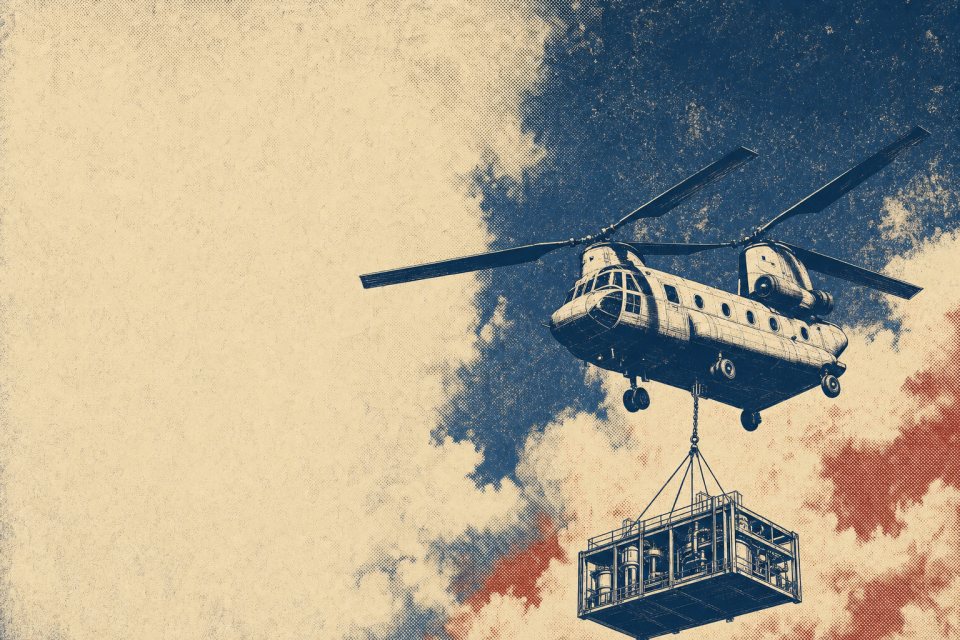
The Kaman K-1200 K-MAX lifts 6,000 pounds on the hook at sea level against an empty weight of 5,145 pounds, and it does nothing else. One seat, no cabin, no passengers, two intermeshing rotors and no tail rotor at all. Sixty were built across two production runs between 1991 and 2023, and every one of them exists to move weight on a line.
Most heavy-lift helicopters are utility airframes adapted to external load work. The K-MAX is the reverse: a clean-sheet civil design whose only job is the hook, built by a company that had been flying intermeshing rotors since the 1940s. Everything a passenger helicopter needs and a lifting helicopter does not was deleted. The result seats one person, cruises at 100 knots clean and 80 knots with a load, and moves 6,000 pounds while burning 85 gallons an hour.
This profile covers what the aircraft is, what the published numbers actually mean, one classification the industry routinely gets wrong, and where the surviving fleet works. Capacity figures are Kaman published values at the reference conditions Kaman states. Available payload on any given day is set by density altitude, not by a brochure.
A helicopter with no cabin
Kaman flew the K-MAX prototype on 23 December 1991 at Bloomfield, Connecticut, and the FAA issued the type certificate on 30 August 1994 under 14 CFR Part 27, less than three years after first flight, according to the type history compiled by Heli-Archive. The design brief was narrow to the point of being austere. The company sold the machine as an aerial truck, and the shape follows the brief exactly.
Two features define it. The first is the rotor system. Two masts sit side by side on the fuselage roof, splayed outward from each other by roughly 25 degrees, each carrying its own two-blade rotor. The discs overlap and the blades pass between one another, which is why the layout is called intermeshing. Because the two rotors turn in opposite directions, their torque reactions cancel, so the aircraft needs no tail rotor to hold heading. Every shaft horsepower the engine produces goes to lift rather than to an anti-torque device, and the aircraft carries no tail rotor drive shaft, gearbox, or blade set to inspect, balance, or strike on a stump.
The second feature is the fuselage, which is barely wider than the pilot. There is one seat. The cockpit sits far forward with a large flat side window, and the pilot leans out over the load and flies vertical reference, watching the hook directly rather than through a mirror or a camera. Rotor pitch is not commanded by a conventional swashplate pushing on the blade root. Steel control tubes run up inside each mast and out through the blade to move a small servo flap set into the trailing edge about three quarters of the way to the tip. The flap deflects, the blade twists itself, and the control loads stay low enough that the flight controls need no hydraulic boost. Kaman has flown that arrangement since the H-43 Huskie, and the K-MAX transmission traces to the same lineage.
Specifications: Kaman K-1200 K-MAX
Three qualifiers belong with the table. First, the 1,800 shaft horsepower figure Kaman publishes for the T5317A-1 is the engine's own rating, not what the installation uses: Heli-Archive records an installed takeoff rating of 1,500 shp flat rated to 7,600 feet and a maximum continuous rating of 1,350 shp flat rated to 6,500 feet. Second, the maximum weight without an external load was raised to 7,000 pounds in 2005, which is why older references quote 6,000 or 6,500 pounds. Third, hook capacity is a sea level number at Kaman's stated reference temperature and falls with altitude on the curve analysed in the next section.
| Item | Kaman K-1200 K-MAX |
|---|---|
| Engine | 1 x Honeywell T5317A-1 turboshaft, 1,800 shp engine rating |
| Installed ratings | 1,500 shp takeoff (flat rated to 7,600 ft); 1,350 shp maximum continuous (to 6,500 ft) |
| Rotor system | 2 intermeshing two-blade rotors, masts splayed about 25 degrees, no tail rotor |
| Rotor diameter | 2 x 48 ft 4 in, 250 to 270 rpm |
| Control | Servo flaps on the blade trailing edge, no hydraulic boost |
| Empty weight | 5,145 lbs |
| Max takeoff weight, no external load | 7,000 lbs |
| Max gross weight, jettisonable external load | 12,000 lbs |
| Useful load | 6,855 lbs |
| Cargo hook capacity | 6,000 lbs at sea level |
| Hover ceiling at 4,000 ft, 95 F | 12,000 lbs in ground effect; 11,500 lbs out of ground effect |
| Maximum airspeed | 100 kt clean; 80 kt with an external load |
| Fuel | 219.5 US gal usable; 85 gal/hr average burn (557.6 lbs/hr) |
| Service ceiling | 15,000 ft |
| Seats | 1 |
| Airworthiness category | Normal category, 14 CFR Part 27, type certificated 30 August 1994 |
| Production | 60 aircraft, 1991 to 2003 and 2015 to 2023 |
Weights, hook capacity, hover performance, airspeed and fuel figures are Kaman published values. Installed engine ratings, rotor speed and the certification date are from Heli-Archive. Lift-day capacity is always set by density altitude.

The payload curve, and where the 3 percent rule breaks
Kaman publishes a lift capability chart by altitude rather than a single number, which is unusually honest for a manufacturer specification sheet and makes a real planning tool out of the page. The site's standing planning shorthand, that available payload falls roughly 3 percent per 1,000 feet of density altitude, can be checked directly against it. The result is worth knowing before anyone plans a mountain job on the rule of thumb alone.
| Altitude | Kaman published hook capacity | Change vs sea level | Average loss per 1,000 ft in that band | 3 percent rule prediction | Rule error |
|---|---|---|---|---|---|
| Sea level | 6,000 lbs | reference | reference | 6,000 lbs | none |
| 5,000 ft | 5,663 lbs | -337 lbs (-5.6%) | 1.1% | 5,100 lbs | rule low by 563 lbs |
| 10,000 ft | 5,163 lbs | -837 lbs (-14.0%) | 1.8% | 4,200 lbs | rule low by 963 lbs |
| 15,000 ft | 4,313 lbs | -1,687 lbs (-28.1%) | 3.3% | 3,300 lbs | rule low by 1,013 lbs |
| 20,000 ft | 1,499 lbs | -4,501 lbs (-75.0%) | 13.1% | 2,400 lbs | rule HIGH by 901 lbs |
Capacity column from Kaman's published K-MAX lift chart, which is headed ISA +15 C / 59 F and stated by altitude; the 20,000 ft row is published in metric as 680 kg and sits above the 15,000 ft service ceiling. Change, per-1,000-ft and rule-error columns are AHLH arithmetic on that chart, not Kaman figures. The chart is an altitude chart, so a hot day converts a given field elevation into a higher density altitude and moves every row down.
The shape of that curve is the flat rating made visible. Below roughly 7,600 feet the engine still delivers its full 1,500 shaft horsepower takeoff rating, so the aircraft is transmission limited rather than power limited and the first 5,000 feet cost only about 1.1 percent of hook capacity per 1,000 feet. Past the flat-rating altitude the engine begins losing what any turbine loses in thin air, the loss rate climbs through 1.8 percent and then 3.3 percent per 1,000 feet, and above 15,000 feet it collapses to more than 13 percent per 1,000 feet. A linear 3 percent rule is therefore conservative by roughly 1,000 pounds through the working band and dangerously optimistic above the service ceiling. The practical planning lesson is the same one that governs how thin air eats lift capacity on the day: a rule of thumb is for sanity checking a plan, and the aircraft flight manual chart is for building one.
Twelve thousand pounds that exist only because the load can be dropped
The weight pair in the specification table is the most instructive thing about the aircraft. The K-MAX is certificated to 7,000 pounds maximum weight with nothing on the hook, and to 12,000 pounds with a jettisonable external load attached. Five thousand pounds of legal gross weight, more than the empty weight of the helicopter, exists only in a configuration where the pilot can release the load.
That is not a Kaman concession. It is the structure of the rule. 14 CFR 27.25 permits a normal category rotorcraft to establish a total weight with a jettisonable external load attached that is greater than its certificated maximum weight, subject to five conditions: no human external cargo, approval of the structural components involved, the excess weight consisting only of the jettisonable load, a demonstration of structural compliance at the increased loads, and appropriate operating limitations. The transport category equivalent at 14 CFR 29.25 works the same way. The jettison capability is what buys the weight, which is why the same physical helicopter is a 7,000 pound aircraft on a ferry flight and a 12,000 pound aircraft on the job.
The operating side of that bargain sits in Part 133. A load that can be released in flight is a Class B rotorcraft-load combination, and Class B is where nearly all K-MAX work lives: logs, buckets, tower steel, pipe, and freight. Anything the aircraft is approved to fly is written into its rotorcraft-load combination flight manual, and the operator may not exceed the external load weight used to show compliance during certification. The mechanics of the certificate and the four load classes are laid out in the external load classes and the certificate behind them.
14 CFR 133.45 Operating limitations 14 CFR 1.1 Load class definitions

Normal category, not restricted: the classification the market gets wrong
The K-MAX is regularly listed alongside the surplus military heavy lifters as a restricted category aircraft. It is not one, and the distinction has money attached to it. The K-1200 holds an ordinary type certificate issued under 14 CFR Part 27, the airworthiness standard for normal category rotorcraft, dated 30 August 1994. Individual airframes therefore carry standard airworthiness certificates. The European validation of the American certificate, EASA TCDS IM.R.103, records the type in the same terms: small rotorcraft, normal category.
What follows from that is the useful part. 14 CFR 91.313 prohibits operating a restricted category civil aircraft over a densely populated area, in a congested airway, or near a busy airport, and 14 CFR 133.45 repeats the bar for external load work. Those prohibitions reach the CH-47D Chinook and the S-70M Black Hawk conversions because those aircraft are restricted category. They do not reach the K-MAX. A K-MAX over an occupied area still needs an approved congested area plan like any other Part 133 operation, which is a real piece of work described in the approval that clears a lift over an occupied area, but it does not start from a categorical prohibition and does not need relief from one.
14 CFR 91.313 Restricted category limits 14 CFR 133 External load certificate
One more classification is worth pinning down, because it produces a genuine oddity. The federal wildfire agencies type helicopters under the NWCG standard, which defines Type 1 by at least 5,000 pounds of allowable payload at 59 degrees Fahrenheit at sea level, 700 gallons of tank capacity, and 15 or more passenger seats. The K-MAX clears the payload line at 6,000 pounds and flies federal Type 1 exclusive-use contracts, and it has exactly one seat and cannot carry a passenger at all. The typing standard was written to move crews and water to fires, so an aircraft built to move nothing but cargo does not fit its shape, which is a good illustration of why capacity tiers and mission capability are different questions. That gap is worked through in what actually separates a heavy-lift helicopter from a medium one.
What it burns, and what that buys
The economic case for the K-MAX is not capacity. Plenty of aircraft lift more, and 6,000 pounds sits in the middle of the field on the aircraft-by-aircraft comparison of what each civil helicopter puts on the hook, below the Bell 214B and far below the 20,000 pound tier. The case is cost per pound moved, and it rests on two published numbers: 6,000 pounds of hook capacity against 85 gallons per hour of average fuel burn.
That works out to roughly 70 pounds of rated hook capacity per gallon burned, which matches the lift-to-fuel ratio of 8.5 that Kaman publishes in metric units. Add the cycle rate. Kaman built the aircraft for repetitive picks, the AHLH fleet reference plans it at 20 to 25 picks per hour, and Heli-Archive records Swiss logging operations averaging 30 turns per hour at 4,000 to 6,000 pounds a turn, with a pick-to-landing cycle under three minutes. At 30 turns of 5,000 pounds, an aircraft burning 85 gallons an hour moves 150,000 pounds in that hour, or roughly 1,700 pounds of timber per gallon of Jet A. No aircraft with a cabin, a tail rotor, and two engines gets near that arithmetic, and that single ratio explains why the type dominates aerial timber extraction economics and suits the same repetitive rhythm as high-cycle aerial concrete placement.
The trade is everything the K-MAX gave up to get there. It carries no passengers and no internal freight. It has one engine, so it is a poor choice where twin-engine redundancy near energized conductors is the requirement. It moves at 80 knots with a load, so long ferry legs are expensive in time. And its sea level hook capacity is under half that of a machine one tier up such as the single-engine Bell heavyweight that owns the class above it. The aircraft is a specialist, and it is only cheap on the work it was drawn for: many loads, short cycles, no road.
Sixty airframes and a closed production line
The K-MAX has been discontinued twice, which is the central fact of its commercial history. The first run ended in 2003 after 38 aircraft, and the second closed in 2023, taking total production to 60 airframes across 32 years.
| Date | Event | Aircraft |
|---|---|---|
| 23 Dec 1991 | Prototype first flight, Bloomfield, Connecticut | 1 prototype |
| 30 Aug 1994 | FAA type certificate issued under 14 CFR Part 27 | type certificated |
| 1991 to 2003 | First production run, ended for low demand | 38 built |
| 2005 | Maximum weight without external load raised to 7,000 lbs | fleet change |
| 2011 to 2014 | Two unmanned K-MAX support US Marine Corps resupply in Afghanistan over 33 months | 2 aircraft |
| Jun 2015 | Production restart announced on an order book of 10 aircraft | line reopened |
| 12 May 2017 | First flight of a restart-line aircraft; first delivery followed that July | deliveries resume |
| Apr 2021 | First flight of the optionally piloted K-MAX TITAN | 1 converted |
| Jan 2023 | Kaman announces closure of the line for low demand | 60 built in total |
Dates and aircraft counts from Heli-Archive, Kaman announcements, and Aviation International News reporting of the January 2023 closure. Aircraft column states the production or fleet effect of each event, not cumulative deliveries.
Kaman announced the second closure in January 2023, citing low demand and wide variation in annual deliveries, and stated at the time that it would continue to support the operating fleet with spares, repair, and training. The unmanned programme is the outlier in that story. Two K-MAX aircraft converted for unmanned operation flew cargo resupply for the US Marine Corps in Afghanistan across 33 months from 2011 to 2014, moving more than 4.5 million pounds by Kaman's account, and the optionally piloted K-MAX TITAN first flew in April 2021 with a safety pilot aboard.
The fleet that remains is small, concentrated, and busy. K-MAX operators hold a meaningful share of federal wildfire work: Kaman reported in May 2020 that K-MAX operators had been awarded 40 percent of all US Forest Service Type 1 exclusive-use helicopter contracts that season. Swanson Group Aviation in Oregon and ROTAK Helicopter Services in Alaska are among the American operators built around the type, alongside logging and utility operators in Europe and Asia.
Sixty aircraft is a rounding error against the Huey lineage, and Kaman closed the line twice because the market for a machine that can only lift is narrow. That narrowness is also the point. Nothing else on the US civil register was drawn from a blank sheet to do one job, and on the days when the job is 30 turns of five thousand pounds up a road that does not exist, nothing else is cheaper.