
More than 16,000 UH-1 airframes were built, and the civil branch of that line runs 204B, 205A-1, 212 and 214B. Each step added power to the same basic machine rather than replacing it. A Bell 205A-1 is certificated to 10,500 pounds with a jettisonable external load, which leaves roughly 4,000 pounds for the hook on a standard day.
More than 16,000 UH-1 airframes came off the line, and civil versions of the same machine have been working American job sites for more than sixty years. That longevity creates a specific problem for anyone reading a lift proposal. Four different model numbers, spanning 1,100 to 2,930 shaft horsepower and 8,500 to 16,000 pounds of gross weight, share one silhouette, one rotor configuration and one general shape. The gap between the smallest and the largest is roughly a factor of two in every number that matters, and none of it is visible from the parking lot.
This profile covers what each civil model actually is, what the published weights leave for the hook, why two aircraft that look identical can hold completely different certificates, and what the market did when it wanted more payload out of a design that stopped being built decades ago.
One airframe, four model numbers
The prototype that started the line was the Bell XH-40, which first flew at Fort Worth in October 1956. It entered US Army service in June 1959 as the first turbine-powered helicopter the Army operated, was redesignated UH-1 in 1962, and kept the nickname earned from its original HU-1 designation. Bell certificated the civil Model 204B on 4 April 1963, according to the type history compiled by Heli-Archive, and the first civil deliveries had already begun in 1961. Agusta built a further 243 AB204Bs under licence in Italy between 1961 and 1973.
The 204B was a capable light-medium machine and a commercially modest one. More than 60 civil examples had been delivered by 1967. The variant that made the family a utility standard was the stretch. Bell flew the Model 205 prototype on 16 August 1961 with the fuselage extended by 41 inches and the main rotor lengthened from 44 to 48 feet on a 21 inch chord, which raised seating to 15 including crew. The military UH-1D carried the 1,100 shaft horsepower T53-L-11; the UH-1H that followed in 1966 carried the 1,400 shaft horsepower T53-L-13, and the civil Model 205A-1 is that aircraft with a commercial certificate.
After that, the line went in two directions at once. The Model 212 answered the demand for a second engine by replacing the single T53 with a Pratt and Whitney Canada PT6T Twin Pac, two power sections geared into one output shaft. It first flew on 16 April 1969 and was FAA certificated on 30 October 1970, with Category A transport certification following on 30 June 1971. The Bell 214B BigLifter went the opposite way, keeping one engine and nearly tripling its output. Both are the same airframe concept, and both are still flying civil external load work in the United States.
The line on paper
Three qualifiers belong with the table. First, every weight is a certificated limit, not a capacity: what any of these aircraft can actually lift on a given morning is set by density altitude, not by a dataplate. Second, the 212 carries two power sections rated at 1,800 shaft horsepower combined, but its main transmission is limited to 1,290 shaft horsepower, so the gearbox rather than the engine defines the working ceiling, exactly as it does on the 214B. Third, published figures for the 204B vary between sources and serial ranges more than they do for the later models, because the type was certificated early and modified often.
| Model | Military ancestor | Engine | Rated power | Main rotor | Max gross, internal | Max gross, external load | Civil certification |
|---|---|---|---|---|---|---|---|
| Bell 204B | UH-1B | 1 x Lycoming T53-L-11A | 1,100 shp | 2 blades, 44 ft | 8,500 lbs | No separate figure published | FAA type certificate 4 Apr 1963 |
| Bell 205A-1 | UH-1H | 1 x Lycoming T53-L-13A (T5313A/B) | 1,400 shp | 2 blades, 48 ft, 21 in chord | 9,500 lbs | 10,500 lbs | Late 1960s, TCDS H1SW |
| Bell 212 | UH-1N | 1 x P&WC PT6T-3 Twin Pac (two power sections) | 1,800 shp combined; 1,290 shp transmission limit | 2 blades, 48 ft 2 in | 11,200 lbs | 11,200 lbs | FAA certification 30 Oct 1970 |
| Bell 214B | 214A Isfahan | 1 x Lycoming LTC4B-8D (T5508D) | 2,930 shp; 2,050 shp transmission limit | 2 wide-chord blades, 50 ft | 15,000 lbs | 16,000 lbs | FAA type certificate 1976 |
Engine, rotor and weight figures are manufacturer and type certificate published values collated by AHLH from the sources cited in this article; the 214B row matches the figures in the site's existing 214B profile. External load gross weight is the higher limit permitted when the load is jettisonable. The 212 is listed with a single gross weight because its published maximum is the same in both configurations. Lift-day capacity is always set by density altitude.
Read down the external load column and the family's logic is visible in four numbers. The stretch from the 204B to the 205A-1 bought 2,000 pounds of gross weight. The second engine on the 212 bought another 700, at the cost of an empty weight that rose from roughly 5,200 pounds to about 6,500. The 214B bought 4,800 more by abandoning any pretence of being a light machine. Nobody redesigned anything: Bell kept adding power to a 1956 airframe for twenty years, and the market kept buying it.
What the hook actually gets
A certificated gross weight is not a payload, and the difference is where most estimating errors on this class of aircraft start. The 205A-1 is the useful worked example because its numbers are widely published. Take the 10,500 pound external load gross weight, subtract a civil-equipped empty weight in the region of 5,300 pounds, subtract two crew at roughly 400 pounds, and subtract enough fuel for a working cycle rather than a ferry leg, call it 1,000 pounds. That leaves about 3,800 pounds for the load and everything between the load and the hook.
Operators publishing sling figures for the type generally quote up to 4,000 pounds, which is the same answer arrived at from the other direction. The arithmetic is worth doing rather than trusting, because three of its four terms move. Rigging is not free: a longline, a remote hook, slings and a master link come out of the same 3,800 pounds the freight does, which is the recurring theme of how a load is actually attached to a helicopter. Fuel is a planning choice, and carrying a full bag to a short-cycle job trades payload for endurance nobody needed. And the whole result is a sea level standard day figure that thin air taxes on the day, which matters more on this family than on most, because a single 1,400 shaft horsepower engine has nowhere to find a reserve.
Put that 3,800 pound answer against the aircraft-by-aircraft comparison of what each civil helicopter puts on the hook and the 205A-1 lands where the 212 does, in the light utility band below the 6,000 pound K-MAX and well below the 214B. That is not a criticism of the type. It is the reason the type is affordable.
The dataplate decides the job
Two Hueys can sit on the same ramp, share a rotor system, an engine family and a fuselage, and be legally incapable of the same work. The civil 204B and 205A-1 hold ordinary FAA type certificates, so individual airframes carry standard airworthiness certificates. A surplus military UH-1H does not. It reaches the US civil register through 14 CFR 21.25, which issues a type certificate in the restricted category for a listed set of special purpose operations, one of which is rotorcraft external load operations. Only aircraft manufactured for and accepted by a US armed force qualify; foreign military surplus is not eligible.
The restriction that follows is the expensive part. 14 CFR 91.313 bars a restricted category civil aircraft from operating over a densely populated area, in a congested airway, or near a busy airport, and 14 CFR 133.45 repeats the bar for external load work. A standard category 205A-1 still needs an approved congested area plan to work over an occupied site, which is real work described in the approval that clears a lift over an occupied area, but it does not start from a categorical prohibition. A restricted category UH-1H does.
14 CFR 91.313 Restricted category limits 14 CFR 133.45 Operating limitations
There is a documented route through it. Vertical Magazine records operators using Part 133 contingency plans that convert a congested area into an uncongested one by controlling access to the site, with one California operator describing trucking his restricted aircraft to job sites on a trailer to satisfy the local flight standards district office. That works, and it costs schedule and mobilization money that a standard category airframe does not spend. The certificate class therefore belongs on the operator vetting checklist next to the Part 133 certificate itself, alongside the approved load classes covered in the external load classes and the certificate behind them.
Four models, one rotor system, and the mistake that follows
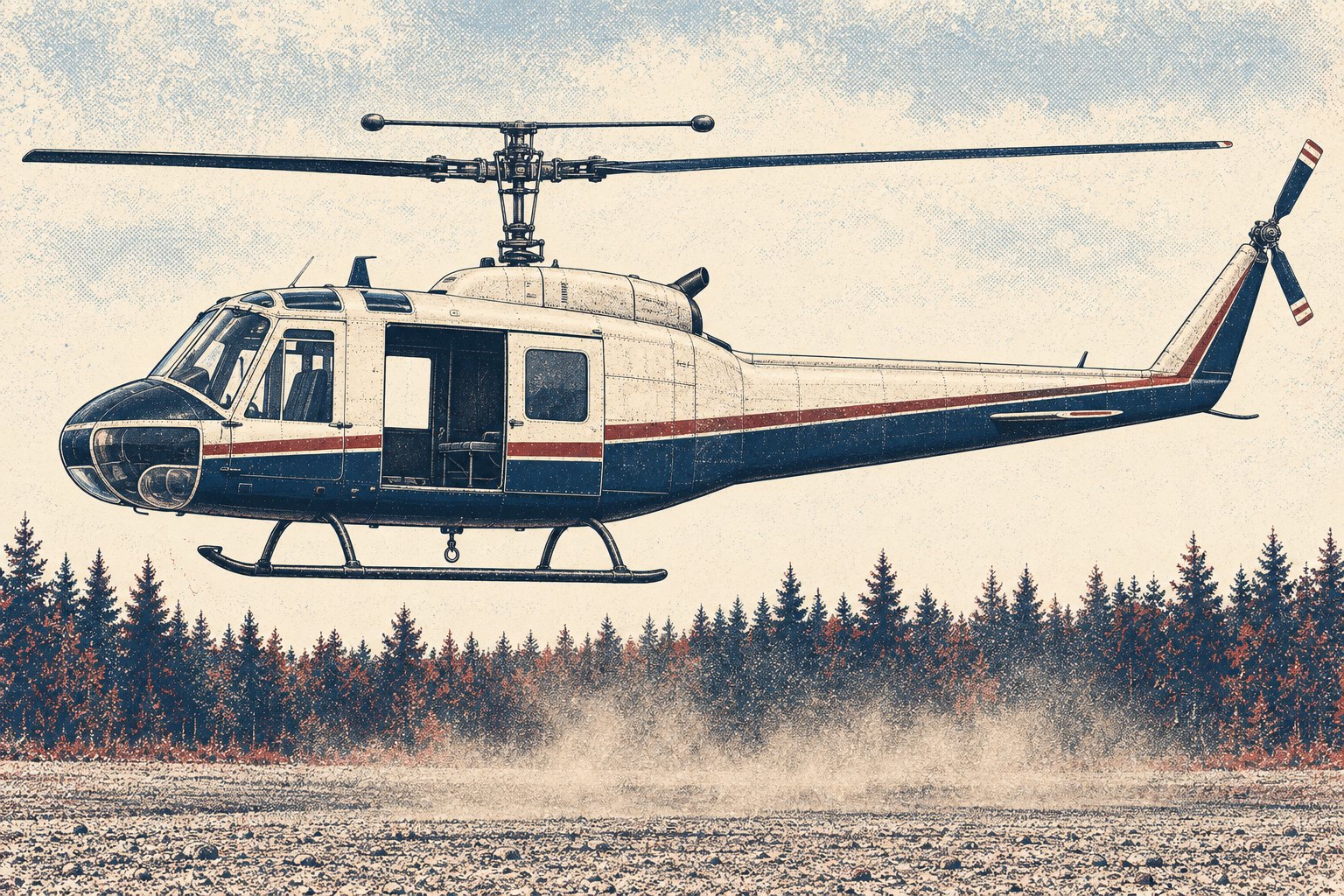
Every civil model in this family carries a two-blade teetering main rotor, which is why blade counting settles nothing here. A two-blade Bell medium is not automatically a 212, and the 214B is two-bladed as well. The table below lists the features that do separate them.
| What to look at | Bell 204B | Bell 205A-1 | Bell 212 | Bell 214B |
|---|---|---|---|---|
| Main rotor blades | 2 | 2 | 2 | 2, noticeably wider chord |
| Main rotor diameter | 44 ft | 48 ft | 48 ft 2 in | 50 ft |
| Stabilizer bar above the rotor head | Present | Present | Present | Absent |
| Engine installation | One turboshaft, one exhaust | One turboshaft, one exhaust | One Twin Pac with two power sections, twin exhausts in a wider cowl | One turboshaft, one large exhaust duct |
| Cabin | Short | 41 in longer than the 204 | 205-length cabin | 205-derived, longer nose |
| Quickest single tell | Short cabin, small rotor | Long cabin, single exhaust | Two exhausts | No stabilizer bar |
Rotor diameters and the 41 inch fuselage stretch are published type figures; the exhaust and stabilizer bar distinctions are visual identification points, not certification criteria. The dataplate and the flight manual are the only authority on which model an airframe is. A Bell 412 is excluded from this table because it carries four main rotor blades and is unambiguous.
The practical consequence is a paperwork one. A proposal naming a 212 and a proposal naming a 205A-1 differ by about 1,700 pounds of gross weight, one engine, and a materially different hourly rate, and a site photograph will not tell them apart from the front. The aircraft registration and the flight manual will, which is one more reason the model, serial and registration belong in writing before a lift is priced.
Keeping a 1960s airframe current
None of these models is in production. Bell stopped building the 214B in 1981, and Bell and Agusta-Bell production of the 205 ran into the early 1980s. What kept the fleet working was a supplemental type certificate market that re-engined the aircraft rather than replacing them, and the direction of travel in that market is the most useful thing on this page.
Bell's own Huey II conversion, introduced in the 1990s, fits a Honeywell T53-L-703 rated at 1,800 shaft horsepower and upgrades the drive train with Model 212 components including the 1,290 shaft horsepower transmission, raising a UH-1H external load gross weight to 10,500 pounds. Eagle Copters took the same approach on the civil side: Transport Canada approved its STC on 24 February 2008 for installing the Honeywell T5317BCV, rated at 1,800 takeoff shaft horsepower at sea level on a standard day, into the Bell 205A-1 as a drop-in replacement with a 5,000 hour initial overhaul interval.
The more revealing product is the Eagle Single, which takes a twin-engine Bell 212 and removes an engine. Replacing the PT6T Twin Pac with a single Honeywell T53 puts the aircraft in the 5,900 pound empty weight range against the 212's 11,200 pound gross weight limitation, and every pound saved on the second engine and its systems becomes useful load. The conversion is certificated in the United States, Canada, Australia, Chile, Peru, Indonesia and Japan. An operator whose work does not require twin-engine redundancy near energized conductors is buying payload back at the cost of a second power source, which is the same trade the 214B made in 1976 from the other direction.

Where the type still earns its keep
The federal wildfire agencies type helicopters by payload, seats and tank capacity rather than by model, and the Bell 204, 205 and 212 are the aircraft the standard names as Type 2 examples: 2,500 pounds of allowable payload at 59 degrees Fahrenheit at sea level, 9 to 14 seats, 300 gallons of retardant or water, and a gross weight between 6,000 and 12,500 pounds. The 205A-1's 9,500 and 10,500 pound limits sit inside that band by design, which is why the typing scheme reads as a fair description of the type rather than the blunt instrument it becomes at the top of the fleet.
NWCG PMS 510 Federal helicopter typing
That market is now visibly moving. California completed the conversion of all ten CAL FIRE helitack bases off the Vietnam-era UH-1H on 31 July 2025, when the last two of 16 Sikorsky S-70i Fire Hawks arrived at McClellan Airfield, according to the state. The replacement carries 1,000 gallons, close to three times what the aircraft it replaced could drop. A single-engine 1960s airframe with a 300 gallon tank does not compete with that on a large fire, and the state stopped asking it to.
What the type still wins is everything the Fire Hawk's acquisition cost buys no advantage on. A 205A-1 or a 212 remains the right machine for loads under roughly 4,000 pounds in terrain that no road reaches: tower steel and hardware on remote tower construction sites, drill moves, trail and cabin material, and freight into sites with no ground access. The pilot base is deeper than for any other civil helicopter, parts and STC support are abundant after 16,000 airframes, and the hourly rate is a fraction of the medium-heavy twin tier. For a pick list that tops out at two tons and a schedule measured in days rather than weeks, the cheapest correct answer is frequently a machine that was designed before the customer's project manager was born.