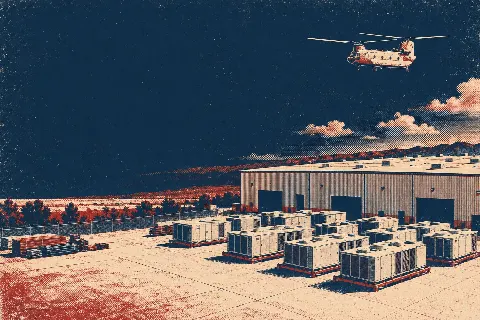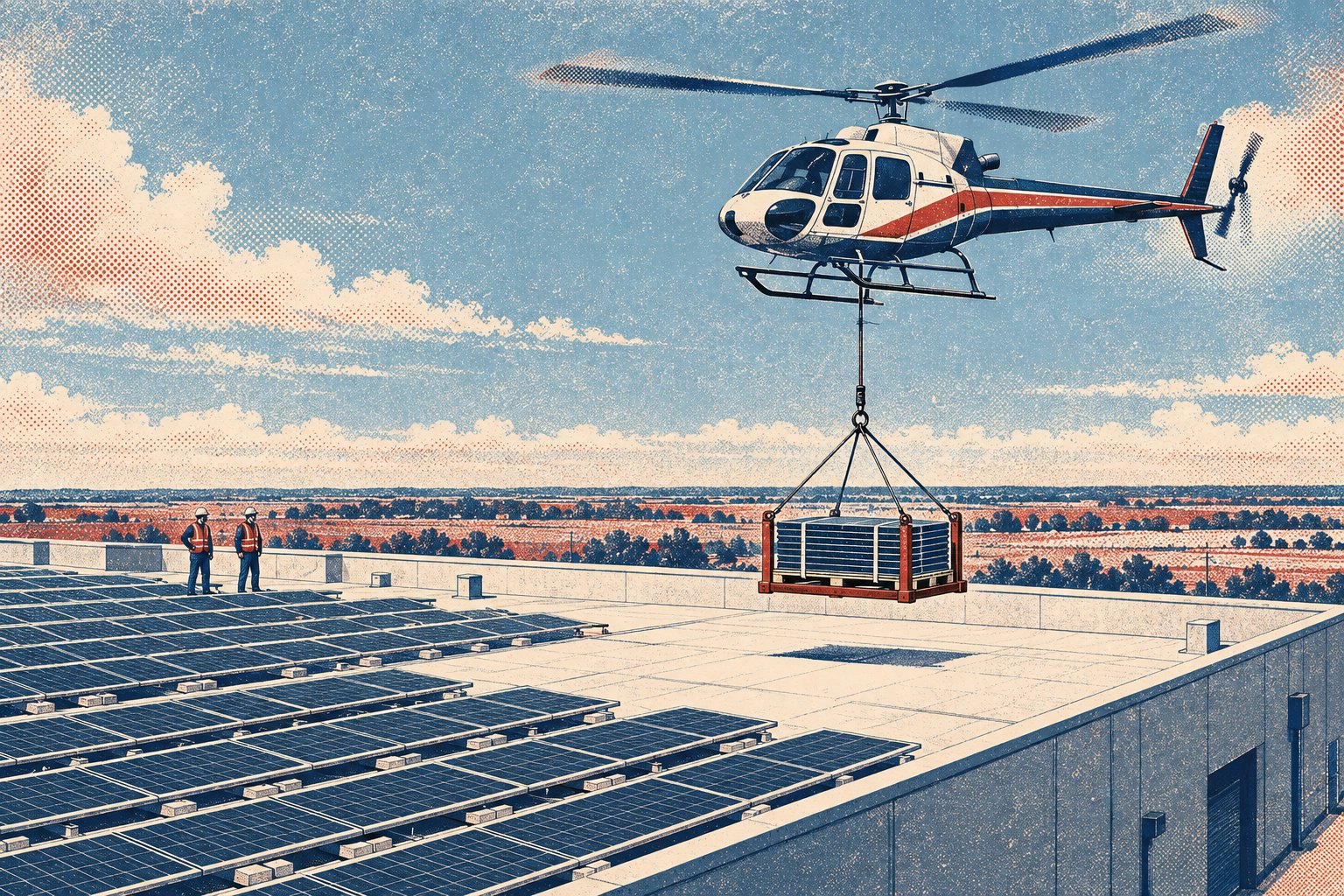
Solar and substation work splits by weight. Module pallets of 500 to 800 kilograms have been set on warehouse roofs by light helicopters in documented one-day lifts, and a 12,000 pound high-voltage breaker is within reach of the heaviest civil cranes in the air. A main power transformer, at 200,000 to 800,000 pounds, never is.
The energy build-out has put a great deal of electrical equipment on trucks, and a small share of it ends up on a hook under a helicopter. That share is narrow and predictable. It includes rooftop solar modules where a crane cannot reach or cannot set up, and the occasional piece of substation equipment at a site with no road, no jetty and no room for a crane pad. It does not include the transformer that anchors a substation, and it rarely includes anything at a utility-scale solar farm built on open, graded ground.
This analysis lines up the published weights of the equipment involved against the working civil fleet, reviews the documented helicopter jobs, and sets out the conditions that decide the method on a solar roof and in a switchyard, where energized conductors change the planning problem entirely.
The equipment ladder, from module pallets to main transformers
The method follows the weight more closely here than on almost any other kind of job, because the equipment spans three orders of magnitude and the manufacturers publish the numbers. The table reads from the lightest pick upward and marks where the civil fleet runs out.
| Item | Published weight | Lightest civil class that covers it (sea level, standard day) |
|---|---|---|
| One bifacial glass-glass solar module, 72-cell format (Jinko Tiger Neo) | 32 kg (70.55 lb) | Not a helicopter load on its own |
| Rooftop module pallet as flown at Tonsley, South Australia (25 panels average) | Up to 800 kg (about 1,764 lb) | Light single, such as the AS350 class |
| Full factory pallet of the same module, 36 pieces, modules only | About 1,152 kg (about 2,540 lb) before packaging | Light or light twin, depending on the day's hook capacity |
| Central inverter (SMA Sunny Central 4000 to 4600 UP-US) | Under 3,700 kg (8,158 lb) | UH-60L at 9,000 lb (restricted category) or S-61N at 10,000 lb; the 214B and UH-60A sit at or below the line |
| 245 kV dead-tank SF6 circuit breaker (Siemens SPS2S) | 12,000 lb | S-64E Air Crane at 20,000 lb |
| Medium-voltage station, transformer and switchgear on a 20 ft skid (Sungrow MVS3200-LV / MVS4480-LV) | About 15 to 17 t (about 33,000 to 37,500 lb) | None: above the 28,000 lb US civil ceiling |
| Downtown substation transformer, Bradford, Pennsylvania, 2024 | Nearly 40,000 lb | None; set by crane over the fence |
| Large power transformer, 100 MVA and above | 200,000 to 800,000 lb | None, by a factor of seven or more |
Weights from the Jinko Tiger Neo datasheet, Renewal SA (Tonsley), the SMA Sunny Central UP-US datasheet, the Siemens Energy SPS2S flyer, the Sungrow MVS datasheet, FirstEnergy (Bradford) and the Department of Energy large power transformer study. The full-pallet figure is AHLH arithmetic (36 x 32 kg) and excludes the pallet, corner boards and wrap. Aircraft classes come from manufacturer and type certificate figures at sea level on a standard day; hook capacity on the lift day depends on the specific aircraft, its fuel load and the density altitude. Rigging and any lifting cradle add to every weight shown.
Two readings follow from the ladder. The first is that solar modules are an ideal light-helicopter load: dense, flat, stackable and easy to break into whatever pallet weight the aircraft can carry on the day. The second is that substation equipment divides sharply. Breakers, switches and inverters sit inside the fleet's upper tiers; the station transformers and the main power transformer sit outside it. The aircraft-by-aircraft lift capacity table carries the full fleet. An inverter fits the medium-heavy tier, while a 12,000 pound breaker needs an S-64 or a Chinook.
Rooftop solar: where the documented work is
The clearest published helicopter solar jobs are rooftop installs on large commercial buildings, and the best-documented ones are Australian. On 6 May 2022 at the Tonsley Innovation District in South Australia, Aerotech Helicopters lifted 2,000 panels onto the roofs in 80 pallets of up to 800 kilograms each, flying 160 separate pick-up and set-down runs across a 10-hour day. Fixing the panels then took about nine weeks, and the project brought the site's combined solar capacity to 5 megawatts (Renewal SA).
Two years later at Kemps Creek in western Sydney, more than 3,000 Jinko 550 watt panels went onto a 1.75 megawatt warehouse roof in a single day. The project's stated reason is the whole case for the method in one sentence: initial plans for crane lifts were impractical due to space and time constraints, and roof access and drainage further complicated the installation (pv magazine Australia). An Australian operator describes the same work from the cockpit side, with an AS350 B2 placing 500 kilogram pallets of panels every couple of minutes (Helicopter Lifting Services).
The pallet weights in those reports are lighter than a factory pallet. Jinko ships its 72-cell dual-glass module 36 to a pallet, about 1,152 kilograms of glass and frame before packaging, while Tonsley averaged 25 panels per pallet and the AS350 figure implies about 15. The inference is that the modules were broken down to suit the aircraft, which is normal practice for any repetitive helicopter job: the pick weight is set by the hook capacity on the day, not by the shipping unit. Repacking costs labor on the ground, and it belongs in the estimate next to the flight hours.
The economic question is the same one every rooftop job faces. A crane that can reach the far side of a warehouse roof is a large machine, and on a big footprint it may need several setups to cover the whole array. When a crane can set up once and reach everything, it usually wins; the conditions that tip a pick back to the ground are laid out in the site's analysis of when a ground crane beats the aircraft. The helicopter's case strengthens as the roof gets larger, the yard gets tighter and the schedule gets shorter, which is exactly the combination both Australian projects described.
For a US warehouse in a populated area, the aircraft's certification also matters. Part 133 external-load work over a congested area requires an approved congested area plan, and restricted-category rotorcraft such as surplus UH-60s may not fly external loads over densely populated areas at all. A rooftop array on an urban distribution center therefore needs a standard category aircraft, and that constraint is covered in detail in the review of restricted-category limits on urban lifts.
14 CFR 133.33 Congested area plan 14 CFR 133.45 Operating limitations
Downwash over a finished array
A roof that is half covered in installed modules raises an obvious concern: whether the rotor wash will damage the panels already in place. The published numbers suggest the pressure itself is not the problem. The FAA's heliport design circular states that rotor downwash loads are approximately equal to the weight of the helicopter distributed uniformly over the rotor disk area, and are generally less than building-code loads for snow, rain or wind (FAA AC 150/5390-2D). Draft heliport outwash guidance puts disk loadings for aircraft from about 3 to 15.6 tonnes at 35 to 57 kilograms per square meter (draft outwash guidance). At the top of that range, the average downward pressure works out to roughly 560 pascals, under a quarter of the 2,400 pascal wind load the Jinko module is certified to.
That comparison is an average over the disk, and it does not account for local gusting at the edge of the wake or for a load held low over one row for several minutes. It does point the hazard where it actually sits: at loose material. A module delivery comes with cardboard corner boards, plastic wrap, banding and dunnage, and a roof under construction carries tools, sheeting and debris. OSHA's helicopter rule requires all loose gear within 100 feet of the pick-up and set-down points, and in any other area exposed to downwash, to be secured or removed. On a solar roof that means a packaging plan: wrap and boards come off and go into a secured bin before the aircraft returns, or the pallets stay wrapped until the helicopter has left.
OSHA 1926.551 Ground crew rule
Substations: why the helicopter is the exception
Substation work differs from rooftop solar in one decisive way: the equipment around the set point may be energized. A substation lift puts a steel load, a steel or synthetic line and an aircraft above bus work and conductors, and a swinging load does not respect a painted line on a site plan. The load itself also carries a hazard. OSHA requires the static charge on a suspended load to be dissipated with a grounding device before ground personnel touch it, or protective rubber gloves to be worn.
There is no OSHA clearance table written for helicopters. The crane standard sets minimum distances from power lines, such as 10 feet up to 50 kV, 15 feet from over 50 to 200 kV and 20 feet from over 200 to 350 kV (29 CFR 1926.1408), but the crane standard's scope expressly excludes helicopter cranes (29 CFR 1926.1400(c)(16)). The clearance around an energized yard becomes a planning decision between the utility, the contractor and the flight operator, and the realistic choices are an outage of the affected bays or a set point far enough from energized parts that neither the load nor the line can reach them. Either one has to be settled before the aircraft is scheduled.
OSHA 1926.551 Ground crew rule
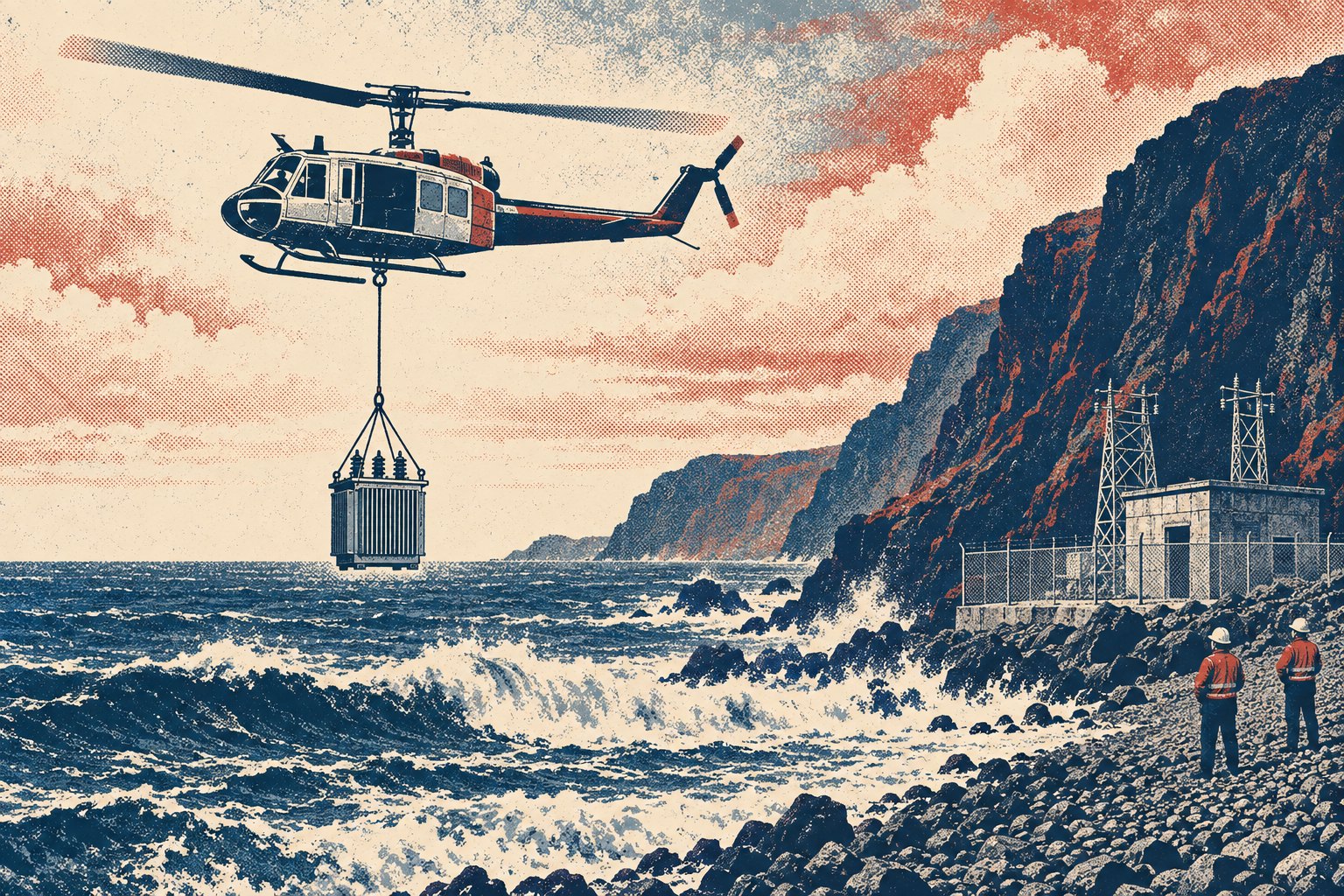
The documented case that fits this pattern most closely is a removal, not an installation. In 2025, Endesa's distribution company used a helicopter on El Hierro in the Canary Islands to remove a 1970s transformer station from a pebble beach with no jetty: the transformer, medium-voltage towers, electrical cubicles and the old oil. Removal by sea had been attempted first, but the only workable window was October and the surf made it unsafe (Endesa). The station was de-energized, the equipment was small, and every alternative had failed. That combination describes the helicopter's place in substation work better than any capacity chart.
A search of US utility releases and operator project pages for this article turned up helicopter work on the lines leaving substations, including structure sets and conductor pulls, but no published US case of a helicopter setting equipment inside a substation fence. The adjacent work is well documented: the site's page on helicopter conductor stringing for electrical contractors covers the line side, where the aircraft is routine. Inside the fence, a mountaintop or island switchyard with no crane access is the plausible use case, and the equipment that fits is the smaller gear: breakers at the lower voltages, disconnect switches, instrument transformers, steel structures and prefabricated control building sections.
The main transformer belongs to the ground
At the heavy end, the numbers close the question. The Department of Energy defines a large power transformer as one rated at 100 MVA or more and puts its weight between about 100 and 400 tons, or 200,000 to 800,000 pounds, with examples such as a 230/115 kV, 300 MVA unit at 170 tons (DOE, 2012). The same study reports lead times of 5 to 16 months in ordinary conditions and describes the specialized Schnabel rail cars, about 30 of them in North America, needed to move the largest units. The civil helicopter ceiling is 28,000 pounds. There is no version of this lift that involves an aircraft.
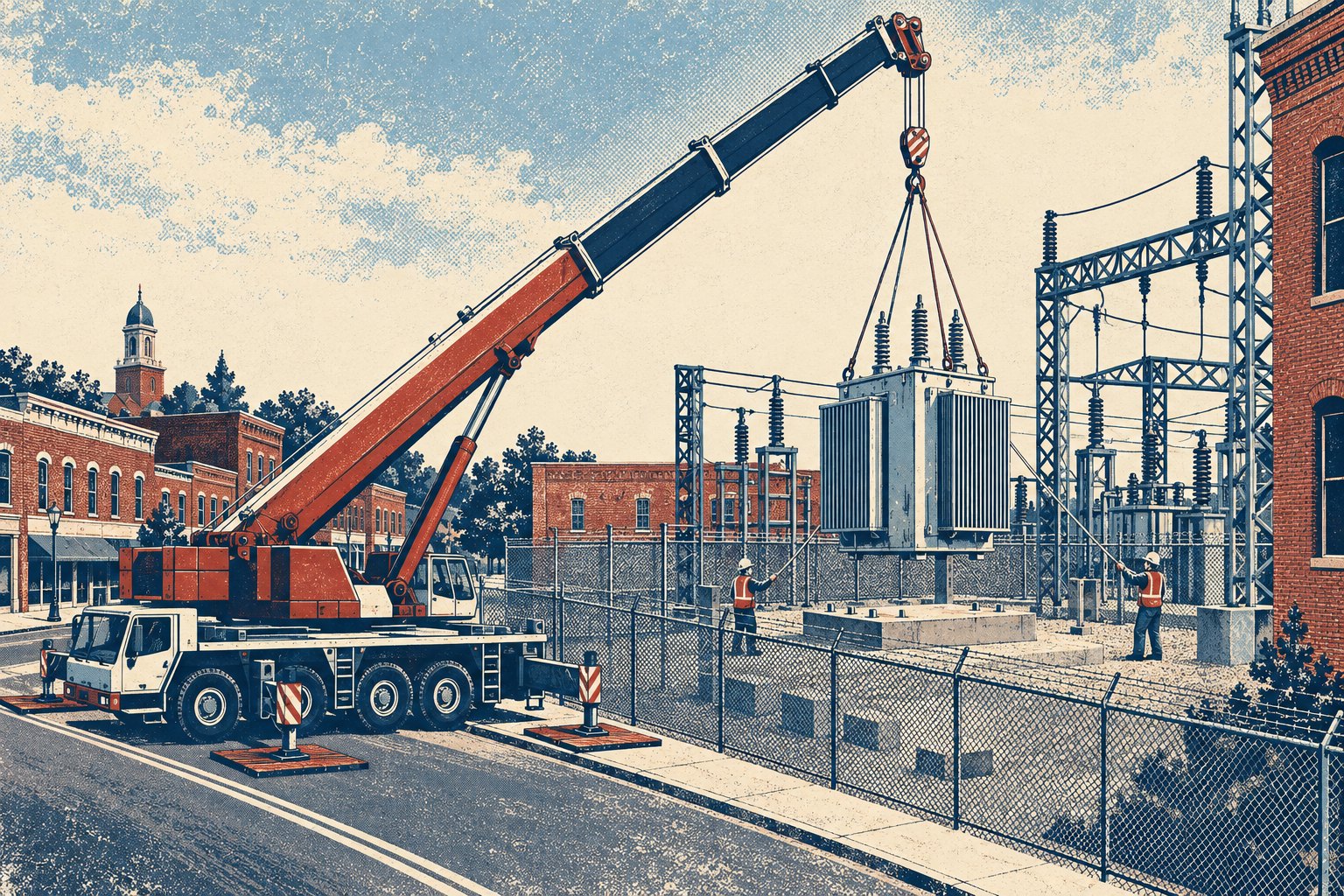
Even the smaller transformers sit outside the fleet. FirstEnergy's replacement unit in downtown Bradford, Pennsylvania weighed nearly 40,000 pounds and measured about 7 by 4 by 11 feet tall; a large crane set it over the substation fence in October 2024 while a mobile substation carried the load (FirstEnergy). The medium-voltage stations at a utility-scale solar farm, which combine a transformer and switchgear on one skid, weigh 15 to 17 tonnes in the Sungrow datasheets. Those farms are built on graded ground with truck access to every pad, so the crane or the delivery truck's own equipment does the setting and the helicopter's usual advantage, reach over an obstacle, does not arise.
Planning inputs that decide the method
For solar and substation projects, the method question can usually be settled early from a short set of facts. Each one below either rules the helicopter out or defines what the operator has to plan for.
- The heaviest single pick, with rigging. Add the cradle, spreader or sling set to the published equipment weight and compare it with the aircraft's hook capacity at the site's elevation and expected temperature, because density altitude on the lift day can take a large share of the margin. Anything over 28,000 pounds is a crane or a jacking and skidding job.
- Whether the load can be broken down. Module pallets can be split to fit the aircraft; a breaker, an inverter or a transformer cannot. Divisible loads suit the light, cheap end of the fleet.
- Energization status. Identify every energized part within reach of the load path and agree the outage or standoff with the utility before scheduling.
- Crane access and setups. Count how many crane setups the job would need and what each costs in street closures and mobilization. A single setup that reaches everything usually settles it for the crane.
- Aircraft certification against the site. An urban warehouse roof needs a standard category aircraft and, over a congested area, an approved plan.
- Loose material on the roof or yard. Plan the packaging, dunnage and debris control that OSHA's 100 foot rule requires, and schedule unwrapping around the flight.
The pattern across all six is consistent. Helicopters do the light, divisible, repetitive work on roofs that cranes reach badly, and they do the occasional small-equipment job at a site no crane can get to. The heavy electrical equipment that defines a substation stays on the ground, and a project plan that assumes otherwise will be corrected by the first capacity check.