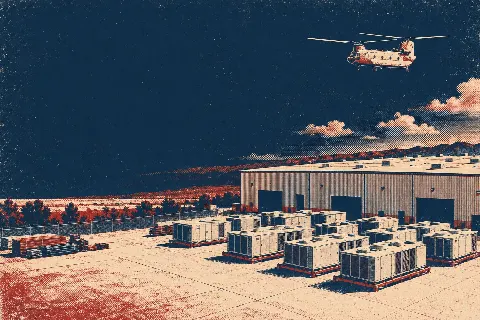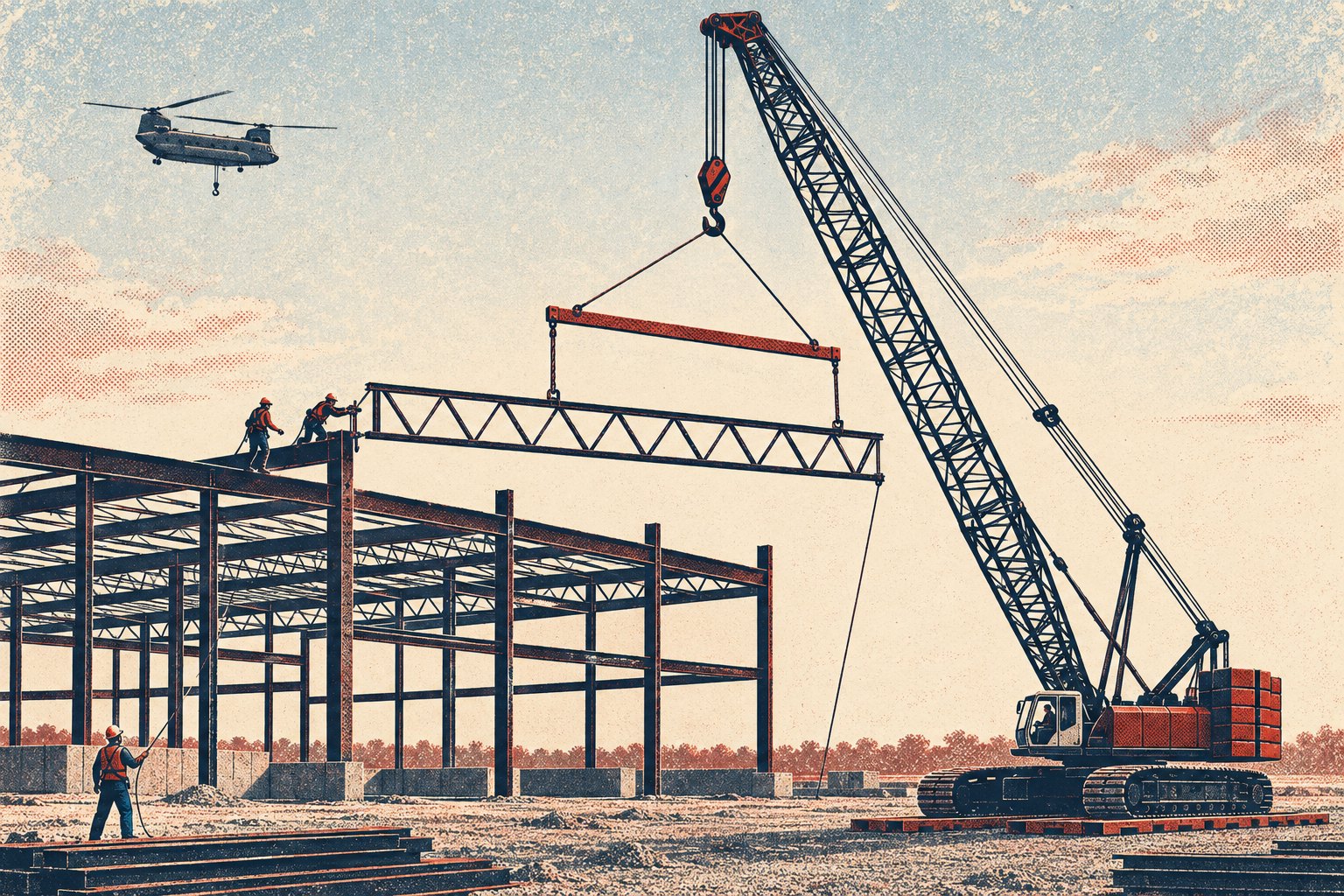
A ground crane is the better choice when the load is heavy, has to be held in place while it is fastened, or has to go somewhere a vertical line cannot reach. The civil helicopter ceiling is roughly 28,000 pounds on the hook; a 1,200 tonne all-terrain crane drives to site on public roads, and a crane can hold a load for as long as the fastening takes.
The total lifted cost comparison shows how site access and mobilization can change the choice between a helicopter and a crane. Compare those costs on both sides, including the helicopter's ferry flights and ground controls. With clear crane access and little setup work, the crane may have a simpler, cheaper path to the same result.
This article works through the other side of the comparison: the conditions under which the crane is the correct machine, with the numbers that show why. There are five of them, and they are independent of each other. Weight, duration, weather, geometry and site access each decide the method on their own, so a job only needs to meet one to belong to the crane.
Weight: the ceiling is low and fixed
The heaviest hook in American civil service belongs to the Chinook family, and it tops out at roughly 28,000 pounds at sea level on a standard day, with the Erickson S-64 Air Crane directly behind it. That figure falls as density altitude rises and as rigging weight comes off the top, which the aircraft-by-aircraft capacity table works through type by type. There is no larger civil helicopter to call. A load over the line has only one method.
Crane capacity scales by a different order of magnitude. Liebherr rates its LTM 11200-9.1, a wheeled all-terrain crane that drives to site on nine axles, at 1,200 tonnes (Liebherr LTM 11200-9.1). Its LR 13000 crawler is rated at 3,000 tonnes at a 12 metre radius and is used to erect refinery columns weighing 1,500 tonnes and measuring 100 metres long, and it breaks down into transport pieces of no more than 70 tonnes each (Liebherr LR 13000).
| Machine | Rated capacity | In pounds | Multiple of the civil helicopter ceiling |
|---|---|---|---|
| Chinook family, heaviest civil hook | About 28,000 lb | 28,000 | 1x |
| 100 ton class hydraulic truck crane | 100 US tons | 200,000 | 7x |
| Liebherr LTM 11200-9.1 all-terrain | 1,200 t | 2,645,000 | 94x |
| Refinery column set by an LR 13000 | 1,500 t | 3,307,000 | 118x |
| Liebherr LR 13000 crawler | 3,000 t at 12 m | 6,614,000 | 236x |
Crane ratings are manufacturer maximums at the shortest radius in the strongest configuration. Capacity at a working radius is much lower, and a crane is sized to the heaviest pick at the radius where it lands, not to its headline figure. The helicopter figure is a sea level standard day value and also falls with conditions. Pound conversions and multiples computed for this article at 2,204.6 pounds per tonne.
The radius caveat in the note matters, because it cuts in the helicopter's favor at the margin. A 100 ton truck crane does not put 100 tons on a roof 150 feet away. What the table does establish is that the two methods do not overlap at the top. Utility-scale wind turbine nacelles run 56 to 75 tons, which is why the wind turbine analysis finds every drivetrain exchange permanently a crane job. Transformers, bridge girders, press frames and process vessels sit in the same place. For those loads the only live question is which crane.

Duration: the hold and the long program
Many loads are not finished when they arrive. A truss is bolted to its column while it hangs. A steeple is aligned to a bolt circle and plumbed. A precast panel is shimmed and braced. Each of those operations keeps the load on the hook until the connection can carry it, and the time it takes is set by the connection rather than by the lifting machine.
A crane holds a load at almost no marginal cost. Federal crane rules even provide for it: the operator may step away from the controls while a load is suspended for longer than normal lifting operations if the operator stays adjacent to the equipment, a competent person restrains the boom, swing and load functions, and the fall zone is barricaded (29 CFR 1926.1417(e)). The rule assumes a crane can park with a load in the air, because it can.
OSHA 1926.1417 Crane operation rules
A helicopter holds a load by burning fuel at hover power, and every gallon carried to extend the hold is weight taken off the hook. The steeple placement analysis documents what that means at a real set point: a crew in Highlands, North Carolina raised a copper steeple into position repeatedly while drilling sixteen holes through its steel base, which a crane absorbs and an aircraft cannot. The table below puts a number on the trade.
| Aircraft | Average fuel burn | Fuel weight per hour | Fuel weight per 10 minutes of hold |
|---|---|---|---|
| Kaman K-1200 K-MAX | 86 gal/hr | 576 lb | 96 lb |
| Bell 214B | 160 gal/hr | 1,072 lb | 179 lb |
| Sikorsky S-61 | 170 gal/hr | 1,139 lb | 190 lb |
| Boeing BV-234 / CH-47 | 405 gal/hr | 2,714 lb | 452 lb |
| Sikorsky S-64F / CH-54B | 522 gal/hr | 3,497 lb | 583 lb |
Fuel consumption is the Forest Service contract figure in the Helicopter Services Hourly Flight Rates, Fuel Consumption, and Weight Reduction Chart, awarded 2018 to 2021. Weights computed for this article at 6.7 pounds per gallon of Jet A. These are average burns. A stationary out-of-ground-effect hover under a heavy load draws more power than an average hour, so the real figures at a set point are higher.
An S-64F that plans a thirty minute hold at the set point carries roughly 1,750 pounds of extra fuel to do it, which is capacity the load no longer has. The crew is also flying a precision hover for the whole period with the aircraft at its narrowest power margin. Operators therefore design aerial sets to capture the load in one motion, with a pinned or self-aligning connection, and to finish the fastening after release. When the connection cannot be designed that way, the method is a crane.
Program length works the same way at a larger scale. A crane that serves a structure for months amortizes one mobilization across thousands of picks, and its marginal cost per pick falls toward the operator's wage. A helicopter program pays the flight rate for every hour on the hook. Aerial lifting wins when the lifting is concentrated into hours. It does not win sustained vertical logistics on a building that needs a hook every working day.
Weather: different conditions stop each machine
Neither machine lifts in all weather, and the conditions that stop them are not the same. That difference decides some jobs by itself.
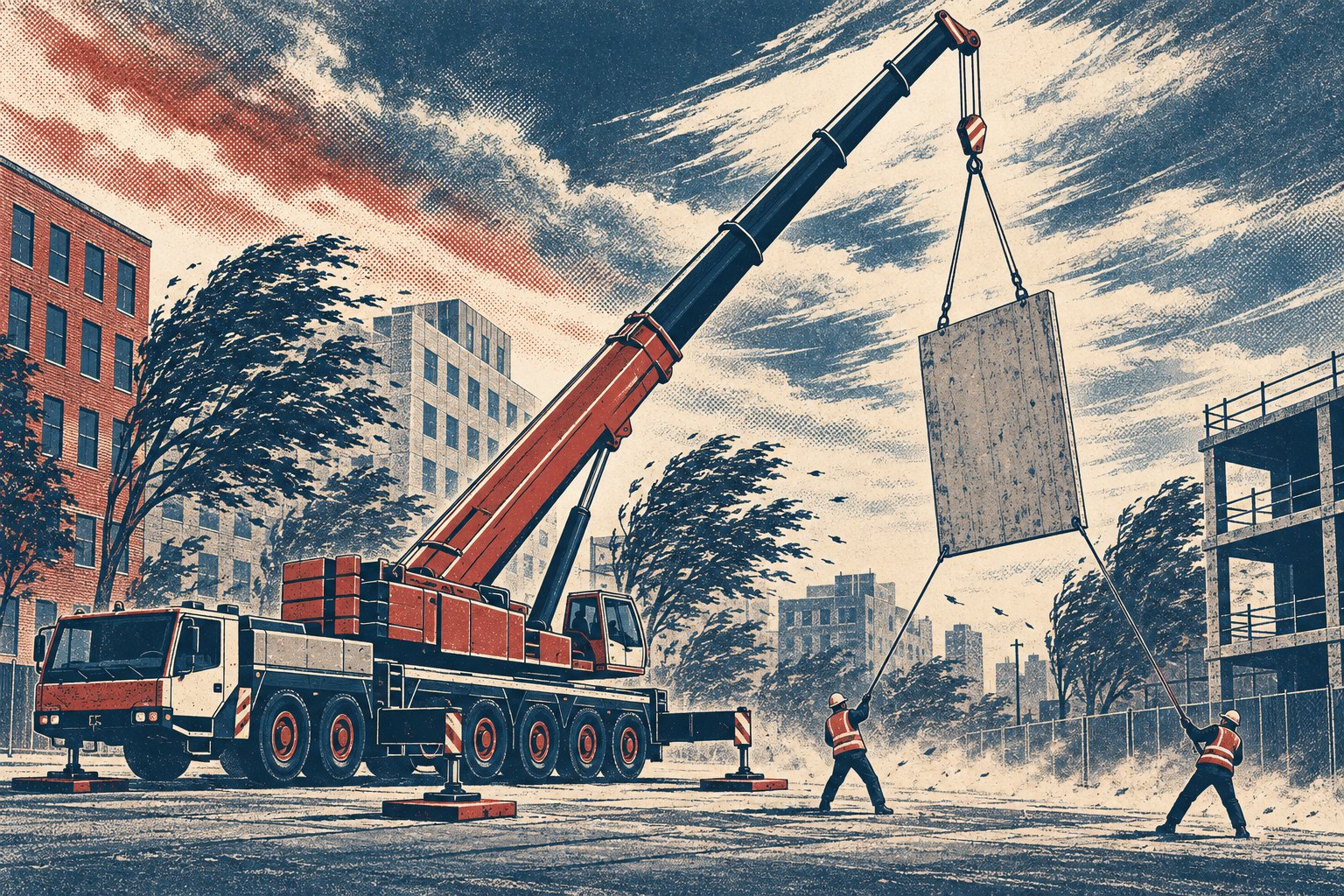
Crane load charts are calculated for a wind. Liebherr's mobile and crawler charts generally apply up to a 3-second gust of 9 metres per second, about 20 miles per hour, measured at the maximum hoist height rather than at the 10 metre height a weather forecast uses, and for a standard load presenting no more than 1.2 square metres of wind area per tonne (Liebherr, Influence of wind on crane operation). Federal rules leave the adjustment to the site: the competent person must adapt the equipment or the operation to the effect of wind, ice and snow on stability and rated capacity (29 CFR 1926.1417(n)).
| Hook height | Liebherr factor, 10-minute mean at 10 m | Highest forecast mean wind at 10 m | Liebherr factor, gust at 10 m | Highest forecast gust at 10 m |
|---|---|---|---|---|
| 10 m (33 ft) | 1.400 | 14.4 mph | 1.000 | 20.1 mph |
| 30 m (98 ft) | 1.566 | 12.9 mph | 1.119 | 18.0 mph |
| 50 m (164 ft) | 1.653 | 12.2 mph | 1.181 | 17.0 mph |
| 100 m (328 ft) | 1.780 | 11.3 mph | 1.272 | 15.8 mph |
| 150 m (492 ft) | 1.861 | 10.8 mph | 1.329 | 15.1 mph |
Height factors are from Table 2 of the Liebherr training document cited above. The two forecast columns are computed for this article by dividing the standard 9 m/s load-chart gust limit by each factor and converting to miles per hour. They apply only to a standard load case on a chart rated at 9 m/s; some configurations are rated higher, and a load with more wind area is rated lower.
The table shows why a forecast that sounds calm can still stop a tall crane. A 12 mile per hour mean wind at ground reference is already at the limit for a standard load at 164 feet. Loads with large faces lose more. Liebherr's own worked example takes a 65 tonne load with 280 square metres of wind area and cuts its permissible gust from 11.1 to 5.86 metres per second, about 13 miles per hour. Wall panels, signs, cladding modules and turbine blades are all special load cases of this kind.
A helicopter is stopped by a different set of conditions. External-load work is visual work. Operators may not conduct external-load operations under instrument flight rules without specific FAA approval (14 CFR 133.33(f)), and no aircraft may operate under visual flight rules beneath a ceiling of less than 1,000 feet inside controlled airspace designated to the surface for an airport (14 CFR 91.155(c)). Low cloud, fog, heavy precipitation and poor visibility ground the aircraft even when the air is still. Heat and elevation reduce what it can carry, which the density altitude analysis quantifies. None of those conditions stops a crane that is inside its wind limit.
The cost of waiting settles close calls. Bigge prices small rough-terrain cranes and boom trucks at $300 to $600 a day and says large all-terrain and crawler cranes can exceed $2,000 a day (Bigge crane rental rates). Montana's exclusive-use contract for a CH-47D pays $37,750 a day for availability before a single flight hour, and $9,785 per flight hour on top, both dry of fuel (Montana DNRC contract DNR25-1303). That is a firefighting contract rather than a construction quote, but the structure carries over. At those figures one weather day for the heavy aircraft costs as much as about eighteen days of a large crane at $2,000 a day. Where the forecast is poor and the schedule can flex, the machine that is cheap to wait with is the better choice.
Geometry: loads that go sideways, underneath or inside
A helicopter delivers a load on a vertical line from above, and the set point needs an open column of air over it. A crane can place a load at a radius, reach under an obstruction with a luffing jib, lower it through a roof opening into an enclosed space, and work in the lee of a structure. Loads bound for a mechanical room, a courtyard under a canopy, a bay inside a partly roofed building or a position beneath a bridge deck are crane work because the aircraft cannot get above them.
Cranes can also share a load, and a helicopter cannot. A tall vessel or column is commonly upended by two cranes working together: the main crane lifts the top through trunnions while a tailing crane carries the base, rotating the load from horizontal to vertical under control at both ends. A helicopter carries its load from its own hook system, a single hook on most types or the three hooks of a CH-47D, and no second machine can share that load with it.
The surroundings matter as much as the load. Downwash velocity rises with disk loading, the aircraft weight divided by rotor disk area, which runs about 2.6 pounds per square foot for a Robinson R22 and 8.8 for a CH-47D (Disk loading). The FAA treats the 30 to 40 knot band as the point where rotorwash becomes hazardous to people and property on the surface (FAA Rotorwash Analysis Handbook). The federal crew rule requires all loose gear within 100 feet of the pickup and set points, and in any other area exposed to downwash, to be secured or removed, and keeps unauthorized people 50 feet from the aircraft while the rotors turn (29 CFR 1926.551(f) and (o)). Fresh roofing, stacked light material, glazing, active scaffolding, a crop under cover or an open-air event next door can make a crane the only practical method, even under a light load.
OSHA 1926.551 Ground crew rule
Access: when the constraint is not there
The helicopter's economic case rests on constraints: a street that has to close, a ridge with no road, a roof beyond a crane's radius from anywhere it can stand. When a site has an open paved lot beside the building, a firm access road and a set point inside a truck crane's chart, those constraints are missing. The crane's day rate then becomes a complete number, and a flight hour rarely beats it.
The approval path also shortens. Crane work is governed by OSHA's crane standard, which expressly excludes helicopter cranes (29 CFR 1926.1400(c)(16)), plus local permits for the street or right of way. An aerial lift over a congested area needs an FAA-approved plan for the complete operation, coordinated with the Flight Standards office and backed by an agreement with local officials to exclude unauthorized persons (14 CFR 133.33(d)). A restricted-category aircraft, which includes most surplus military heavy lifters, may not operate over a densely populated area at all (14 CFR 91.313). The congested area plan explainer covers what that process involves. Cranes are not free of federal paperwork: a crane reaching above 200 feet triggers an FAA obstruction notice, as the permitting guide sets out, and that notice has its own lead time.
14 CFR 133.33 Congested area plan 14 CFR 91.313 Restricted category limits
Mobilization follows the same logic. A heavy helicopter bills its ferry flight at the flight rate in both directions, measured from the operator's base or the aircraft's current location, and the mobilization cost breakdown shows how that reaches six figures on a cross-country positioning. A local crane yard twenty miles from the site has no equivalent line.
A decision table
The five conditions reduce to a check that can be run on any pick list before an aerial quote is requested. A single row pointing firmly to the crane usually decides the job.
| Condition | Points to a crane when | Points to a helicopter when |
|---|---|---|
| Weight | Any pick with rigging exceeds about 28,000 lb, or the lift-day capacity of the aircraft available | Every pick sits well inside lift-day capacity with margin for rigging |
| Hold time | The load must stay on the hook while it is aligned, drilled, bolted or braced | The connection captures the load in one motion and fastening follows release |
| Program length | The structure needs a hook daily for weeks or months | The lifting fits into a few concentrated hours or days |
| Weather | Low ceilings, fog or heat are likely and the schedule can flex | A clear window exists and waiting would idle a large crew |
| Geometry | The set point is under a roof, canopy, deck or jib, or the load must be upended by two machines | The set point is open to the sky and the surroundings tolerate downwash |
| Access | An open, firm crane position lies within chart radius and no street closes | The crane would need a street closure, a temporary road or an oversized machine for reach |
| Approvals | The site is congested and the only aircraft available are restricted category | The site is uncongested, or a standard-category aircraft and an approved plan are available |
A qualitative summary of the sections above. It does not replace a lift plan, an engineered crane selection or an operator's lift-day performance calculation.
Most real jobs split. A rooftop program may put the heavy chillers on a crane from the loading dock and fly the small condensers from the back of the roof in a morning, which is a pattern the rooftop HVAC guide describes. A transmission project may truck and crane the structures at road crossings and fly the ridge sites. The useful discipline is to run the check pick by pick instead of choosing one method for the whole scope, and to price both methods wherever the table is mixed.