Helicopters do real work on wind farms, but almost never the work the photographs suggest. A utility-scale nacelle weighs 56 to 75 tons and the heaviest hook in the US civil fleet carries about 14 tons, so rotorcraft fly rotor blades, technicians, tools, and cargo into places roads cannot reach. The crane still sets the machine.
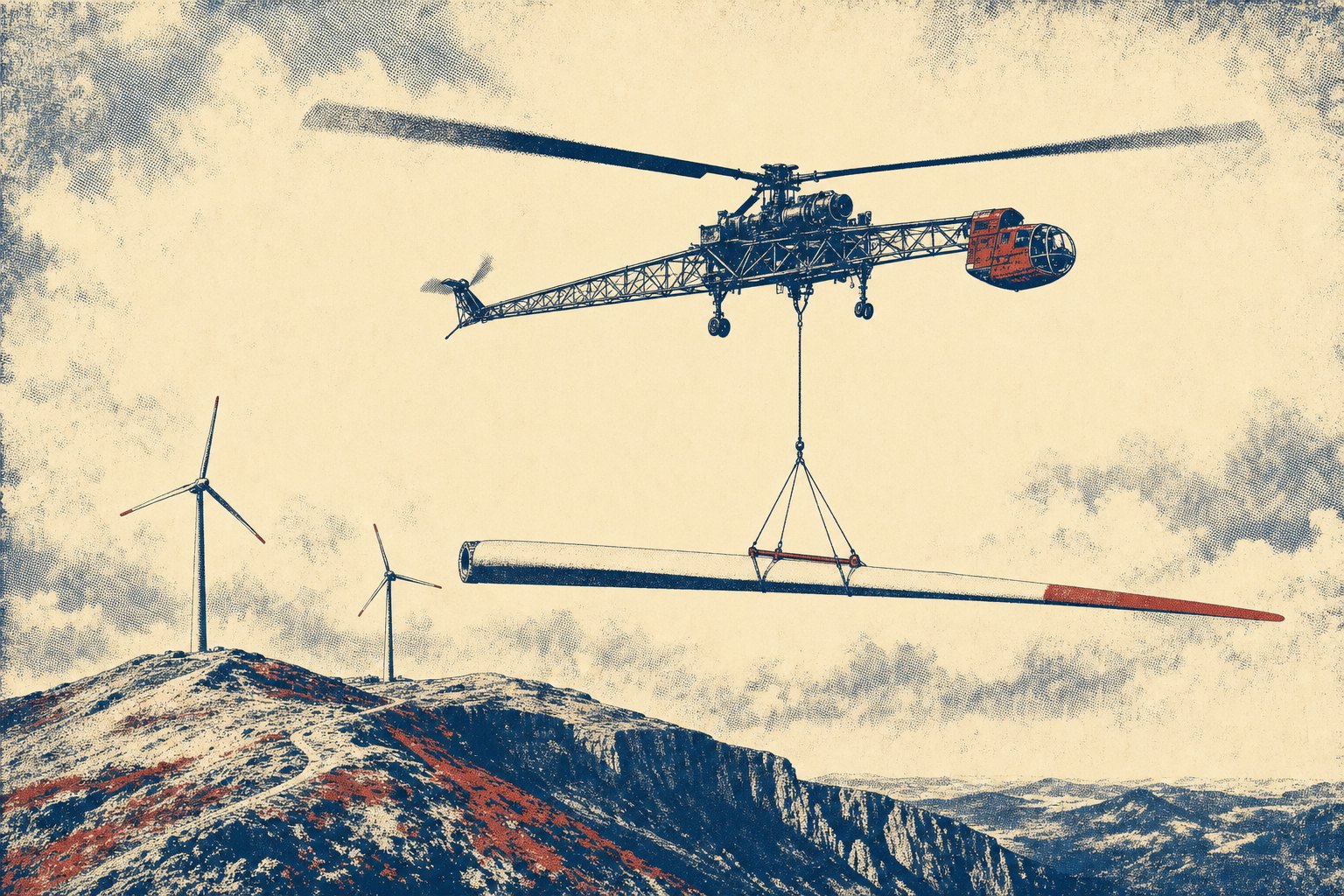
Search results for helicopters and wind turbines are dominated by two images: an aircraft dangling a rotor blade over a mountain ridge, and an aircraft spraying a frozen blade with hot water. Both are real. Neither is routine, and neither describes most of the rotorcraft work the wind industry actually buys.
The useful question for a project manager is narrower. Given what a modern turbine weighs and where its components have to go, which tasks does a helicopter perform better than a truck, a crane, or a boat, and which tasks are physically closed to it. This article answers that with component weights, hook capacities, the cost anatomy of the crane the aircraft would be replacing, and the federal rule that changes the moment a technician rides the line instead of the load.
The weight problem, stated plainly
Every argument about aerial work on turbines starts with mass. A utility-scale wind turbine is not a heavy machine in the way a rooftop chiller is heavy. It is a heavy machine in the way a bridge span is heavy, and the numbers put most of it permanently outside rotorcraft reach.
The table below sets three widely deployed onshore machines against the working end of the US civil lift fleet. Component weights are as published by National Wind Watch from manufacturer data; hook figures are the sea level standard-day capacities used across the AHLH library and detailed in the aircraft-by-aircraft helicopter lift capacity table.
| Component or aircraft | Weight or hook capacity | Within a US civil helicopter hook? |
|---|---|---|
| GE 1.5 MW nacelle | More than 56 tons | No, by roughly 4x |
| Vestas V90 1.8 MW nacelle | 75 tons | No, by more than 5x |
| Gamesa G87 2.0 MW nacelle | 72 tons | No, by more than 5x |
| Vestas V90 tower (262 ft) | 152 tons | No, and it ships in sections |
| GE 1.5 MW blade assembly (three blades plus hub) | More than 36 tons | No, by roughly 2.5x |
| Single 144 ft rotor blade, 3.0 MW class | Flown at or under 20,000 lb by S-64 | Yes, at the top of the envelope |
| Columbia BV-234 Chinook (heaviest US civil hook) | 28,000 lb (14 tons) | The ceiling itself |
| Erickson S-64 Air Crane | 25,000 lb catalog, 20,000 lb working | The wind-work aircraft of record |
Turbine weights are US tons as published from manufacturer data and vary by tower height and site class. Helicopter figures are sea level standard-day hook capacities; available payload falls with density altitude, addressed below.
One line in that table matters more than the rest. A single rotor blade is the only major turbine component that fits inside a heavy helicopter's hook, and it fits at the very top of the envelope. Everything structural above the blade, the hub, the nacelle, the gearbox and generator inside it, and every tower section, is a crane job in the United States and will remain one. No amount of aircraft selection changes a 75-ton nacelle into a 14-ton load.
What rotorcraft actually fly on a wind project
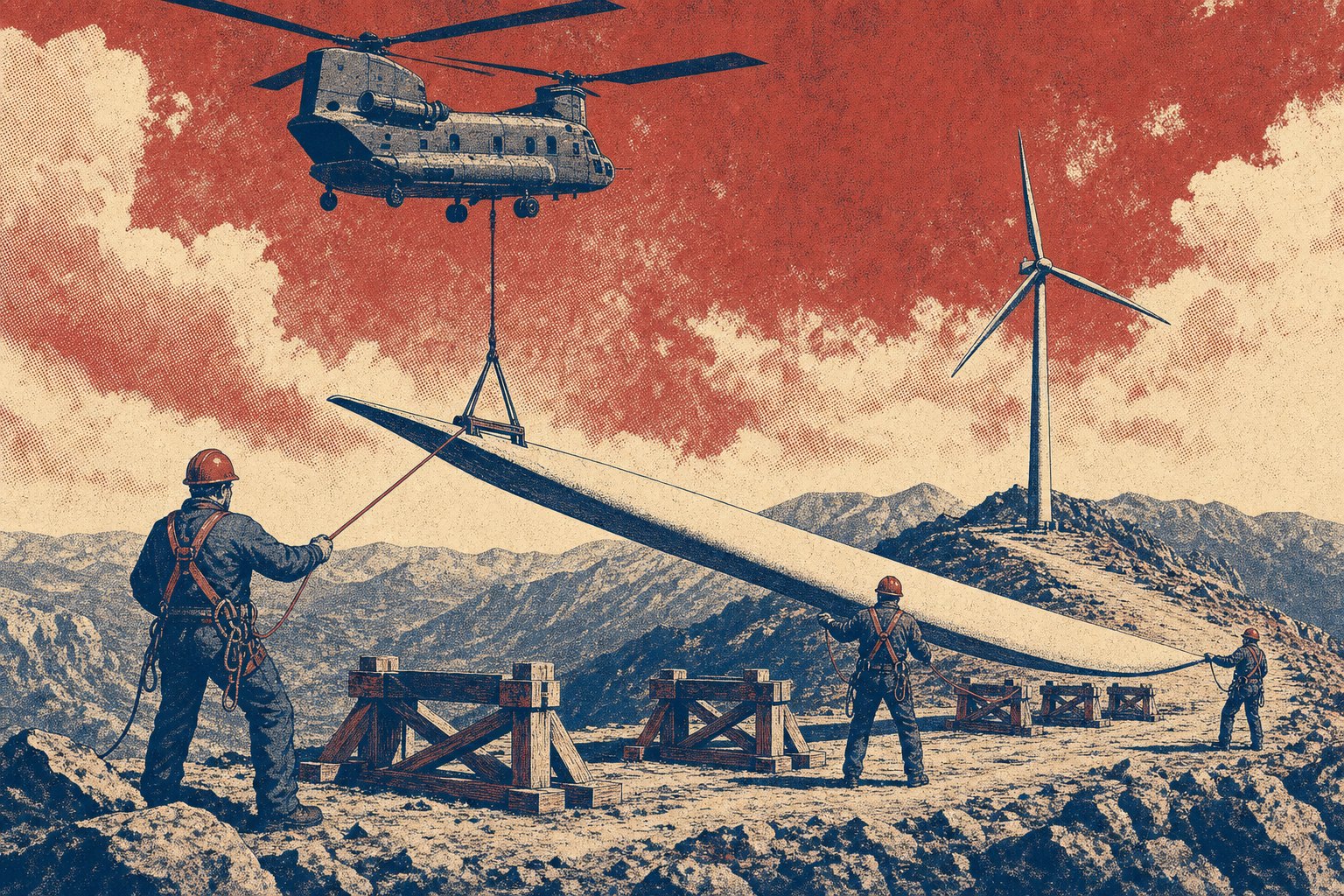
The blade is where the aerial mission lives, and the documented projects are blade projects. Erickson has flown turbine blades on several jobs, including three blades lifted to the top of the Grouse Mountain turbine near Vancouver and a campaign in the mountainous terrain around Ricigliano, Italy, where the aircraft delivered 39 blades of 144 feet each to a site on which Vestas built twelve 3.0 MW V90 machines (Windpower Engineering & Development).
That job produced a piece of hardware worth noting. Erickson and Vestas designed a purpose-built blade carrier for the Italian work, and the load flew on a long line specifically so the aircraft's rotor wash would not disturb the blade or its placement at the receiving end. A 144-foot airfoil is the least cooperative shape in external-load work: enormous surface area, very little mass, and a lifting profile of its own the moment it moves through air. The sling geometry, the anti-rotation hardware, and the dynamic margins behind a load like that follow the same discipline covered in the engineering behind aerial rigging, pushed toward its aerodynamic limit.
Below the blade sits the work nobody photographs: bolts, tooling, transformers, cable reels, small nacelle components, fuel, and crew gear moved to pads that a loaded truck cannot reach in the build season. This is ordinary aerial freight to sites with no usable access road, and it is the same pattern the AHLH library documents in alpine chairlift construction, where the terrain rather than the weight is what defeats ground equipment.
The road that never gets built
The economic case for aerial delivery on a wind project is not made against the crane at the tower. It is made against the road that reaches the tower. New access roads are among the largest cost items a wind farm owner carries, and turbine geometry is the reason: tower sections and blades exceeding 120 feet demand large-radii turns that a mountain right-of-way frequently cannot accommodate at any price. Erickson's construction staff put the alternative at 20,000 pounds per lift with only light crew-truck access left to build, and estimated the savings at millions on a suitable project (Windpower Engineering & Development).
The crane side of that ledger is unusually well documented, because the wind industry has been auditing it. Crane equipment and labor account for 30 to 50 percent of turbine maintenance cost; a single day of crane rental runs $10,000 to $50,000 depending on size; moving a large crane typically takes 20 or more truckloads; and mobilization alone can approach half the total crane cost of a single turbine repair, with setup and teardown consuming days at each end and idle-time inefficiency accounting for as much as 40 percent of labor cost (Windpower Engineering & Development).
| Cost element | Large mobile crane | Heavy-lift helicopter |
|---|---|---|
| Getting the asset to site | 20+ truckloads; mobilization near 50% of total crane cost | Ferry flight, billed by the hour, plus a fuel and support truck |
| Site preparation required | Graded access road, large-radii turns, engineered crane pad | Staging area at the base plus a cleared receiving zone |
| Time before the first pick | Days of assembly after arrival | Minutes after arrival on station |
| Day rate | $10,000 to $50,000 by size | Flight-hour rate, high but paid only while turning |
| Idle labor exposure | Up to 40% of labor cost during assembly and moves | Ground crew engaged only during the flight window |
| Maximum single load | Whole nacelles and tower sections, tens of tons | 28,000 lb ceiling; one blade, not one nacelle |
Crane figures are as published by Windpower Engineering & Development from wind-services practice; helicopter cost structure follows the AHLH cost model. The comparison holds only where the load is inside rotorcraft capacity, which for turbines means blades and freight rather than drivetrain components.
That last row is the honest limit of the comparison, and it is why the aerial argument on a wind farm is narrower than it is on a rooftop or a transmission line. A helicopter does not remove the crane from a wind project; it removes the road, and only when the site is remote enough or steep enough for the road to be the dominant cost. The general framework for running that arithmetic is set out in the AHLH analysis of what a lift actually costs once mobilization and downtime are counted.
Thin air on a ridge line
Wind projects are sited where the wind is, which means ridges, passes, and plateaus. That is also where a helicopter loses payload. The working rule across the AHLH library is a loss of roughly three percent of available payload for every 1,000 feet of density altitude, with heat and humidity stacking on top of field elevation.
The industry states the same discount in operational terms. Erickson's aircraft carry roughly 25,000 pounds on paper, and the company's own construction staff describe 20,000 pounds per lift as the reasonable planning figure once elevation, temperature, and flight distance are accounted for. That is a 20 percent haircut applied before a single blade leaves the staging yard, and it is the single most common reason an aerial delivery plan that pencils at sea level fails at 7,000 feet on an August afternoon. Heavy picks on a ridge get flown in the first cool hours after sunrise for exactly this reason.
Offshore, the hoist replaces the boat
The fastest-growing rotorcraft mission in wind has nothing to do with lifting turbine parts. Offshore, the helicopter is a personnel system, and it competes with the crew transfer vessel rather than the crane. Most CTV designs stop working at about 1.5 meters significant wave height, which in a North Sea year removes a meaningful share of the available access window and concentrates the loss in winter, when turbines fail most.
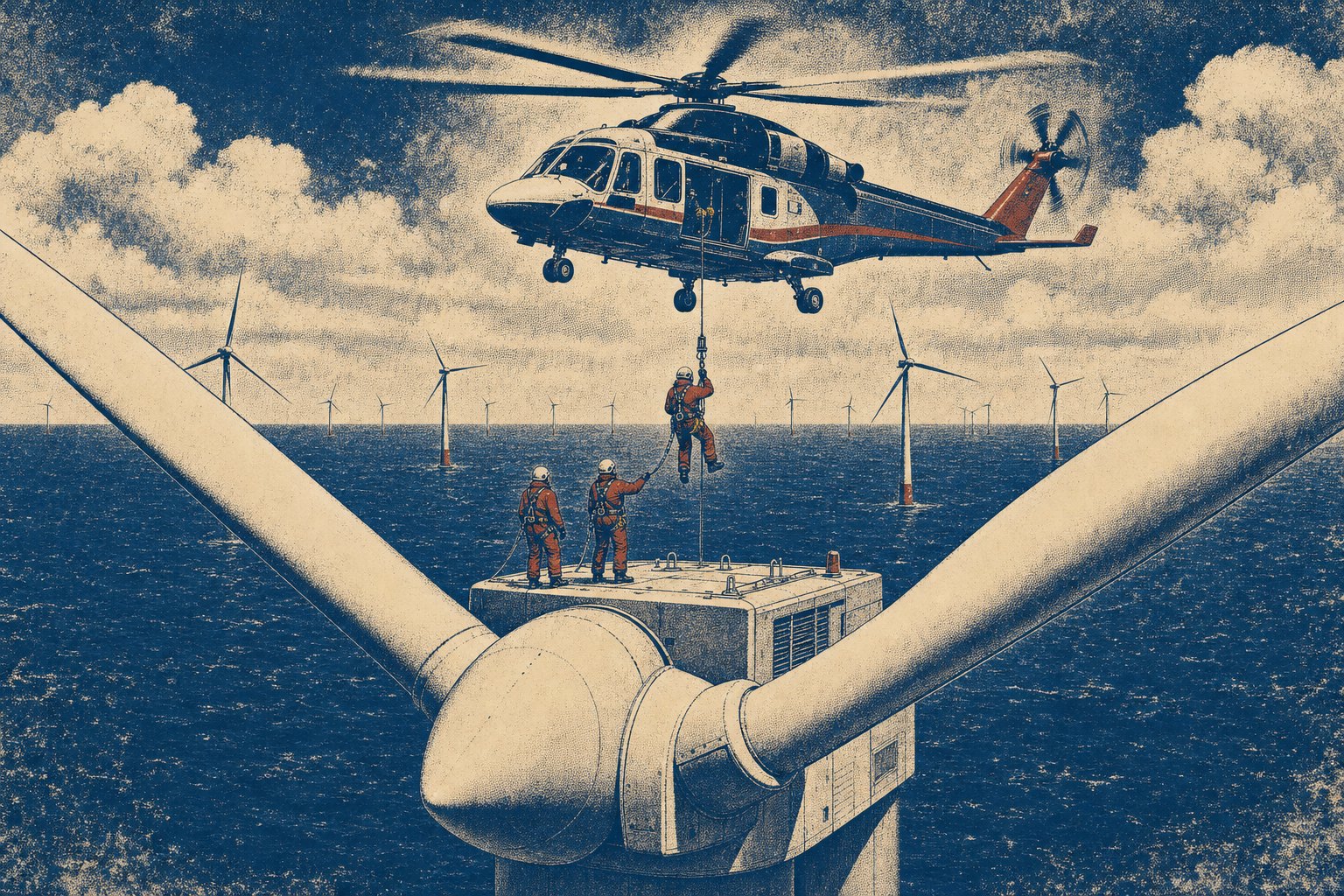
A hoist changes that calculus. Technicians are winched onto the nacelle roof rather than landed, because turbines carry no helideck. In an October 2023 trial at the Hywind Tampen floating wind farm roughly 110 nautical miles off Bergen, an Airbus H135 hoisted cargo and an H145 hoisted two crew onto the nacelle of a floating turbine in 30 knots of wind and sea state 6, with waves measured at 5.5 meters, conditions the participating pilots described as the upper limit of what is possible (Airbus). The United States entered this market in April 2022, when a joint venture awarded HeliService USA the first helicopter contract supporting American offshore wind, covering crew transfer and hoisting at South Fork Wind, Revolution Wind, and Sunrise Wind from a base at Quonset State Airport in Rhode Island (offshorewind.biz).
The constraint is capacity, not access. Offshore support helicopters typically carry two to six technicians and a limited weight and volume of spares and tools, which is why they buy uptime rather than replace vessels outright (BVG Associates, Guide to a Floating Offshore Wind Farm).
De-icing, inspection, and the jobs that came and went
The viral image of a helicopter spraying a wind turbine is genuine and frequently miscaptioned. It records work by the Swedish operator Alpine Helicopters in 2014, spraying heated water, with no chemicals added, to clear ice from turbine blades (Science Feedback). The technique addresses older machines that lack integrated blade heating, and it survives only where the value of restored production over a cold snap exceeds the cost of a flight day. Modern turbines built for cold climates carry their own anti-icing systems, which is precisely why the practice is rare enough to be newsworthy when it happens.
Blade inspection followed a similar arc in the opposite direction. Helicopter-borne cameras, including thermal imaging flown past the pressure and suction sides of a rotor in sequence, were an established method before small unmanned aircraft matured. Drones now hold that work: they cost a fraction of a flight hour, fly closer to the surface, and do not require the aircraft to hold a hover alongside a structure. The rotorcraft retains the missions the drone cannot serve, which are the ones involving weight, distance over water, or a human being who has to arrive at the nacelle.
Which federal rule covers which flight
Aerial work on turbines splits cleanly into two regulatory regimes, and the split is not about the aircraft. It is about whether a person is on the line. Carrying a blade, a transformer, or a pallet of hardware beneath the aircraft is a Class B rotorcraft-load combination: a jettisonable load carried free of land or water, flown by an operator holding a Rotorcraft External-Load Operator Certificate under 14 CFR Part 133. Hoisting a technician onto a nacelle is not. Any operation that puts a human being on the external line leaves Class B and becomes Class D human external cargo, with a materially higher bar.
14 CFR 133 External load certificate 14 CFR 1.1 Load class definitions
| Wind-project task | Load class | Governing requirement |
|---|---|---|
| Blade or component delivered on a long line | Class B | Part 133 certificate, approved rotorcraft-load combination, jettison capability |
| Freight in a cargo basket bolted to the airframe | Class A | Part 133; load cannot move freely or be jettisoned |
| Pull or tow line in contact with the surface | Class C | Part 133; the class that covers conductor and collector-line work |
| Technician hoisted to a nacelle roof | Class D | Transport-category rotorcraft, engine-out hover capability, approved personnel device, two-action emergency release, direct crew intercom |
| Ground crew receiving any load | Not a class | OSHA helicopter-crane rules: static discharge before contact, secured hard hats, no loose clothing |
Class definitions per 14 CFR 1.1; Class D equipment and performance conditions per 14 CFR 133.45(e). A restricted-category aircraft such as the S-64 or a converted Black Hawk operates freely on an open wind site but is barred from routine flight over congested areas.
Two practical consequences follow. First, an operator certificated for Class B blade delivery is not automatically authorized to hoist people, and a wind farm buying both services is buying two different authorizations from the same certificate. Second, the ground crew standing on the nacelle roof or at the receiving pad works to the federal helicopter-crane rules regardless of which class is flying: grounded static discharge before anyone touches a load, hard hats secured against downwash, and no loose clothing near the hoist line.
14 CFR 133.45 Operating limitations OSHA 1926.551 Ground crew rule
Where the crane still wins
On a wind farm, most of the time. Every gearbox, generator, main bearing, hub, and nacelle exchange on a modern turbine exceeds rotorcraft capacity by a wide margin, and the industry's own answer to expensive crane mobilization has been better cranes rather than aircraft: self-hoisting tower-mounted units, single-blade exchange rigs, and synthetic-rope winch systems that lower a blade without a boom at all. Those tools attack the same mobilization cost the helicopter attacks, and they reach loads the helicopter cannot.
The rotorcraft case narrows to four situations, and they are worth naming precisely. Delivery to a site where the access road is the dominant cost rather than the crane. Blade placement in terrain that a transport trailer cannot negotiate at any radius. Personnel and cargo movement offshore, where the sea rather than the ground is the obstacle, and where the hoist buys access the vessel cannot. And time-critical delivery, where a flight hour is cheaper than a week of lost generation.
Outside those four, the aircraft is the more expensive answer to a question the ground can already handle, which is the same conclusion the discipline reaches in aerial tower erection in roadless terrain: the helicopter is a tool for beating access, not for beating tonnage. The wind industry's turbines got heavier faster than the civil lift fleet got stronger, and the honest reading of the numbers is that the gap is still widening.