The words night, light, illuminate, and visibility do not appear anywhere in 14 CFR Part 133. A helicopter external-load lift flown at two in the morning is authorized by the same certificate, under the same operating rules, as the same lift flown at noon. Everything that actually changes after dark is imported from Part 91, Part 61, and one OSHA lighting table.
That silence is easy to misread as an oversight. It is not. The drafters of Part 133 restricted flight conditions when they wanted to. Section 133.33(f) bars external-load operations under instrument flight rules unless the Administrator specifically approves them, and bars carrying a person as part of an external load under IFR under any circumstances. Section 133.45(d) bars restricted-category rotorcraft from densely populated areas, congested airways, and the vicinity of busy passenger airports. The rule reaches for a prohibition twice in the space of two sections. It never reaches for one about darkness.
The practical consequence is that a night lift is a planning problem rather than a permissions problem. No separate FAA authorization exists to apply for. What exists instead is a stack of general rules that quietly tighten after sunset, a set of physical constraints that get harder, and one set of economics that gets materially better.
Part 133 is silent, and the silence is the finding
A search of the current published text of Part 133, across all twenty-two sections from 133.1 through 133.51, returns no instance of night, no instance of light or lighting, no instance of illumination, and no instance of visibility. The certificate issued under 133.17 carries no day-only restriction on its face. The operating rules at 133.33 govern the flight manual, the flight-operational checks for a new rotorcraft-load combination, congested-area operations, and the low-altitude relief that lets external-load work proceed below 500 feet and closer than 500 feet to persons and structures. None of it is time-of-day conditional.
The currency rule inside the part behaves the same way. Section 133.37 requires that a pilot have demonstrated knowledge and skill for the class of operation under 133.23, and that Class D crewmembers complete initial or recurrent training within the preceding twelve calendar months unless they have performed an operation of the same class in the same type within that window. It sets no separate night qualification and recognizes no night currency of its own.
14 CFR 133 External load certificate 14 CFR 133.33 Operating rules
Everything a contractor is told about night lift eligibility therefore traces to something other than the external-load rule. That is worth establishing before any of it is planned, because the most common errors in the trade literature are errors about which clock is running. The federal certificate that governs rotorcraft external-load work is not where the answer lives.
Three different definitions of night govern the same flight
A single lift beginning in late evening can be simultaneously inside one regulatory definition of night, outside a second, and approaching a third. The three definitions serve different purposes, are written in different sections, and produce different clock times on the same date at the same latitude.
| Instrument | The window it defines | What that window controls |
|---|---|---|
| 14 CFR 1.1, definition of night | End of evening civil twilight to beginning of morning civil twilight, per the Air Almanac, converted to local time | The legal meaning of night everywhere the regulations use the word, including the VFR weather minimums table |
| 14 CFR 91.209(a) | Sunset to sunrise | Position lights lit, and the parking, moving, and anchoring rules for a lighted aircraft. Starts earlier than legal night |
| 14 CFR 61.57(b) | One hour after sunset to one hour before sunrise | Pilot recency to carry persons: three takeoffs and three landings to a full stop in the preceding 90 days. Starts later than legal night |
| 14 CFR 61.57(f) and (g) | Night vision goggle operations, tracked in calendar months | Goggle-aided recency, including six night vision goggle operations for helicopters when persons are carried |
Civil twilight ends roughly 25 to 30 minutes after sunset at mid latitudes and lengthens considerably toward the poles and in summer, so the three windows do not open in a fixed order or at fixed intervals. The 91.209(a) light requirement is stated differently in Alaska. No Federal Aviation Regulation uses the figure of 30 minutes after sunset, which circulates widely in commercial marketing copy and is a Canadian construction, not a US one.
14 CFR 1.1 Definition of night 14 CFR 91.209 Aircraft lights
What actually tightens after dark
The constraints that do move are general aviation constraints, and they move by modest, specific amounts. The table below sets the day and night version of each rule that touches an external-load flight side by side, which is the form a lift planner can actually work from.
| Rule | Day | Night | Net effect on a lift |
|---|---|---|---|
| 14 CFR 133.33, 133.37, 133.45 (the external-load rule) | Applies | Applies identically | None. No night clause exists |
| 91.155, Class G at or below 1,200 ft AGL, helicopter | 1/2 statute mile, clear of clouds | 1 statute mile, clear of clouds | The weather margin doubles. An airplane in the same airspace jumps to 3 statute miles with cloud clearances |
| 91.205, required equipment | Day VFR list | Adds position lights, an approved anticollision light system, an adequate electrical source, and spare fuses | An unequipped light single is out. Most working utility aircraft already comply |
| 91.209(a), lights | Not required | Position lights lit from sunset to sunrise | Lights the aircraft. Says nothing about the load |
| 91.151, VFR fuel reserve, rotorcraft | 20 minutes | 20 minutes | Unchanged. The airplane reserve rises from 30 to 45 minutes at night; the rotorcraft reserve does not move |
| 61.57(b), pilot recency | No night element | Three takeoffs and three full-stop landings in the preceding 90 days, in category, class, and type | Narrows the pilot roster on short notice |
| 29 CFR 1926.56, site illumination | Ambient | 5 foot-candles general construction area, 3 foot-candles for access ways, loading platforms, and refueling areas | The only affirmative lighting requirement on the whole job, and it is OSHA, not FAA |
| 29 CFR 1926.551, helicopter ground crew | Applies | Applies identically | None. Paragraph (m) addresses visibility reduced by dust, not by darkness |
Airspace class governs the weather minimum, so a lift inside Class D or Class E surface area carries the 3 statute mile and basic cloud clearance figures day or night. The Class G rows are shown because most construction and utility set points sit in uncontrolled airspace below 1,200 feet. Table D-3 of 1926.56 lists further values for specific work areas and is reproduced in full at the source.
14 CFR 91.155 VFR weather minimums OSHA 1926.56 Site illumination
The aircraft is lit by rule. The load is not.
This is the single largest gap between what the rules require and what a night lift needs. Section 91.209 lights the aircraft. Nothing in Part 91, Part 133, or 29 CFR 1926.551 requires a light on the external load, on the sling bridle, or anywhere along a longline that can run 50 to 150 feet below the belly hook. The largest and lowest object in the operation, the one that will strike a parapet or a stack first, carries no mandated illumination at all.
The contrast with the ground alternative is stark. Under FAA Advisory Circular 70/7460-1M, effective 16 November 2020, temporary construction structures including cranes and derricks are addressed in their own chapter, structures exceeding 200 feet above ground level should be marked or lighted, and steady-burning L-810 units are used during construction until the permanent flashing-red L-864 system is energized. A tower crane at the same job site is lit by advisory standard. The helicopter load is lit only because an operator chose to light it.
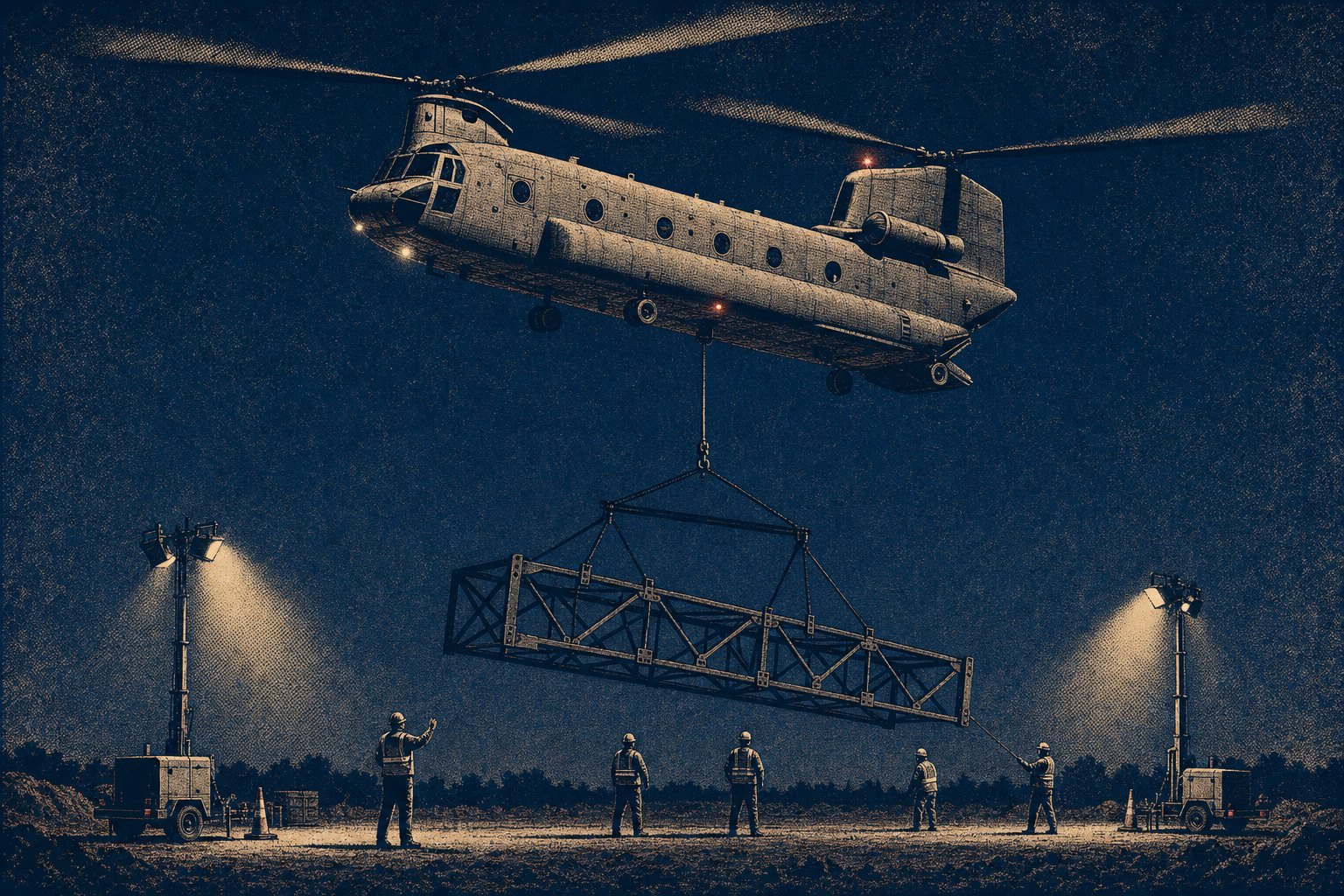
What operators actually do is procedural rather than regulatory, and it belongs written into the lift plan rather than assumed. Battery beacons or chemical light sticks are fixed to the load and to the sling apex so the pilot retains a visual reference on an object that is otherwise a hole in the sky. Belly-mounted hook lights, standard equipment on most utility airframes, illuminate the hook area rather than the load at the far end of a long line. The set point itself is lit from the ground, aimed down and inward. None of this is prescribed, which means none of it is guaranteed to be present unless someone specifies it. That gap belongs on the same checklist that covers sling selection, shackle inspection, and tag line control before the first pick.
Goggles solve navigation, not placement
Night vision goggles are the most misunderstood item in the conversation. They are genuinely transformative for the transit and obstacle-detection portions of the mission, and they are close to irrelevant to the moment the load touches down.
The authorization path runs entirely outside Part 133. Under 14 CFR 61.31(k), a pilot needs ground and flight training specific to goggle operations, covering aeromedical factors and night vision protection, unless a qualifying proficiency check has been completed. Section 61.57(f) then sets goggle recency in calendar months, requiring takeoffs and landings, hovering tasks, area departures and arrivals, aided-to-unaided transitions, and six goggle operations for a helicopter within the preceding two calendar months when persons are carried, extended to four calendar months when they are not. Section 91.205(h) lists the installed equipment that must be present and FAA approved, including compatible interior and exterior lighting, a two-way radio, an artificial horizon, adequate generator capacity, and a radar altimeter. Part 133 operators seeking goggle authority request it from the principal operations inspector as an operations authorization, not as an amendment to the external-load certificate.
14 CFR 61.57 Night and NVG recency
The optical limits are the reason the precision benefit does not follow. A goggle presents roughly a 40 degree field of view against something near 190 degrees unaided, so the scan that a vertical-reference pilot runs across the door frame becomes a head movement rather than an eye movement. Acuity under good conditions runs about 20/25 to 20/30, is commonly cited near 20/40 in an aircraft, and degrades toward 20/80 or worse at mean starlight or in low contrast. Most decisively, the pilot is looking at an electronic image on a phosphor screen, which means stereoscopic depth perception is absent.
Depth perception is precisely the cue that a longline placement is flown on. Vertical-reference work asks a pilot to judge the closure rate of a load against a curb, a foundation, or a tower flange from 50 to 150 feet above it, out the door or through a bubble window. Goggles restore the ability to see the obstacle field, the terrain, the wires, and the crew. They do not restore the ability to judge the last three feet. That is why night operations that work tend to pair goggle-aided flight with heavily engineered ground lighting at the set point and a rehearsed approach and placement sequence walked in daylight first.
Lighting the ground without blinding the cockpit

The lighting requirement on a night lift site is an OSHA requirement. Table D-3 of 29 CFR 1926.56 sets 5 foot-candles for general construction area lighting and 3 foot-candles for concrete placement, excavation, waste areas, access ways, active storage areas, loading platforms, refueling, and field maintenance areas. A receiving crew rigging and unhooking a load at the set point is working in exactly those categories, so the pad has to be lit whether or not the pilot wants it lit.
That obligation runs against the pilot directly. Human dark adaptation is a two-stage process, with the cones adjusting within about 5 to 10 minutes and the rods requiring roughly 30 minutes to reach full sensitivity, at which point they are on the order of 100,000 times more sensitive than in daylight. A single unshielded white floodlight swept across a cockpit resets that clock. The design answer is geometric rather than photometric: fixtures mounted high and aimed down, shielded on the aircraft side, positioned so that no beam intersects the approach and departure paths, and a hard rule that no one on the ground points a hand light at the aircraft. Both obligations are then satisfied at once, and neither is negotiable at the hook.
The ground crew equipment does not change. Complete eye protection and hard hats secured by chinstraps are still what 29 CFR 1926.551(e) names for the crew receiving the load, and the only paragraph of that standard touching visibility, paragraph (m), addresses visibility reduced by dust or other conditions rather than by darkness. Reflective markings on the crew and a distinct color reserved for the designated signalman do more work at night than any added item of gear, because the signalman has to remain distinctly recognizable when the only light is coming from below.
The fall zone is a visual assurance, and darkness attacks it
Over a congested area, 133.33(d)(1) requires the operator to develop a plan for each complete operation, coordinate it with the responsible Flight Standards office, obtain approval, and include an agreement with the appropriate political subdivision that local officials will exclude unauthorized persons from the area. Paragraph (d)(2) then requires each flight to be conducted at an altitude and on a route that will allow a jettisonable external load to be released, and the rotorcraft landed, in an emergency without hazard to persons or property on the surface.
14 CFR 133.33 Congested area plan
Both provisions are assurances about what is on the ground, and both are ordinarily verified by looking. At night the exclusion agreement carries more weight rather than less, because a perimeter that cannot be scanned from the air has to be held by posted personnel, radio confirmation, and lit closure points. The jettison route is the harder half. A route selected in daylight because the ground beneath it is empty is a route whose emptiness cannot be reconfirmed in flight after midnight, which is an argument for surveying and photographing the entire route in daylight and for keeping the night version of the route identical to the surveyed one. The same discipline applies to the municipal side of the file, where street closures, fire department standby, and local approvals stack on top of the federal plan and frequently carry their own hour restrictions.
Why a night window gets chosen rather than endured
Night lifts are not a concession. In four recurring situations the night window is the reason the lift is viable at all.
Thermal performance. Density altitude falls with temperature, and the diurnal swing at a construction or utility site is routinely 25 to 35 degrees Fahrenheit. The table below models the effect using the standard planning rule of 120 feet of density altitude per degree Celsius above the standard temperature at field elevation, then applies the customary planning haircut of roughly 3 percent of payload per 1,000 feet of density altitude to a nominal 12,000 pound planned hook load.
| Site | Afternoon temperature and density altitude | Pre-dawn temperature and density altitude | Density altitude recovered | Modelled payload gain on a 12,000 lb pick |
|---|---|---|---|---|
| Coastal site, field elevation near sea level | 95 F, about 2,400 ft | 72 F, about 900 ft | About 1,500 ft | About 540 lb |
| High desert pad, 4,000 ft field elevation | 100 F, about 7,700 ft | 65 F, about 5,300 ft | About 2,400 ft | About 860 lb |
| Mountain set point, 8,000 ft field elevation | 80 F, about 11,300 ft | 48 F, about 9,200 ft | About 2,100 ft | About 760 lb |
Modelled, not measured. Density altitude computed as field elevation plus 120 feet per degree Celsius above the standard temperature at that elevation, at standard pressure; a non-standard altimeter setting shifts every row. The 3 percent per 1,000 feet payload figure is a planning heuristic, and the governing number for any actual pick is the hover performance chart in the Rotorcraft-Load Combination Flight Manual required by 14 CFR 133.47, not a rule of thumb. Humidity, which usually rises overnight, works against the temperature gain and is not modelled here. Full treatment in the density altitude and payload analysis.
Outage and closure windows. Transmission owners schedule planned outages when system load is lowest, which is overnight, and the outage is what makes structure and hardware work on a de-energized circuit possible. State transportation departments close highways for girder and sign-truss placement overnight for the same reason, typically from around 7 or 9 in the evening until the morning commute. When the window is dictated by a system operator or a highway agency, the aircraft either works inside it or does not work. That is the governing case on most conductor and hardware work along an energized corridor.
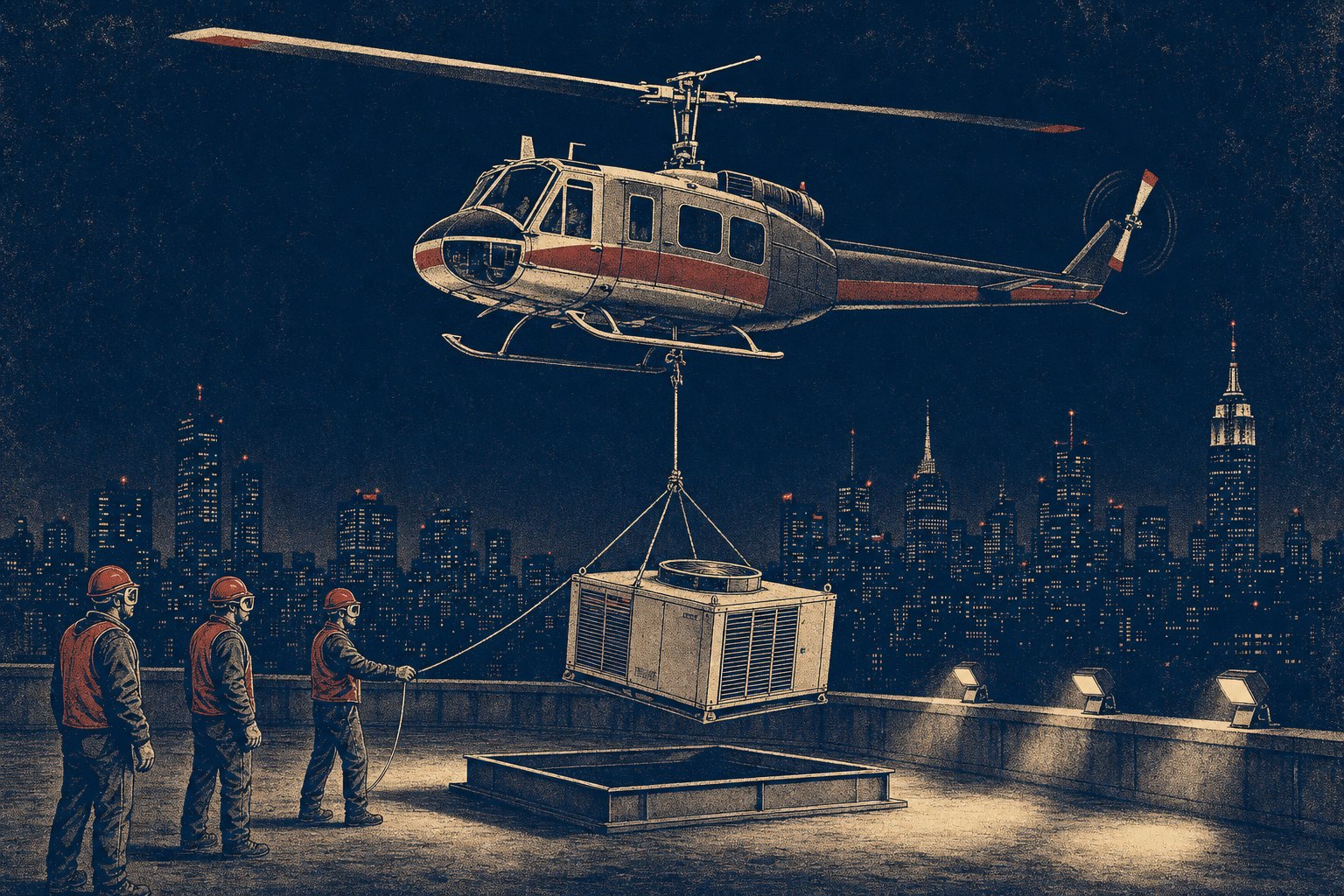
Occupancy. A mechanical unit set over an occupied shopping center, hospital, or office tower puts fewer people under the flight path at three in the morning than at three in the afternoon. Since the congested-area plan turns on excluding unauthorized persons from the area, an hour when the building is empty is an hour when the exclusion is achievable. That logic drives a meaningful share of rooftop mechanical unit replacement work, where the alternative is a street closure during business hours.
Air mass stability. Surface winds commonly decouple from the gradient wind after sunset as the boundary layer stabilizes, and mechanical and thermal turbulence over broken terrain typically subsides. Calmer air is worth more to a suspended load than to almost any other flight regime, because load oscillation is what sets the practical limit on a precision placement.
The costs are equally real and belong in the same estimate. Night work carries shift premiums for the ground crew, mobilization and fuel for light towers, a smaller pool of current and goggle-qualified pilots, and a slower placement cadence than the same crew achieves in daylight. No published civil dataset quantifies the night cycle-rate penalty for external-load work, so any bid that assumes daylight production rates after dark is assuming a number nobody has measured.
What a night lift plan adds to a day lift plan
- A named clock. State which definition of night the plan is using for each obligation, because 14 CFR 1.1, 91.209(a), and 61.57(b) open three different windows on the same evening.
- A pilot currency check against 61.57(b), and against 61.57(f) if the operation is goggle-aided, confirmed for the specific individuals rostered rather than for the operator in general.
- A load lighting specification, since no rule supplies one. Beacons or light sticks on the load and the sling apex, with a stated method for retrieving them after the set.
- A ground lighting layout drawn to the 5 and 3 foot-candle figures in Table D-3 of 29 CFR 1926.56, with every fixture aimed down and inward and no beam crossing the approach or departure path.
- A daylight survey and photographic record of the approach, the departure, and the jettison route, on the understanding that the night route is the surveyed route and not a variation of it.
- A perimeter held by posted personnel and radio confirmation rather than by visual scan, and a signalman in a color reserved to that one person and lit from below.
- A payload figure taken from the flight manual hover chart at the forecast overnight temperature, not from the afternoon planning figure and not from the catalog limit.
None of that comes from Part 133, which is the point. The external-load rule treats a night lift as an ordinary lift, and it is correct to, because the certificate governs the rotorcraft-load combination rather than the hour. Everything that makes the night version harder sits in general aviation rules, in an OSHA lighting table, and in human vision, and every one of those is a planning input a contractor can control in advance. Operators that treat night as a discipline rather than an exception are the ones that work the full external-load envelope instead of half of it.