
HVAC & Rooftop Units
Hospitals and research buildings put unit verification, emergency access, and pedestrian control ahead of simple roof reach.

Local lift planning
Class B traffic sits over an active harbor while curb-space controls shape the ground plan below.
Census Vintage 2025 estimates the Boston-Cambridge-Newton metropolitan area at 5,034,221 residents. Boston is the principal-city anchor. The whole-metro figure sets guide order and is not Boston city population or evidence of project demand.
The current FAA Chart Supplement places Logan International Airport one mile east of Boston at 19 feet elevation. It lists six paved runways, including the 10,083-by-150-foot Runway 15R/33L, in Class B airspace. Current NOTAMs, traffic, permission, aircraft fit, and the external-load route remain separate checks.
Massport describes Conley Terminal as a 130-acre container terminal with seven cranes, 3,300 linear feet of berth, and direct proximity to I-90 and I-93. That working layout makes current vessel, crane, truck, rail, and tenant activity part of any waterfront site review.
FAA remarks identify birds and numerous cranes on or near Logan. Airport proximity cannot substitute for current airspace coordination, obstacle review, property permission, or a controlled load path.
An NWS Boston climatology notes summer thunderstorms, northeasters, and recurring heavy fog. Historical patterns do not set a work window. Current observations, forecasts, surface wind, visibility, and the selected operator’s limits control.
Boston asks for at least seven business days to process a street occupancy application. The application addresses traffic, police details, truck length, occupied dimensions, and pedestrian detours. The congested-area planning guide explains why public-space control and the flight path must be considered together.
Hospitals and research buildings put unit verification, emergency access, and pedestrian control ahead of simple roof reach.
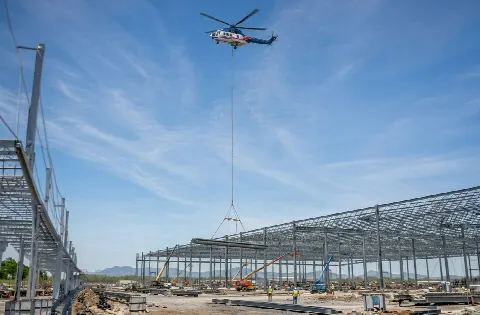
Port and urban steel moves need component geometry checked against the receiving zone and the final street route.

Logan’s Class B environment and published crane activity make airspace coordination a front-end constraint.

Urban tower work must account for airport traffic, local obstacles, property control, and a protected ground area.

Street occupancy does not establish utility, landowner, or aviation authority along an urban corridor.
Boston’s 2026 economy report identifies health care and social assistance as the largest private-payroll sector, averaging 146,287 jobs in the third quarter of 2025. Hospitals and occupied medical buildings can put verified rooftop-unit weight, emergency access, and pedestrian control ahead of straight-line reach.
The same report places professional, scientific, and technical services second at 97,744 jobs. Research buildings and dense commercial sites still need parcel-specific shutdown, access, receiving-zone, and utility checks.