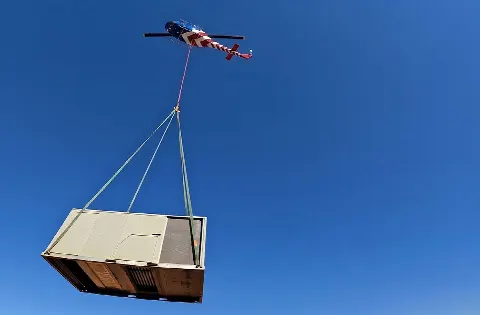
HVAC & Rooftop Units
Detroit treats helicopter lifts and street occupation as permit-controlled work. Rooftop equipment planning still begins with verified unit weight, roof capacity, and a protected set point.

Local lift planning
Major airport traffic, working river terminals, and a helicopter-specific city permit put route and ground control on equal footing.
Photo: Lrgjr72, CC BY-SA 4.0, via Wikimedia Commons. Cropped, resized, and compressed under CC BY-SA 4.0.
Census Vintage 2025 estimates the Detroit-Warren-Dearborn metropolitan area at 4,390,913 residents. Detroit anchors Michigan’s largest metro. The whole-region figure sets guide order and is not Detroit city population or evidence of project demand.
The current FAA Chart Supplement places Detroit Metro Wayne County Airport 15 miles south of the city at 645 feet elevation. It lists six paved runways, including a 12,003-by-200-foot runway, continuous attendance, and Jet A. Those facts do not establish project acceptance, helicopter parking, or staging permission.
Detroit’s ground process is unusually direct: the Department of Public Works lists Helicopter Lift as a right-of-way permit type. Temporary occupation of a street, alley, sidewalk, or berm also requires review, and the application must carry plans for the proposed work area.
The FAA entry identifies birds and waterfowl on or near DTW, directs users to the DTW NOTAM file, and lists surface limitations. A project date depends on current airspace, route, and NOTAM review for the actual site.
NWS Detroit climate normals record 45.0 inches of annual snowfall and 34.32 inches of precipitation. Snowfall normally spans November through April. Those figures frame access and schedule risk, but the live forecast and operator limits control the work window.
Detroit’s Technical Review Committee reviews Central Business District and Midtown work for congestion, emergency access, construction conflicts, events, and parking. The urban congested-area guide explains why the closure footprint and flight path must be evaluated together.
Detroit treats helicopter lifts and street occupation as permit-controlled work. Rooftop equipment planning still begins with verified unit weight, roof capacity, and a protected set point.
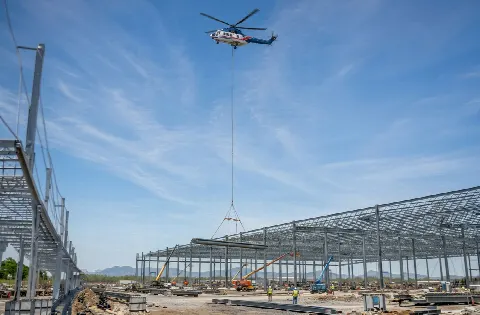
Manufacturing and project-cargo sites can present constrained steel placements. Component geometry, certified weight, and the closure footprint must be fixed before route planning.

DTW traffic, riverfront property control, current NOTAMs, and the city permit process remain separate planning gates.

Airport traffic and a dense urban obstacle environment require current charts, a site-specific route, and a controlled area below the work.

Utility work in public right-of-way still requires street, sidewalk, emergency-access, and property controls even when an aerial method is considered.
The Detroit/Wayne County Port Authority identifies 29 public and private terminal facilities in Detroit, River Rouge, and Ecorse. The terminals handle general, liquid, and bulk cargo, with steel leading by value and ore by tonnage.
The Port Authority terminal handles steel, aluminum, cement, and project cargo supporting Southeast Michigan manufacturing. That is a defensible setting for awkward components, but the load verification sheet keeps certified weight separate from port handling records.