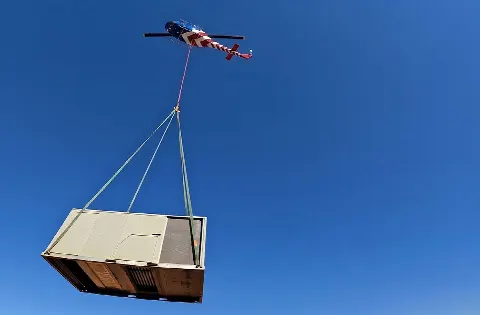
HVAC & Rooftop Units
For a production building, document the new unit and the removal load separately. Match the placement sequence to the facility interruption window.

Local lift planning
Precision manufacturing and a busy riverway put facility protection and public access into the same planning problem.
Photo: Bpp88520, CC0 1.0 via Wikimedia Commons. Cropped and compressed.
The Census Vintage 2025 metro workbook records 1,056,149 residents in the Rochester metropolitan area, placing it third among metros containing New York territory. That regional count selects the guide. It does not predict aerial-lift demand. Define the actual load and receiving point first, then compare a ground-crane concept with an aircraft concept using the same access assumptions. The New York directory explains how the statewide guide set is selected.
Rochester has a specific precision-manufacturing context. In April 2025, Empire State Development announced EvolvOptic’s Rochester expansion and identified the AIM Photonics test, assembly, and packaging facility at Eastman Business Park. Those facilities establish local industry context, not evidence of helicopter work. For a comparable manufacturing property, separate the rooftop equipment replacement from the process operating below it. Record the facility’s protection requirements and acceptable interruption window before fixing a pickup location.
The city’s May 2026 Maplewood Park completion notice identifies the final paved segment of the 24-mile Genesee Riverway Trail and improved links through the river corridor. The planning implication is straightforward: a corridor visible from above can also be a public route below. A proposed equipment placement near that corridor needs a ground-access survey that includes connecting paths. Check the actual work boundary instead of assuming the riverbank provides empty space.
The FAA Rochester airport briefing identifies Class C airspace and a mix of airline, cargo, military, and other aviation activity at the city’s southwestern edge. It specifically cautions against air-work loitering near FEPUG, an approach fix. Use that detail to trigger a current route review, not to sketch a clearance from this article. Airport briefings supplement the current chart and NOTAM review; they do not approve an off-airport external-load operation.
The National Weather Service Rochester climate narrative says snowfall varies sharply over short distances and that Lake Ontario can sustain lake-effect snow through winter because it usually remains unfrozen. A workable schedule needs a decision point for the full route, not simply a favorable forecast at the receiving roof. Recheck ground access after weather changes and keep an alternate work sequence available for a postponed placement. Compare this pattern with Buffalo’s lake-effect exposure when planning across both metros.
Rochester’s right-of-way guidance covers streets and sidewalks as well as obstructions and barricades. It states that construction using the right-of-way for more than two weeks needs a Traffic Control Board-approved maintenance and protection of traffic plan before a permit is issued. A shorter operation still needs its applicable permit review. Show where deliveries wait and how pedestrians pass the site. Do not make the building owner’s permission stand in for control of the public street.
For a production building, document the new unit and the removal load separately. Match the placement sequence to the facility interruption window.
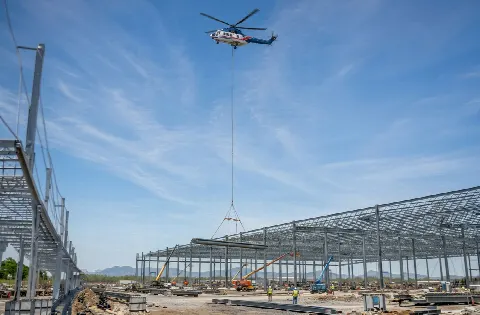
For work beside a riverway, compare assembly and receiving areas with the public paths crossing or approaching the work boundary.

A corridor placement needs both an aircraft route and a ground-access plan. Neither follows automatically from an open view of the receiving point.

For a proposed mast or antenna placement, review the exact coordinates against current Rochester airport procedures before fixing the ground schedule.
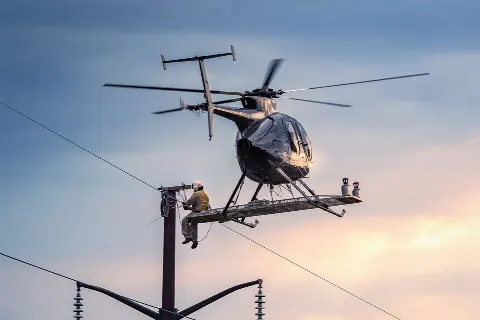
For line work crossing a road or public path, document each crossing interface and the electrical work controls separately from aircraft staging.
The EvolvOptic announcement describes production of precision optical components for specialized applications. For a similar operating plant, a mechanical-equipment change should begin with verified lifting points and the full rigged weight. The load-weight verification guide helps organize that evidence. Keep the receiving crew’s access and protection requirements separate from the aircraft performance assessment. A useful industry example is not proof that either a helicopter or a crane fits the building.
River-corridor infrastructure creates a different set of interfaces. The city’s Maplewood completion notice describes connections using the Route 104 pedestrian bridge and an accessible bypass beneath Driving Park Avenue. For comparable future maintenance, review the approach from the street all the way to the work point, including paths outside the apparent construction footprint. The slung-load motion article explains why load shape and stability belong in the discussion alongside mass and reach.