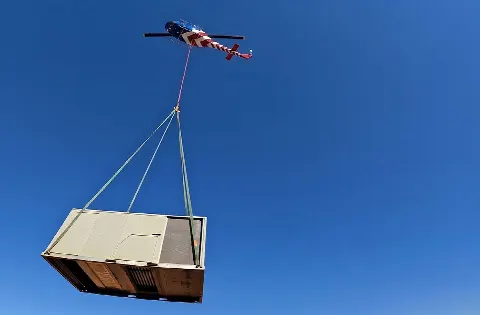
HVAC & Rooftop Units
Industrial, healthcare, and institutional roofs can make ground-crane access or facility circulation the deciding constraint.

Local lift planning
Class D airspace, an airport freight corridor, and a deep manufacturing base make exact route and work-zone control essential.
The Rockford metropolitan area had 337,242 residents in the Census Bureau Vintage 2025 estimates, fifth among the selected Illinois metros. Population establishes order, not aircraft demand or site authority.
The current FAA Rockford entry places Chicago/Rockford International in Class D airspace with TRSA service. Its runways measure 10,002 by 150 feet and 8,200 by 150 feet. Airport proximity does not make a route or staging area available.
Rockford’s industrial-advantage summary identifies advanced manufacturing, aerospace, logistics and distribution, and healthcare as core sectors. The city’s economic development overview separately documents I-39, I-90, U.S. 20, rail service, and RFD as a connected freight network.
The FAA supplement identifies approach-area trees or a road plus bird and deer activity. Class D service, TRSA procedures, obstacles, current charts, and NOTAMs make route and work-zone placement site-specific.
The NWS Rockford normals show 37.1 inches of annual snowfall, 135.8 days with lows at or below freezing, and 14.8 days with highs at or above 90 degrees. Winter surfaces and summer performance margins require different planning responses.
The city’s right-of-way permit application covers excavation, lane closures, and sidewalk closures, with construction details, bond and insurance evidence, and added traffic controls where needed. The permit jurisdiction guide explains why ground permission remains separate from aviation review.
Industrial, healthcare, and institutional roofs can make ground-crane access or facility circulation the deciding constraint.
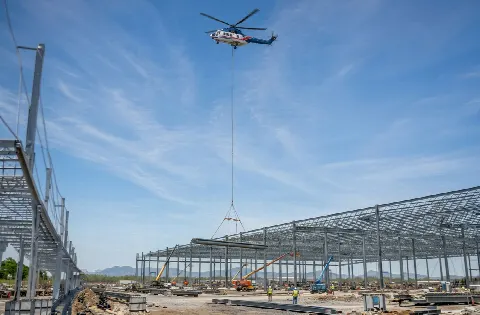
Manufacturing and aerospace facilities may involve structural or process components near active operations.

Communication and utility structures require route clearance, exact component weight, and controlled ground access.

Transmission work across developed or road-limited parcels needs crossing control, pull-site access, and current weather limits.

Class D airspace, TRSA procedures, Part 133 authority, aircraft fit, insurance, and site control are separate checks.
Rockford’s official sector summary supports advanced manufacturing and aerospace as local contexts for large roofs, structural placements, process equipment, and controlled industrial yards.
The documented I-39, I-90, U.S. 20, rail, and airport freight network can improve ground access while also concentrating traffic around industrial sites. Method selection still starts with exact weight and the full staging footprint.