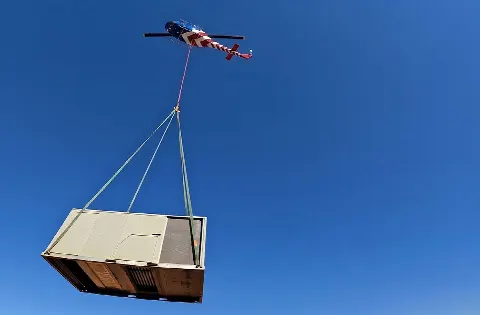
HVAC & Rooftop Units
Large plants and data-center roofs require verified equipment weights, roof access, shutdown limits, and loose-material control.

Local lift planning
Class C airport procedures, severe convective weather, and sharply different plant environments demand an exact load path and ground plan.
The Cedar Rapids metro had 279,285 residents in the Census Bureau Vintage 2025 estimates. Whole-metro population establishes the Iowa guide order, not worksite demand.
The current FAA airport entry places The Eastern Iowa Airport six miles southwest of Cedar Rapids and lists two grooved concrete runways. The continued FAA entry lists Class C service during published hours and Class E otherwise.
Cedar Rapids combines aerospace and precision manufacturing with fabricators and engineering firms. Plant security, shutdown rules, roof layouts, and receiving zones must be treated as site facts rather than regional assumptions.
The FAA airport entry flags birds plus snow and ice procedures when the tower is closed. Current charts, NOTAMs, runway status, and the proposed route remain controlling.
The NWS Quad Cities archive documents severe wind, tornadoes, hail, heavy rain, and flooding across eastern Iowa. A lift plan needs current observations, defined stop criteria, and a safe stand-down state.
The city’s annual oversize permit directs permitted loads toward designated truck routes where possible, separates state and county permits, and does not guarantee vertical clearance. The helicopter lift permitting guide explains why the street route and aviation approvals stay on separate tracks.
Large plants and data-center roofs require verified equipment weights, roof access, shutdown limits, and loose-material control.
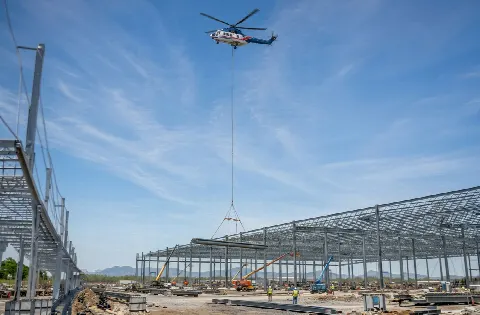
Manufacturing expansions can create placements where production traffic and crane setup deserve direct comparison.
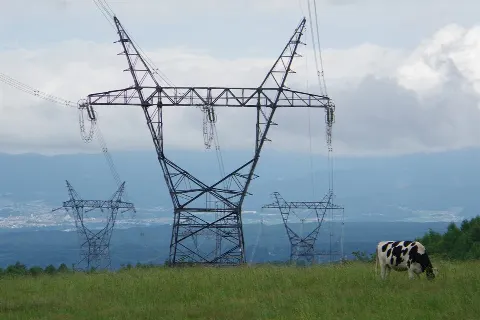
Class C airspace, airport hot spots, and the obstacle environment require a current route review.

Utility work around large industrial campuses must preserve plant access and coordinate with the asset owner.

The aircraft decision follows verified load, staging, route, receiving-zone, and operating-window facts.
The local manufacturing profile identifies a large aerospace presence backed by machine shops, fabricators, and engineering firms. Active production boundaries can make shutdown timing more important than straight-line crane reach.
City economic-development material describes food processing and data-center construction alongside aerospace, logistics, and technology. These site types have different utility interfaces, loose-material risks, and access controls.