
HVAC & Rooftop Units
Research and life-science buildings put verified equipment weight, occupied-building controls, and the roof receiving zone ahead of simple reach.

Local lift planning
A short municipal runway, snow-heavy winters, and occupied research sites make aircraft fit and ground control front-end decisions.
Photo: Dwight Burdette, CC BY 3.0, via Wikimedia Commons. Cropped, resized, and compressed.
Census Vintage 2025 estimates the Ann Arbor metropolitan area at 370,214 residents. It ranks fifth among metros containing Michigan territory, ahead of South Bend-Mishawaka, IN-MI at 324,538. Whole-metro counts set guide order and do not measure project demand.
The current FAA Chart Supplement places Ann Arbor Municipal Airport three miles south of the city at 839 feet elevation. Its paved Runway 06/24 is 3,505 by 75 feet, while Runway 12/30 is turf. Published dimensions do not establish aircraft fit, load capability, or staging permission.
Ann Arbor requires a right-of-way permit for construction in public streets and sidewalks. Traffic interference adds a Traffic Control Permit. Standard notice is 72 hours, while a full closure with a posted detour calls for 10 business days.
FAA remarks identify deer, large birds, and winter operating limitations at Ann Arbor Municipal. The entry directs pilots to confirm snow-removal activity when the tower is closed and states that the turf runway receives no snow removal. Current NOTAMs and surface conditions remain essential.
NOAA 1991-2020 normals show 61.4 inches of mean annual snowfall at the Ann Arbor U of Michigan station. January averages 18.3 inches of snow. These normals cannot set a work window.
Ann Arbor requires traffic-control plans to conform to MMUTCD Part VI and identify the work location, activity, timing, and detour. The city permit page governs public space. The permit-jurisdiction guide keeps that approval separate from property, utility, and aviation authority.
Research and life-science buildings put verified equipment weight, occupied-building controls, and the roof receiving zone ahead of simple reach.
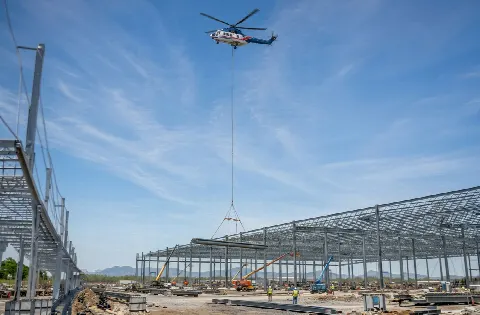
Automotive and technical facilities still require certified weight, component geometry, and a parcel-specific receiving area.

Scheduled Class D service, wildlife remarks, winter conditions, and airport permission make current review essential near Ann Arbor Municipal.

Airport traffic and a snow-heavy winter baseline require a fresh site, route, and weather review for each tower location.

Work in public right-of-way can require a city permit, while traffic impacts add a separate application and advance-notice period.
Ann Arbor SPARK identifies automotive and mobility, biotechnology, life sciences, and research as key regional industries. Those sectors create varied facility types, but the regional list does not establish demand or make a parcel suitable for helicopter work.
A 2026 State of Michigan release describes an Ann Arbor power-infrastructure headquarters and innovation lab tied to grid and data-center work. The facility and investment figures are conditional company commitments, not a citywide forecast.