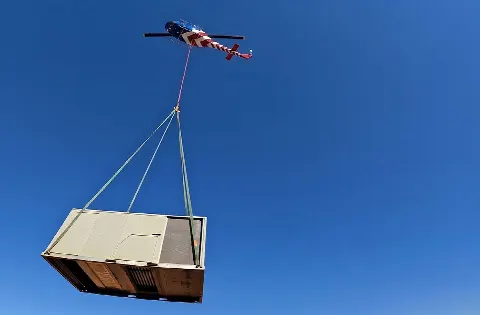
HVAC & Rooftop Units
Data-center and warehouse roofs can have active yards and strict operating limits that shape receiving-zone and exclusion-area planning.

Local lift planning
A narrow local runway and rapid west-side industrial growth put obstacles and ground access at the center of the plan.
Photo: National Trails Office, U.S. National Park Service, public domain. Cropped, resized, and compressed.
The Los Lunas Urban Area had 53,365 residents in the 2020 Census. That whole-area count places it fifth in this New Mexico release. It is not a current city-population or demand estimate.
The current FAA Southwest Chart Supplement places Mid Valley Airpark three miles south of Los Lunas at 4,836 feet. Its 4,332-by-37-foot runway has displaced thresholds, roads at both ends, and noted railroad, ditch, residential, aircraft, and building obstacles.
The Village’s 2040 comprehensive plan identifies roughly 4,200 acres of industrial land west of I-25, including business parks and the Central New Mexico Rail Park beside the BNSF transcontinental line.
The National Weather Service monsoon guide says downbursts can spread damaging wind away from a storm and create dust that rapidly reduces visibility. A visible rain shaft is not required for hazardous outflow at the site.
The 2040 plan identifies a FEMA Special Flood Hazard Area east of the New Belen Ditch. It also describes high winds carrying dust from the west mesa across I-25.
Commercial work can require Village review of grading, drainage, utilities, curb cuts, floodplain compliance, and public right-of-way impacts under the development and building-permit process. The permit-jurisdiction guide keeps those approvals separate from aviation planning.
Data-center and warehouse roofs can have active yards and strict operating limits that shape receiving-zone and exclusion-area planning.
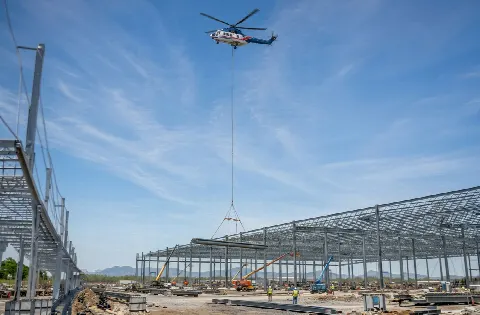
Industrial land beside the rail park may present structural work where freight access and occupied parcels constrain ground equipment.

I-25, rail lines, the Rio Grande, and established development make the complete ground route as important as the final placement.
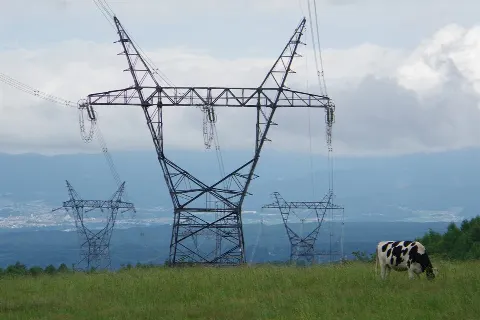
Mid Valley Airpark’s narrow runway environment and nearby obstacles demand current airport and route review.

Transmission work around solar and industrial uses must account for energized infrastructure, freight movement, and local access review.
The comprehensive plan identifies distribution, data-center, warehouse, manufacturing, rail-park, and solar uses west of I-25. These facilities have different shutdown limits and exclusion-zone problems even when they share one industrial district.
The Village’s 2026 economic-development plan treats traffic and infrastructure capacity as current growth issues. Property control and the surrounding public network must be understood before a work window is fixed.