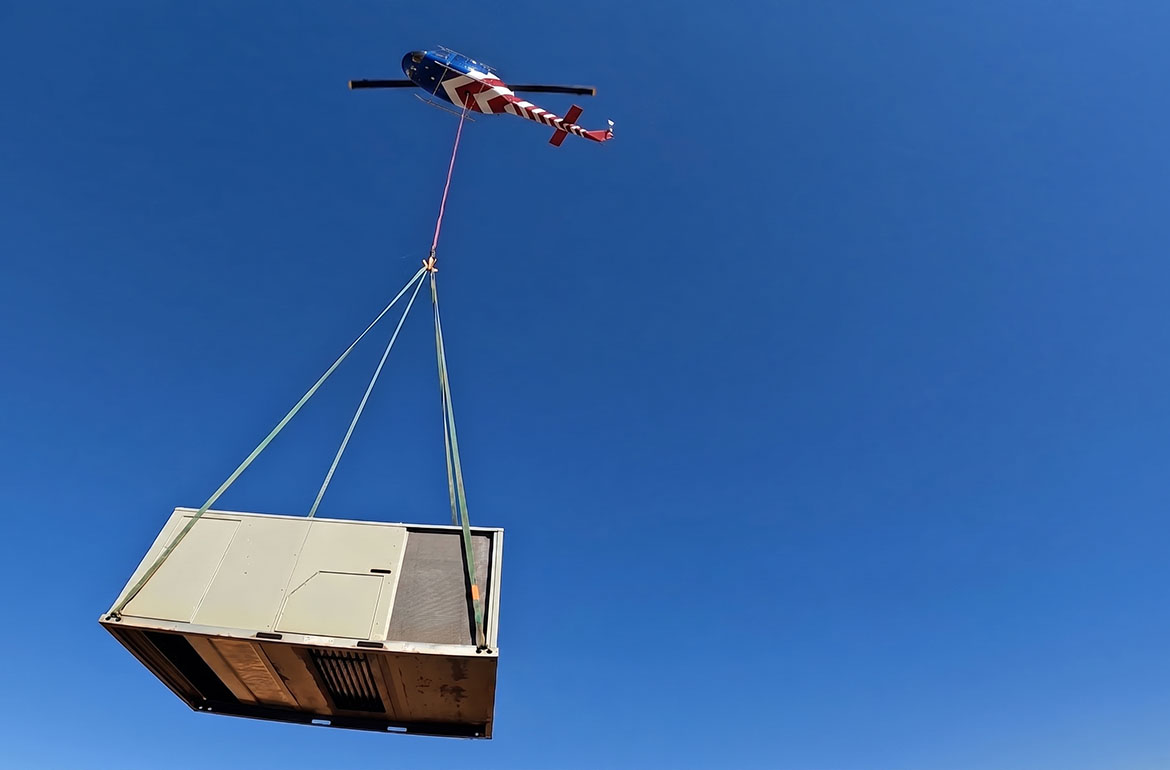
HVAC & Rooftop Units
Dense commercial parcels can leave little room for ground lifting equipment. Confirm roof capacity, unit data, access control, and a clear load path before a closure window is set.

Local lift planning
Nashville combines busy Class C airspace with fast-changing streets and industrial parcels. The route above the city and the route into staging need separate checks.
Photo: Quintin Soloviev, CC BY 4.0 via Wikimedia Commons. Cropped, resized, and compressed. License terms.
The Census Bureau Vintage 2025 metropolitan-area table estimates 2,197,416 residents in the Nashville-Davidson--Murfreesboro--Franklin MSA on July 1, 2025. That whole-area figure makes it Tennessee’s largest MSA and selects this guide. It is not a city population or a measure of lifting demand.
The current FAA Chart Supplement entry for Nashville International places BNA five miles southeast of the city in Class C airspace. The four-runway airport includes an 11,030-foot runway, and the FAA prohibits flight over the main terminal building. A proposed suspended-load route needs exact coordinates, current charts, NOTAMs, and air traffic review before a staging area is fixed. The external-load guide explains the broader operating record.
Metro Nashville’s transportation permit page routes temporary street closures and encroachments through ePermits and asks for applications at least two business days before nonemergency work. Some uses need legislative action. Map the road closure, support equipment, and every affected property boundary before setting the work date.
BNA is a continuously attended Class C airport with published approach-control frequencies. The FAA entry also reports bird activity and specific surface restrictions. Distance from the runway alone cannot settle the route.
The National Weather Service Nashville climate record reports an annual average of 49 days with highs of at least 90 degrees, 50.51 inches of precipitation, and measurable precipitation on 121 days. Those normals support heat, rain, surface-condition, and visibility hold points. Current aviation weather and the aircraft-specific performance calculation still control the work window.
The TDOT oversize and overweight permit FAQ says routes are evaluated case by case because road and construction conditions change. Loads taller than 15 feet 6 inches require a route survey, while loads wider than 16 feet require a letter of necessity from the shipper. Aerial placement does not remove the delivery problem before the component reaches staging.
Dense commercial parcels can leave little room for ground lifting equipment. Confirm roof capacity, unit data, access control, and a clear load path before a closure window is set.
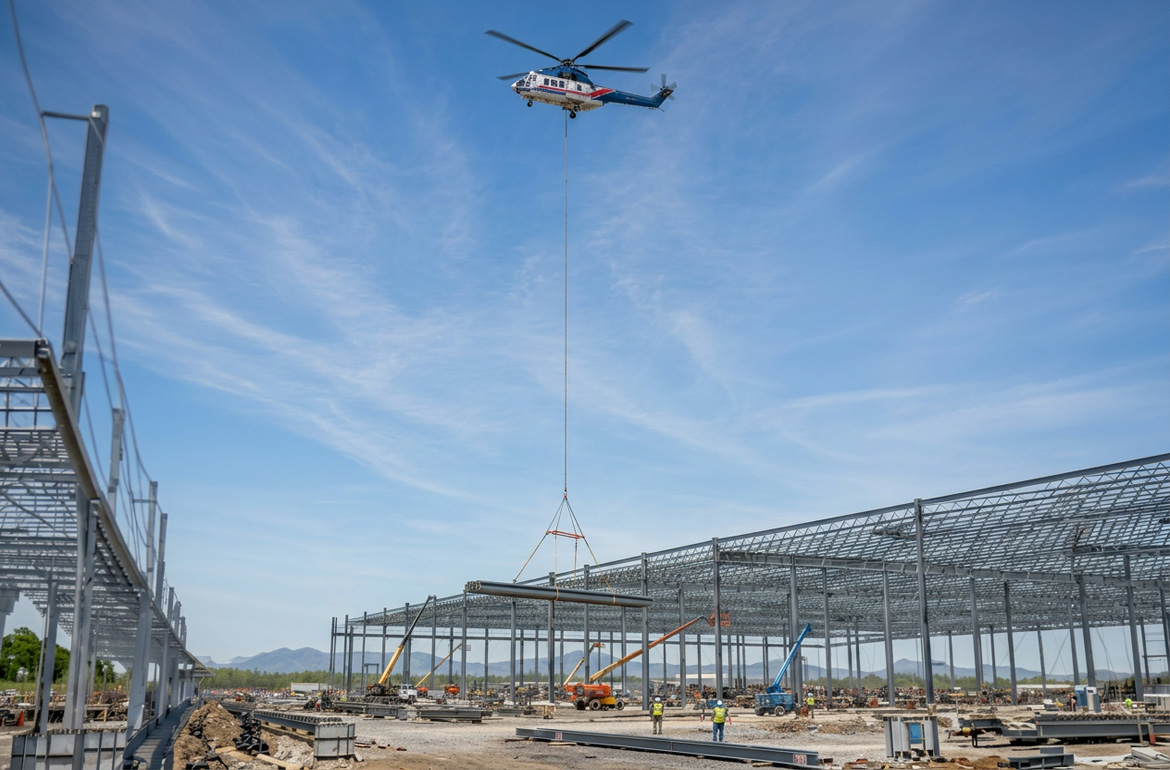
Building contractors lead the employment categories in Metro’s industrial study. Structural pieces still need certified weights, attachment details, laydown space, and public separation.

BNA airspace and a developed regional skyline make exact coordinates central to a tower concept. Current obstacles, airspace, property access, and the proposed route need one map.

Utility work that affects a street or sidewalk can trigger Metro encroachment or closure review. The aviation plan and the public right-of-way approval remain separate.

Heat, heavy rain, and changing road conditions can affect both staging and the flight window. Recovery work still needs current airspace, weather, access, and site authority.
Metro’s South Nashville Industrial Study counted building contractors as 22 percent of the study area’s industrial employment, followed by durable-goods wholesale at 17 percent and nondurable-goods wholesale at 13 percent. These are study-period shares, not current employment totals or evidence of a project at a named parcel.
The same study identifies trucking, food manufacturing, warehousing, and building-material supply among larger industrial activities. Occupied plants, distribution roofs, and constrained construction parcels put shutdown boundaries and a controlled area below the load into the first site review. The load-weight guide covers the equipment record needed before aircraft matching.