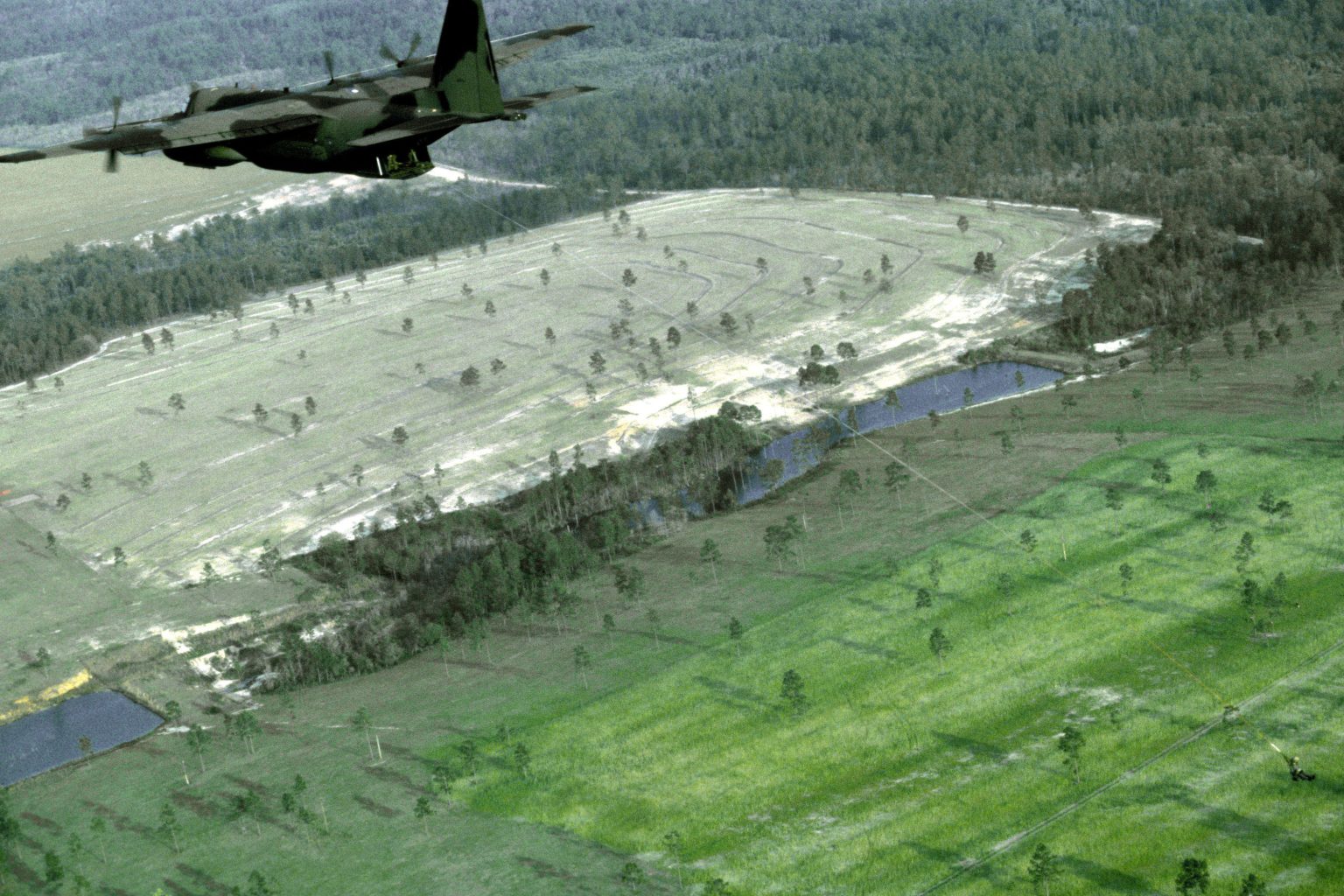
The Skyhook was the everyday name for the Fulton surface-to-air recovery system, a Cold War method for lifting a person or a package off the ground and into a flying aircraft without the aircraft ever landing. A man on the ground clipped into a harness, released a helium balloon that carried a lift line into the sky, and a low-flying aircraft with a steel yoke on its nose caught that line in the air and reeled the load aboard. Robert Edison Fulton Jr. engineered it for the CIA in the early 1950s. The United States Air Force flew it on C-130 Hercules variants for roughly three decades before helicopters and aerial refueling made it obsolete. We tell this story because the instinct behind it, trusting an aircraft to retrieve something precious from the ground with precision, is the same instinct that runs through modern heavy lift.
Every project has a lineage, and ours runs partly through a nose-mounted steel fork on a four-engine transport. American Heavy Lift Helicopters is a group of rotor wing enthusiasts, and one of the founding contributors is the son of a United States Air Force flight navigator who flew C-130s in the Vietnam War, flew Skyhook missions, and earned his Skyhook patch. That patch, and the family stories that came with it, are part of why this project exists. So before we get into density altitude and sling angles anywhere else on this site, we want to spend some time with the program that first pulled a family, and eventually this project, toward the world of aerial lift.
The Skyhook deserves to be remembered accurately, not as a movie stunt. What follows is the honest account: who built it, how it actually worked, where it flew, and why it was retired. It is a heritage story, but it is a true one.
An inventor who liked hard problems
Robert Edison Fulton Jr. was the kind of American inventor the twentieth century produced in small numbers and then stopped making. He had ridden a motorcycle around the world in the 1930s, built an amphibious flying car, and designed a link trainer that taught aerial gunners to shoot. He was a tinkerer with a serious engineering mind and a taste for problems that other people had given up on. In the early 1950s the Central Intelligence Agency handed him one of those problems.
The question was blunt: how do you get a person out of a place where an aircraft cannot land? Downed pilots, agents, and small teams could end up in terrain with no runway, no clearing, and no friendly airfield within range. Parachuting people in was a solved problem. Getting them back out was not. Earlier attempts had strung a line between two poles and flown a snatch aircraft through it with a hook, a technique used to recover gliders and mail pouches, but it was violent, imprecise, and hard on the human body. Fulton set out to build something a person could actually survive, and then survive comfortably enough to do it on purpose.
His answer was patient and iterative. He spent years refining the balloon, the line, the harness, and the catching mechanism, testing with weighted dummies and instrumented pickups before any person trusted it with their own spine. The result was elegant in the way good engineering is elegant. Every part of it existed to remove one specific danger from the sequence.
How the Skyhook actually worked
The genius of the Fulton system was that it turned a brutal aerial snatch into something closer to a controlled lift. The sequence had a rhythm to it, and each step set up the next.
- The kit dropped in. The aircraft, or another delivery, put a package on the ground near the person to be recovered. Inside were a flight suit and harness, a coiled high-strength lift line, a folded balloon, and a small tank of helium.
- The balloon went up. The person on the ground donned the harness, connected the lift line, and inflated the balloon, which was self-inflating from the helium bottle. The balloon rose and carried the line vertically to a height of several hundred feet, holding it taut like a fishing line standing on end in the sky.
- The aircraft made its run. A recovery aircraft fitted with a large V-shaped yoke on its nose flew straight into the balloon's tether at low altitude and modest speed. The line slid down the open V and was captured at the point of the fork by a locking mechanism. The balloon, no longer needed, was released and fell away.
- The lift became gentle. This was the part people find hard to believe. Because the line was elastic in effect and the geometry was designed for it, the person was not jerked violently upward. They were lifted off the ground and swung out behind and below the aircraft in a long, rising arc. Recovered subjects consistently reported that the initial lift was smoother than a parachute opening.
- The winch brought them home. Trailing behind the aircraft, the person was then winched aboard through the open rear ramp by the crew, who used a pole to catch the line and guide it to the winch. Minutes after leaving the ground, the recovered person was inside the aircraft.
The same rig could recover cargo instead of a person. A sealed package of documents, film, or equipment could be clipped to the line and lifted exactly the same way, which mattered a great deal in an era when intelligence was carried on physical film and paper.
From a modified B-17 to the Hercules
The first aircraft to carry the operational Fulton yoke was a modified Boeing B-17 Flying Fortress, a wartime bomber pressed into peacetime intelligence work and flown by CIA-linked crews. The B-17 proved the system in the field and recovered both cargo and, eventually, people. But it was an aging airframe with limited range and payload, and the system deserved a better platform.
It found one in the Lockheed C-130 Hercules. The Hercules was rugged, long-legged, and built around a rear ramp that made winching a recovered person aboard far more practical than working around a bomber's fuselage. From roughly 1965 onward, the Air Force fitted the Fulton yoke to specialized Hercules variants, principally the HC-130 for combat rescue and the MC-130E Combat Talon flown by special operations crews. On these aircraft the twin nose booms of the yoke could be folded back against the fuselage when not in use, giving the Combat Talon its distinctive whiskered profile.
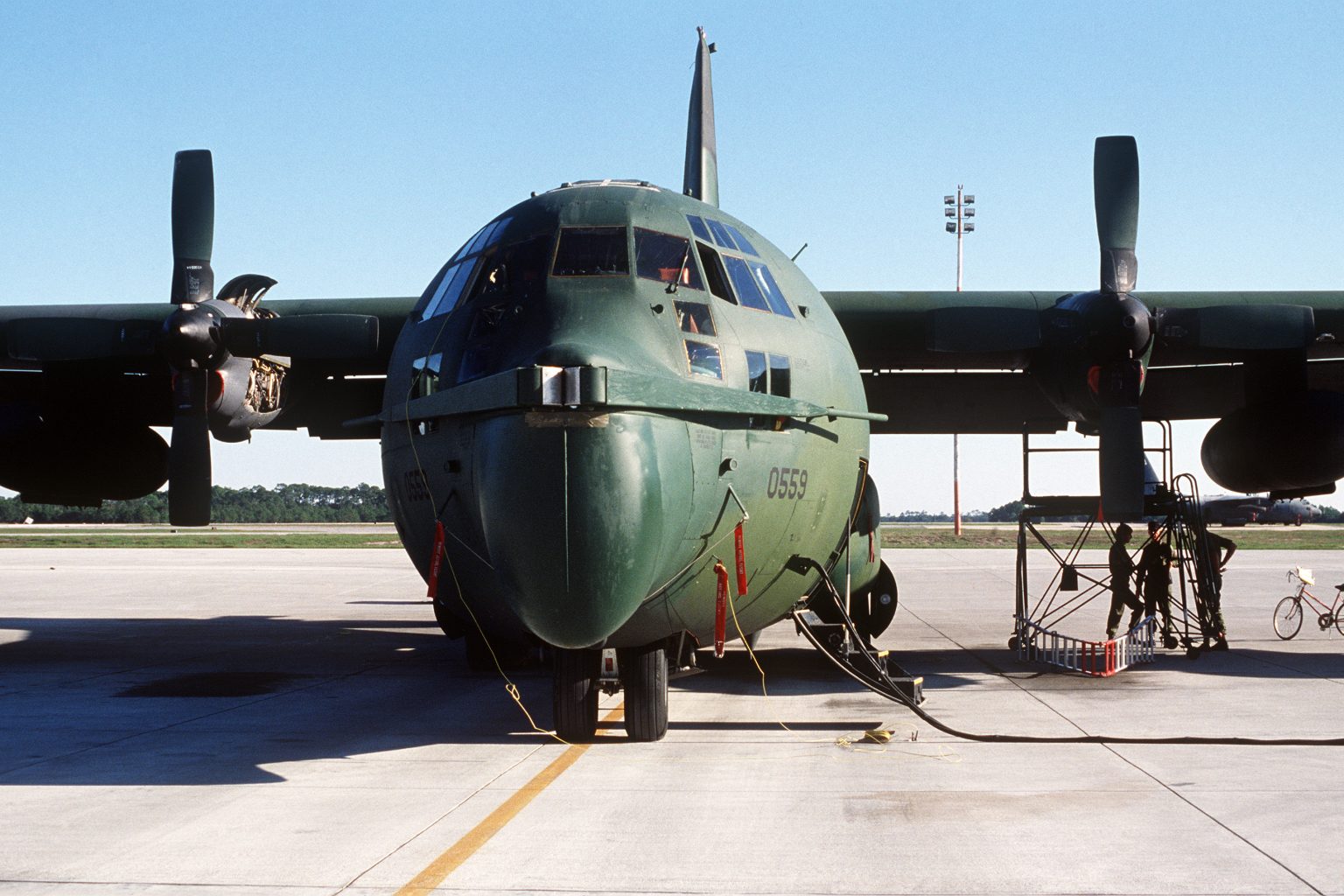
Putting the system on the Combat Talon told you what it was for. That aircraft was the special operations community's long-range infiltration and exfiltration workhorse, built to fly low, at night, into places it was not supposed to be. The Skyhook gave those crews a way to bring people back out of exactly those places. A recovery that once required a landing strip could now be flown as a single low pass over open ground.
Project Coldfeet: the story that made it real
The mission that best captures what the Skyhook could do took place in 1962, over the frozen Arctic, and it is worth telling in full.
The Soviet Union operated drifting research stations on the polar ice. In 1961 a naval survey flight spotted one such station, designated NP-9, that the Soviets had abandoned after the ice runway supplying it broke up. That station drifted out of reach before a mission could be mounted, but in early 1962 the Soviets abandoned a second and more modern station, designated NP-8, and it became the target instead. American intelligence wanted to know what the Soviets had been doing there, particularly what they understood about under-ice acoustics and submarine detection. The problem was that the abandoned station sat on drifting Arctic ice, hundreds of miles from any airfield, with no possibility of landing a conventional aircraft and no possibility of a ship reaching it.
The operation, called Project Coldfeet, put two investigators onto the ice by parachute. They spent days examining the abandoned station, photographing equipment, and gathering documents and hardware. And then, with no runway and no way to walk out, they were recovered by the Fulton system. A B-17 fitted with the yoke flew out over the drifting ice, and one at a time the two men, along with the material they had collected, were lifted off the polar surface and reeled aboard a moving aircraft. Both men and their cargo came home.
Project Coldfeet is the mission people point to because it answers the obvious skeptical question. Was this a laboratory curiosity or a thing that actually worked when it mattered? Coldfeet is the answer. Two men walked out onto drifting Arctic ice, did intelligence work at the edge of the world, and were plucked off it by an aircraft that never touched down. The system was real, and it was trusted with human lives in one of the least forgiving environments on earth.
A Cold War tool for an era without helicopters everywhere
To understand why the Skyhook existed, you have to remember what the recovery landscape looked like in the 1950s and 1960s. The helicopter was maturing, but the long-range, all-weather, combat-capable rescue helicopter that we take for granted today did not yet blanket the map. Rotary-wing aircraft of that era had limited range and could not reach deep into denied territory and return. The Skyhook filled that gap. A fixed-wing aircraft could cover enormous distances at speed, make a single low pass, and lift a person off the ground far beyond the reach of any helicopter of the day.
That reach is what made it a genuine special-operations and intelligence capability rather than a novelty. It could recover an agent from behind a border, a downed aircrew from open country, or a small team from a place no runway existed. It was used sparingly, because the situations that truly required it were rare, but its existence changed the calculation for anyone deciding whether a mission deep in hard terrain could be flown at all. Knowing there was a way home mattered as much as any weapon.
This is the world our founding contributor's father flew in. As a C-130 flight navigator during the Vietnam War, he was part of the Hercules community that carried this capability, flew Skyhook missions, and earned the Skyhook patch that marked a crew member who had trained on and flown the system. We keep the details of his service general here out of respect and accuracy, because the point is not to inflate one man's record. The point is that the C-130 and the Skyhook were part of a family's story, and that story is part of why a group of enthusiasts eventually built a site devoted to lifting heavy things with aircraft.
Why the Skyhook was retired
Good engineering earns its retirement by being made unnecessary, and that is what happened to the Skyhook. The Air Force removed the Fulton system from service in 1996, and the reasons were straightforward.
| Factor | What changed | Effect on the Skyhook |
|---|---|---|
| Helicopter range and reliability | Dedicated combat rescue and special operations helicopters grew far more capable, with real range and all-weather performance | A helicopter could now land or hoist in places that once required a fixed-wing snatch |
| Aerial refueling | Helicopter air-to-air refueling extended rotary-wing reach deep into distant territory and back | The core advantage of the fixed-wing pickup, sheer range, was matched by the helicopter |
| The hoist-equipped rescue helicopter | A hovering helicopter with a rescue hoist could recover people directly and repeatedly on one sortie | Recovery no longer needed a balloon, a line, and a single high-speed pass |
| Risk and complexity | The Skyhook was demanding to rig and fly, and each pickup recovered one load at a time | Simpler, safer, higher-capacity methods displaced it |
The through-line is the helicopter. The very aircraft this site is devoted to grew up over those decades into the machine that made the Skyhook obsolete. A hovering helicopter with a hoist could do directly, and repeatedly, what the Fulton system did once per pass with a balloon and a prayer. The Skyhook was not defeated by a better version of itself. It was retired by a different aircraft that could do the whole job in one hover. There is something fitting in that, given where our own interest points.
What the Skyhook and modern heavy lift share
It would be easy to file the Skyhook away as a piece of Cold War trivia, all balloons and steel forks and daring pickups over the ice. But the reason it belongs on a heavy lift site is that it was solving a version of the problem heavy lift solves every day. Strip away the intrigue and the Skyhook was an exercise in trusting an aircraft to retrieve something precious from the ground with precision, under conditions where getting it wrong was not survivable.
That is exactly the instinct behind a modern external load lift. When a helicopter places an HVAC unit on a downtown roof or sets a transmission tower on a ridgeline, it is doing the same fundamental thing the Skyhook did: reaching down from the air to connect with a load on the ground, and moving it with a margin engineered in advance rather than improvised in the moment. The tools have changed. The balloon is gone, the yoke is gone, the single high-speed pass has become a controlled hover. But the discipline is continuous. Both are built on rigging you can trust, a flight profile planned before the aircraft moves, and a crew who understands that the load is the whole point of the mission.
The people who flew the Skyhook understood aerial lift as a life-and-death precision task long before it became a construction tool. That understanding is part of the heritage this project carries forward, and it is the same instinct the external load operations rulebook codifies in modern law.
Why this story lives on our site
American Heavy Lift Helicopters does not operate aircraft, and this is not a recruiting page for anything. We are enthusiasts, and this is a heritage story we care about telling correctly. The Skyhook connects a father's C-130 navigator wings and hard-earned Skyhook patch to a son's fascination with what aircraft can lift, and that thread, run out over years, is part of what became this project.
Robert Fulton solved an impossible problem with a balloon, a line, and a steel fork, and for a few decades that solution brought people home from places nothing else could reach. The helicopter eventually did the job better, which is the best possible outcome for any piece of rescue engineering. We keep the story here because the line from that nose-mounted yoke to a modern hovering heavy lift is a real one, and because the people who flew it earned the remembering. You can read more about the enthusiasts behind this site on the about page.