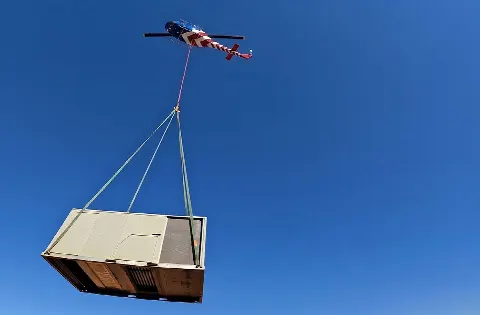
HVAC & Rooftop Units
Casino-hotel and commercial roofs can have limited street access, but state plan review and occupied public areas must be resolved early.

Local lift planning
Coastal water levels can close the ground route before the aircraft becomes the limiting factor.
Photo: Dough4872, CC BY-SA 4.0, via Wikimedia Commons. Cropped, resized, and compressed under CC BY-SA 4.0.
The Census Bureau estimates 372,047 residents in the Atlantic City-Hammonton metropolitan area in 2025. The current geography includes Atlantic and Cape May counties. The whole-area estimate sets guide order. It does not measure city population or project demand.
The FAA describes Atlantic City International Airport as a medium-size, multi-use airport about seven miles northwest of the city with Class C airspace. Any proposed lift area needs a current airspace review before the flight window or ground plan is fixed.
Atlantic City’s Engineer Office manages construction permits in public rights-of-way and Boardwalk areas. Street opening or closing and Boardwalk vehicle permits put equipment delivery, temporary closures, pedestrian control, and support positioning into a separate access workstream.
ACY’s Class C setting makes the surrounding airspace part of site planning even when the work is away from the airport. The FAA airport page is a planning reference, not permission to operate. Current airspace, temporary restrictions, and operating authority still need project-specific confirmation.
The National Weather Service coastal-flood guidance says minor flooding reaches the most vulnerable roadways, while moderate flooding can leave many roads impassable. Water levels must be checked against the delivery route and ground-staging area.
NJDEP applies coastal enforceable policies through CAFRA, coastal-wetlands, and waterfront-development reviews. Atlantic City separately controls public right-of-way and Boardwalk work. The permit-jurisdiction guide keeps those approvals distinct from aviation authority.
Casino-hotel and commercial roofs can have limited street access, but state plan review and occupied public areas must be resolved early.
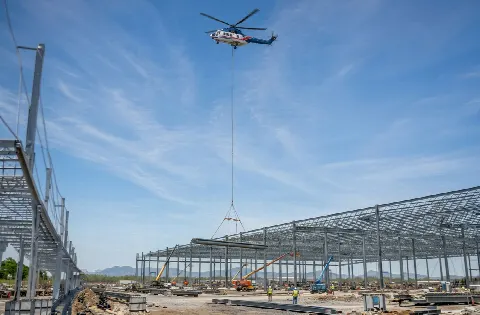
Boardwalk, bulkhead, and waterfront structures require exact load data plus a route that protects public access and coastal resources.

Class C airspace, coastal weather, rigging, and the full ground exclusion area belong in one planning record.

Communication work on a barrier island adds public exposure, salt conditions, and airport traffic to the obstacle review.

Electrical-facility work may require state plan review, utility control, and flood-aware support access before aircraft selection.
The city’s Construction Office says casino hotels plus electrical generating stations and substations require New Jersey DCA review and release before municipal permits. Rooftop equipment or electrical-component work needs the reviewing authority confirmed before a date is treated as fixed.
The City Engineer’s portfolio includes bridges, roads, bulkheads, and stormwater systems. Those assets create civil-infrastructure access problems, but they do not prove a current project pipeline or that aerial placement is the right method.