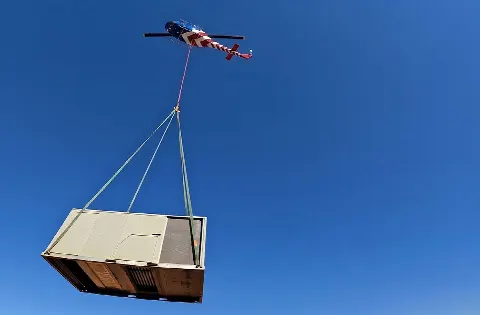
HVAC & Rooftop Units
For a mechanical replacement, compare roof reach with the complete support footprint. Include the receiving crew, disconnected equipment, and a weather-safe stopping point.

Local lift planning
A river terminal and a semiconductor research campus need different lift plans, even when both sit within the same metropolitan area.
Photo: Antony-22, CC BY-SA 4.0 via Wikimedia Commons. Cropped and compressed under the same license. License terms.
The Census Vintage 2025 metropolitan estimates place the Albany-Schenectady-Troy, NY metropolitan statistical area at 915,835 residents on July 1, 2025. That is the fourth-largest MSA containing New York territory. Albany anchors this guide; the count covers the whole metropolitan area. It says nothing about the room available beside a building. Start a lift study with the actual property boundary, then map the pickup point and every occupied area between it and the set point.
The Port of Albany facility inventory describes land on both sides of the Hudson River, a paved marine terminal, and on-dock rail operations. That is a useful reason to examine the whole material route. An aerial placement concept should account for ground movements at the pickup point as carefully as the final landing. A clear patch on an aerial photograph may serve an active cargo movement or emergency route. Confirm its use before counting it as staging space.
The September 3, 2026 FAA Chart Supplement entry for Albany International identifies Class C service and a continuously attended airport. It also records wildlife near the airfield and weather-balloon launches approximately three miles south. These are route-review inputs, not a route clearance. The airport reference does not establish that a proposed external-load flight is acceptable. The operator must evaluate the work coordinates against current aeronautical information and the actual operating period.
Winter planning should include uncertainty in both snowfall and icing. NWS Albany winter guidance separates expected accumulations from lower- and upper-end scenarios and provides precipitation onset and ending information when applicable. For a lift study, use those scenarios to test the ground plan: where will removed snow go, can support vehicles reach the staging area, and will the receiving crew have safe access? A promising flight window is of little value if the roof remains inaccessible.
Albany publishes separate street-opening and right-of-way access review forms. A property-side setup should therefore identify any equipment or traffic control that extends into public space early enough for the relevant review. Do not assume that a private owner can authorize use of a street. The site survey checklist helps keep the support footprint visible beside the flight-path sketch.
The port inventory includes mobile harbor cranes and heavy-lift cargo equipment. Existing ground handling deserves a fair comparison before adding an aircraft. Ask where the available equipment can actually reach and what must stop while it works. The helicopter-versus-crane analysis explains why total setup and disruption matter. A helicopter may address a difficult final placement, while conventional equipment remains the simpler way to move the load through the rest of the site.
For a mechanical replacement, compare roof reach with the complete support footprint. Include the receiving crew, disconnected equipment, and a weather-safe stopping point.
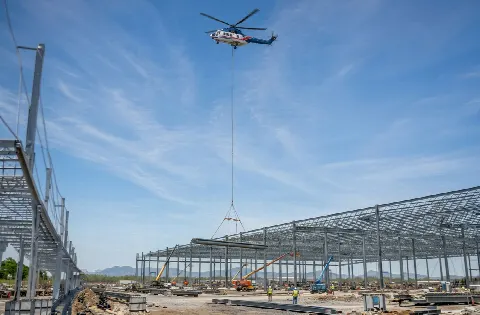
A structural placement study begins with connection details and verified lifting points. Keep temporary bracing and the release sequence visible in the method comparison.

A short final gap can justify studying external-load access, but the route below the load must be evaluated from pickup through placement.

For a tower component, check assembly weight and center of gravity before selecting a method. Survey obstructions from the proposed approach direction.

A conductor operation needs a corridor plan of its own. Identify crossing controls and the work limits of ground crews before considering an aircraft.
Semiconductor research gives Albany a different equipment-handling context from its waterfront. Empire State Development identifies the Albany NanoTech Complex as a semiconductor research and development facility. For a hypothetical mechanical-equipment replacement there, the study should distinguish building equipment from sensitive process tools. Define allowable movement, lifting points, and packaging before comparing methods. The rigging guide is useful background for assembling those questions; it does not certify an individual load.
The port lists project cargo, forest products, steel scrap, and grain among its cargo categories. Each prospective placement needs its own work envelope. A bulk-material area requires a loose-material survey; a structural component needs verified weight and geometry. Neither cargo volume nor terminal acreage proves a need for aerial lifting. A useful study follows one defined component from delivery through final connection and records where conventional access becomes difficult.